


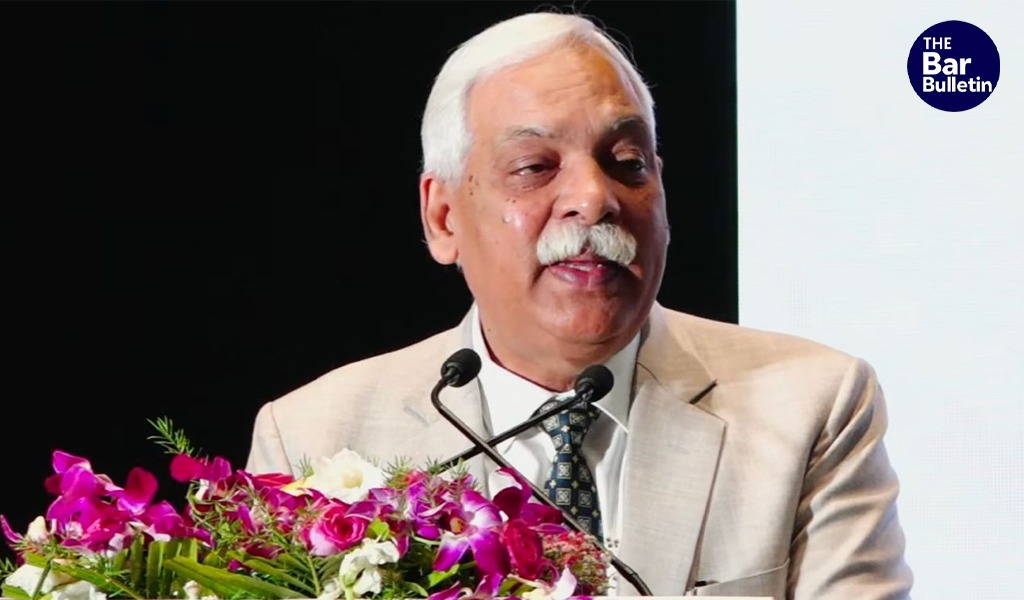

Justice Devendra Kumar Upadhyaya, Chief Justice of the Delhi High Court, on Sunday highlighted the transformative potential of artificial intelligence in the judicial system while cautioning against its unregulated use, noting concerns around digital exclusion, accountability and evidentiary integrity.
Speaking at the 1st Supreme Court Bar Association Conference, 2026, the Chief Justice commenced his address by congratulating the Supreme Court Bar Association and the Commonwealth Lawyers Association on the signing of a Memorandum of Understanding, noting that such collaborations strengthen cross-border legal engagement.
Addressing the proposal for a uniform digital platform for courts across the country, Justice Upadhyaya observed that while the idea may be comparable in ambition to India’s UPI framework, its implementation remains challenging given the diversity of judicial infrastructure across States, High Courts and jurisdictions. He emphasised that disparities in technological access particularly at the district judiciary level pose a serious concern, directly impacting access to justice.
Highlighting the growing role of artificial intelligence, the Chief Justice noted that AI-driven tools are increasingly being deployed across jurisdictions globally to tackle systemic issues such as case backlogs, delays and administrative inefficiencies. Referring to developments in countries such as Brazil, Singapore, Argentina and the United Kingdom, he outlined how AI is being used for legal research, precedent identification, case management, transcription and translation.
In the Indian context, he referred to platforms such as SUPACE and other AI-enabled tools that assist in extracting key facts, identifying relevant case law, and generating structured summaries. He also noted the increasing use of speech-to-text technologies in courtrooms, particularly in district courts where proceedings are often conducted in regional languages, observing that such tools have significant potential to enhance efficiency and inclusivity.
At the same time, Justice Upadhyaya raised serious concerns regarding the reliability of AI-generated outputs. He highlighted instances where “hallucinated” case law generated by AI systems had been cited before courts, including cases where legal practitioners faced professional consequences for relying on non-existent authorities. Stressing that accountability must remain with lawyers, judges and researchers, he stated that the use of AI heightens the duty of verification and due diligence.
The Chief Justice also cautioned against the emerging threat of deepfakes and AI-manipulated evidence, noting that such technologies could undermine established evidentiary standards relating to authenticity and admissibility. He highlighted the need for specialised forensic mechanisms and greater technological awareness within the judiciary to address these challenges.
Further, he flagged concerns surrounding the use of predictive AI tools in judicial decision-making, warning that such systems risk embedding and perpetuating existing biases present in historical data. He emphasised that adjudication is not a mechanical exercise, but one that requires human judgment, contextual understanding and sensitivity to consequences, which cannot be substituted by automated systems.
Referring to the Supreme Court of India’s White Paper on AI in the judiciary published in November 2025, Justice Upadhyaya called for a structured and responsible approach to the integration of technology within judicial processes.
Concluding his address, the Chief Justice observed that legal practitioners are currently ahead of judges in adopting AI tools, underscoring the need for the judiciary to proactively engage with technological advancements while maintaining institutional safeguards.