


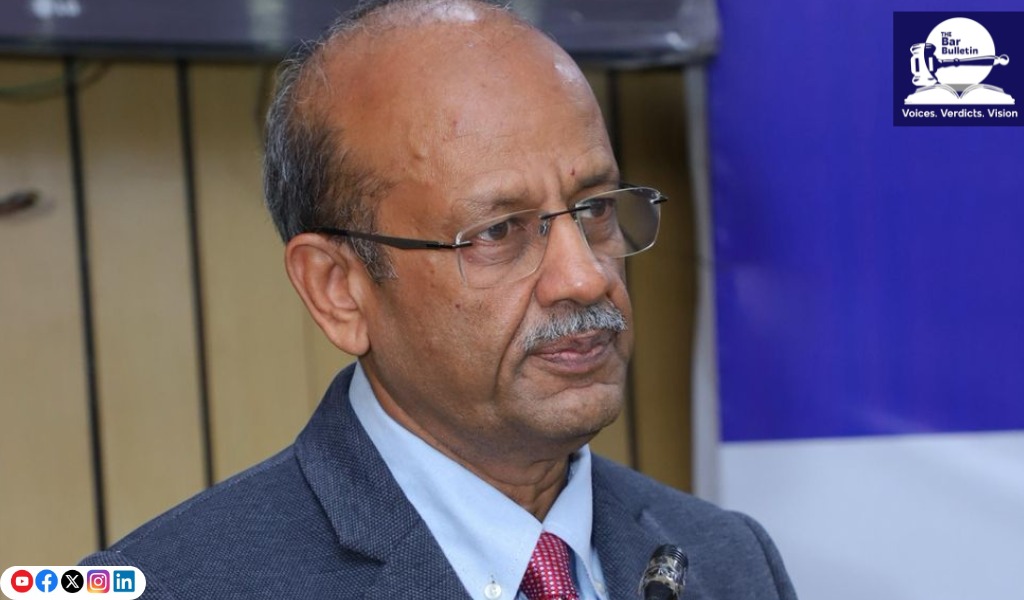

The All India Lawyers’ Forum (AILF), in association with the Indian Law Institute (ILI), successfully organised the National Seminar on the “Role of Artificial Intelligence in Legal System” at the Indian Law Institute, New Delhi. The event drew an impressive turnout of members of the Bar, law students, researchers, academicians, and professionals from both legal and technology sectors reflecting India’s growing interest in the legal and ethical dimensions of Artificial Intelligence (AI).
The programme commenced with a warm welcome to all dignitaries, followed by a ceremonial bouquet presentation by Advocate-on-Record and former AAG Haryana, Mr. Vikas Verma. The event was moderated by AoR Pragya Parijat Singh.
Hon’ble Mr. Justice Rajesh Bindal, Judge, Supreme Court of India, graced the seminar as Chief Guest and delivered a cautionary keynote on the increasing dependence on AI. He noted that AI-driven tools are beginning to shape human behaviour, memory, and decision-making, often at the expense of personal privacy and independent reasoning. Expressing concern over data harvesting, synthetic data, deepfakes, and AI-generated misinformation, Justice Bindal emphasised that AI must remain a tool to assist humans, never a master.
Justice Bindal also highlighted AI’s significant role within the judiciary, from virtual courts and translation tools to transcription, metadata extraction, and platforms such as the National Judicial Data Grid and e-SCR. However, he warned against the dangers of unverified citations, AI-generated evidence, and over-reliance on open-source platforms that may produce inaccurate or fabricated material. Stressing the need for accountability of intermediaries and strong data protection safeguards, he called AI “the challenge of the century” and urged a careful, ethical, and scientifically grounded approach to its adoption.
Attorney General for India, Shri R. Venkataramani, addressed the gathering as Guest of Honour, offering a deeply reflective perspective on the evolving relationship between technology and human thought. Describing AI as an emerging “thought machine,” he warned that technological tools increasingly influence how individuals think, act, and make decisions. Drawing on George Orwell’s 1984, he highlighted growing concerns around autonomy, surveillance, and mental freedom.
The Attorney General noted that the need to preserve a “right to a reflective mind, a necessary precondition for true freedom of speech. He discussed the implications of AI in public policy, data governance, intellectual property, and confidentiality, emphasising that while AI offers immense benefits, it also carries a significant “shadow side.” India, he stressed, must develop its own ethical and human-centered model for integrating AI into governance and justice.
Senior Prof. Dr. V. K. Ahuja, Director, ILI, presided over the seminar and highlighted the intersection of AI with intellectual property and cyber law. He emphasised the role of academic institutions in engaging with emerging technologies and contributing meaningfully to policy-making.
Mr. Vikas Verma, Co-Chairman of AILF and Ex-AAG Haryana, also addressed the audience, noting that AI despite its exponential growth cannot replace human intelligence, particularly due to its lack of emotional consciousness.