


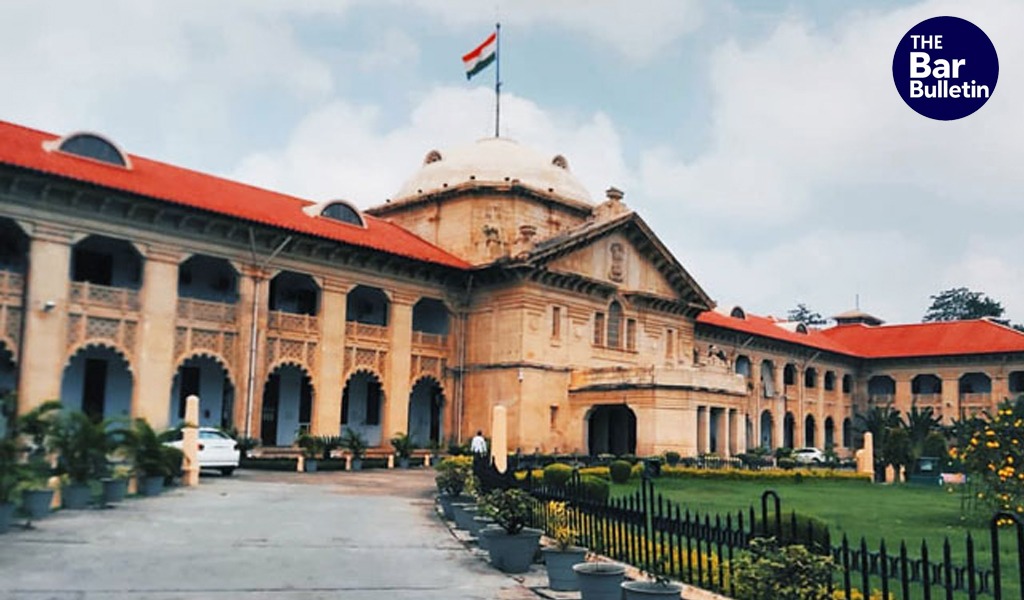

In a bail application filed before the Allahabad High Court seeking release of the applicant facing trial under Sections 305(a), 331(4), 317(2) of the Bharatiya Nyaya Sanhita, 2023 (BNS), a Single Judge Bench of Justice Arun Kumar Singh Deshwai prescribed guidelines to be followed in cases of grievous injury to the accused in police encounter and granted bail to the applicant.
In a previous hearing, the Court found that the matter was related to a police encounter in which the applicant sustained grievous injuries. By an order dated 13-01-2026, the Court directed the AGA to seek instructions as to whether a First Information Report (FIR) had been registered regarding the police encounter as per the Supreme Court’s decision in People’s Union for Civil Liberties (PUCL) & Anr. v. State of Maharashtra (2014) 10 SCC 635.
The AGA submitted that an FIR had been registered and admitted that the applicant’s statement had neither been recorded before the Magistrate nor by any Medical Officer. The Court noted that the directions issued by the Supreme Court in PUCL (supra), affirmed in Andhra Pradesh Police Officers Association v. Andhra Pradesh Civil Liberties Committee (2022) 16 SCC 514, had not been complied with in the present case.
The Court found it surprising that, despite the directions being circulated, the police appeared either unaware of or indifferent to them. The Court found that certain police officers were misusing their authority to attract the attention of higher officers or to create an impression of public sympathy by portraying incidents as police encounters involving firing upon the accused.
In compliance with the order dated 28-01-2026, the Additional Home Secretary, UP, and DGP, UP, submitted that circulars dated 01-08-2017 as well as 11-10-2024 had been issued to comply with the directions of the Supreme Court regarding police encounters. However, in light of the facts of the present case, both officers assured the Court that they would issue fresh directions to all police officers for strict compliance with the directions issued in PUCL (supra).
Referring to the said directions, the Court held that they constitute the law of the land in view of Article 141 of the Constitution of India, and that they must be followed mandatorily by the police. It was also stated that it is the duty of the High Court and the District Courts to ensure strict compliance with the said directions.
Further, the Court said that in order to get out of turn promotions or appreciation from higher authorities or to become famous over social media, some police officers cause firearm injuries to the legs of the accused, which is impermissible in the eyes of the law, as the power to punish is within the judiciary’s domain and not the police.
The Court referred to the Universal Declaration of Human Rights (UDHR), the United Nations Code of Conduct for law enforcement officers, and Article 21 of the Constitution of India and stated that human life and dignity are not only protected by the Constitution but also by universal principles that are accepted by the international community. It was said that such protection cannot be taken away at the whim and fancy of certain officers.
Thereafter, the Court prescribed the following guidelines in cases of grievous injury to the accused in a police encounter:
• If in pursuance to any information, police reaches at the spot and encounter takes place wherein fire arm is used by the police and the accused or any other person receives grievous injury, then an FIR shall be registered by the head of the police in the same police station or adjoining police station, but investigation of said FIR shall be conducted by CBCID or police team of any other police station under the supervision of senior police officer at least one level above the head of police party engaged in the police encounter.
• In the FIR, the names of the police officers involved in the encounter are not required to be mentioned in the category of accused/suspect, but only the team, whether STF or regular police, can be mentioned.
• Injured criminal/victim should be provided medical aid and his/her injury should be examined, and thereafter his/her statement should be recorded either by the Magistrate or Medical Officer with a certificate of fitness of the injured.
• After a complete investigation, a report should be sent to the competent court, which will follow the procedure as mentioned in PUCL (supra).
• Out-of-turn promotion or gallantry award shall not be given to the officer soon after the occurrence of a police encounter. It must be ensured that such rewards are given or recommended only when the gallantry reward of a person is established beyond doubt by a committee constituted by the police head.
• If the family of the injured finds that the above procedure has not been followed or there exists a lack of independent investigation or a pattern of abuse or impartiality, then a complaint can be made to the Sessions Judge having territorial jurisdiction over the place of the incident. Upon receiving the same, the Sessions Judge shall look into the merits of the complaint and redress the grievance raised therein.
Further, the Court directed that if any police officer is found to have violated the Supreme Court’s directions, not only the person leading the team but also the District Police Chief would be held liable for contempt of court, in addition to disciplinary proceedings by the police department. The Court held that the Sessions Judge may act on complaints filed by persons aggrieved by non-action regarding death or grievous injuries in police encounters and may also refer the matter to the High Court for initiation of contempt proceedings against the District Police Chief in matters where flagrant violation has been reported.
Considering the facts and circumstances of the present case, the Court held that the applicant was entitled to be enlarged on bail upon furnishing a personal bond and two sureties of like amount, subject to strict conditions.
Appearances:
For Applicant(s) – Kusum Mishra
For Opposite Party(s) – G.A.
