


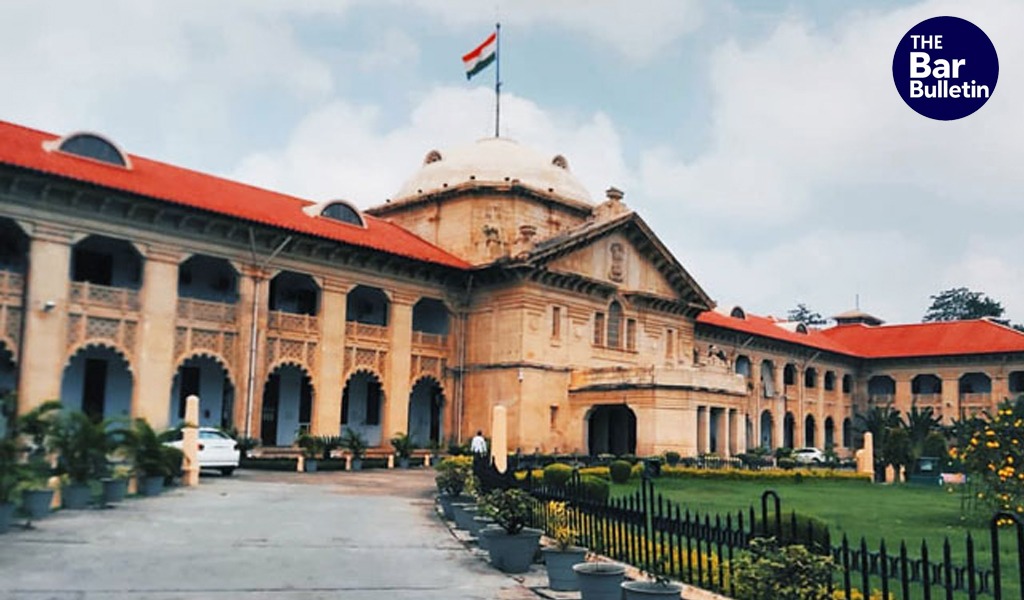

The Allahabad High Court has set aside the conviction and life sentence awarded to the accused for the murder of his wife, holding that the prosecution failed to prove the charge beyond reasonable doubt as the dying declaration, the sole basis of conviction was unreliable and legally unsafe.
A Division Bench comprising Justice Rajan Roy and Justice Rajeev Bharti allowed Criminal Appeal and quashed the judgment dated 6 May 2022 passed by the Sessions Court, Lakhimpur Kheri, which had convicted the appellant under Section 302 IPC and sentenced him to life imprisonment.
The case related to the death of the victim, who sustained extensive burn injuries on 16 June 2018 and succumbed on 5 July 2018. While the trial court had acquitted the appellant of charges under Sections 498-A, 304-B IPC and the Dowry Prohibition Act, it convicted him for murder solely on the strength of a dying declaration recorded on 27 June 2018 at a Lucknow hospital.
On appeal, the High Court closely scrutinised the evidentiary value of the dying declaration and found multiple infirmities. The Bench noted that although the doctor certified that the deceased was “conscious”, there was no certification or recorded satisfaction that she was in a fit mental state to make a voluntary and reliable statement, a distinction consistently recognised in criminal jurisprudence, especially in cases involving victims with 90% burn injuries.
The Court further observed that the Sub-Divisional Magistrate who recorded the dying declaration failed to disclose any basis or preliminary questioning to satisfy himself about the deceased’s mental fitness. Merely recording that the victim was conscious, the Bench held, could not substitute the mandatory requirement of mental fitness, particularly when sedatives and pain-relieving drugs are routinely administered to burn patients.
Significant contradictions were also highlighted. While the FIR and medical evidence recorded a smell of kerosene and placed the incident in the evening hours, the dying declaration spoke of petrol being extracted from a motorcycle and the incident occurring in the morning. The prosecution offered no explanation for these material inconsistencies. Additionally, although evidence suggested the existence of an earlier dying declaration dated 17 June 2018, the same was neither produced nor explained.
The Court also found serious procedural lapses, noting that the incriminating contents of the dying declaration were never put to the accused during his examination under Section 313 CrPC, thereby causing prejudice and vitiating reliance on that evidence. The investigation was further criticised for failure to collect bed-head tickets, examine treating doctors, and explain omissions crucial to the prosecution case.
Holding that suspicion, however strong, cannot take the place of proof, the High Court concluded that the dying declaration did not inspire confidence and could not form the sole basis for conviction. Consequently, the conviction under Section 302 IPC was set aside, the appellant was acquitted, and directions were issued for his immediate release, subject to compliance with Section 437-A CrPC.
Appearances:
Counsel for Appellant : Atul Verma, Akhilendra Pratap Singh
Counsel for Respondent(s) : Ravish Chandra Mishra, A.G.A.
