


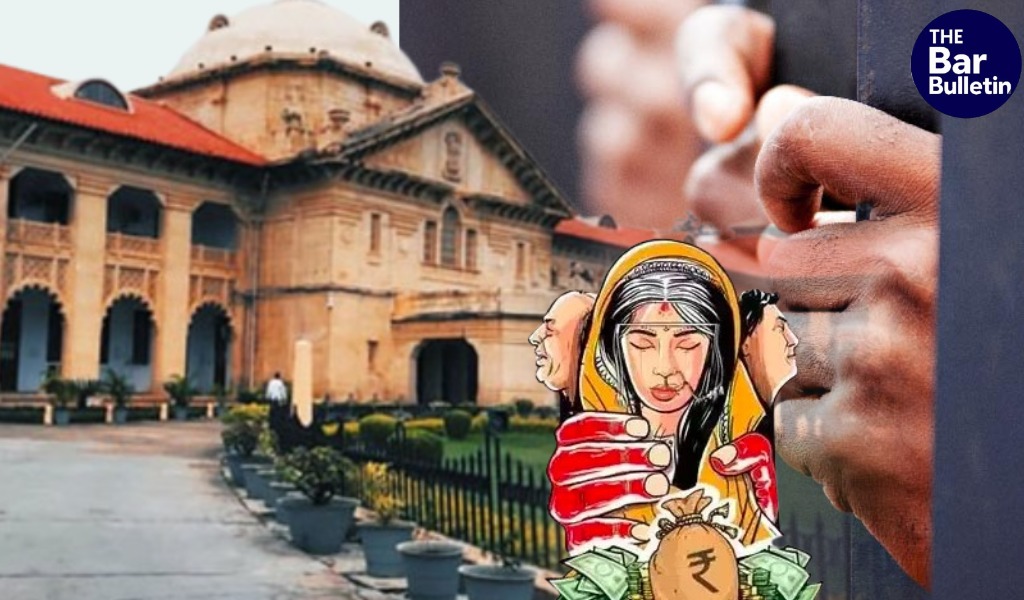

In a criminal appeal filed before the Allahabad High Court against the judgment and order passed by the Special Judge, Bijnor, under the Essential Commodities Act, 1955, in a matter regarding commission of offences under Sections 304B/302/34 of the Indian Penal Code, 1860 (IPC), and Section 4 of the Dowry Prohibition Act, 1961, a Division Bench of Justice Salil Kumar Rai and Justice Vinai Kumar Dwivedi partly allowed the appeal by reducing the sentence of the appellants to the time that they had already served and maintained the finding of the Trial Court.
By the impugned order, the Special Judge had convicted and sentenced the appellants (accused persons) to undergo imprisonment for life under Section 304B and to undergo imprisonment for two years, as well as to pay a fine of Rs. 10,000/- under Section 4 of the Dowry Prohibition Act. Both sentences were to run concurrently.
A First Information Report was registered on 24-04-2015 against the husband and in-laws of the informant’s daughter. It was alleged that the daughter was taunted after her marriage for bringing less dowry, and demands were made to her. On 09-04-2015, the husband put kerosene on the informant’s daughter, and the in-laws set her on fire, due to which she suffered serious injuries and eventually died.
After recording the statements of witnesses under Section 161 of CrPC, a chargesheet was filed only against the appellants under Section 304B of IPC and Sections 3/4 of the Dowry Prohibition Act. The cause of death of the deceased was ante mortem burn injuries, and she had sustained approximately 80% burn injuries. The Trial Court found the appellants guilty and convicted them. Aggrieved, the present appeal was filed.
The Court perused the evidence of the prosecution witnesses and found that it was proved that the deceased had died in her matrimonial home under unnatural circumstances by suffering 80% burn injuries. It was noted that the Trial Court had relied on the dying declaration, and hence, the burden was on the appellants to explain the circumstances in which the deceased sustained said injuries, which they were unable to do.
Further, the Court noted that the parties belonged to weaker sections of society, who earned their livelihoods through manual labour. It was stated that punishment should neither be unduly lenient nor unduly harsh. Considering the social condition and economic capacity of the appellants, the Court found that the life imprisonment awarded to them was too severe. The Court sustained the order of conviction, but reduced the sentence from life imprisonment to the period already undergone by the appellants.
Thus, the appeal was partly allowed, and the appellants were directed to be released.
Appearances:
For Appellants – Mr. Arvind Kumar Srivastava, Mr. R.P.S. Chauhan, Mr. Rajiv Sisodia, Mr. Shailesh Kumar Srivastava, Mr. Shyam Shanker Pandey
For Respondents – G.A.
