


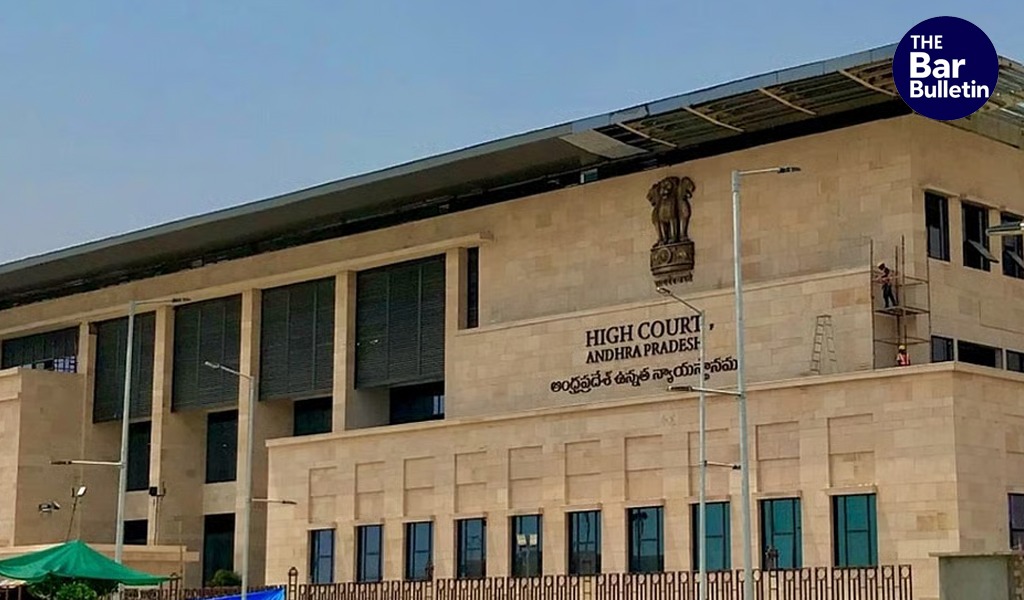

The Amaravati Bench of Andhra Pradesh High Court has held that the power of tax officials at a check post under Sections 129 and 130 of the GST Act, 2017, is limited and does not extend to making determinations on the valuation of goods in transit. Such questions of potential undervaluation are to be adjudicated by the jurisdictional Assessing Authority only.
Further, the Court clarified that it is not a reasonable exercise of power for the authorities of a transit State to confiscate goods or impose penalties for potential tax evasion that may occur in the destination State. Based on these principles, the Court directed the release of the seized goods and vehicles.
The Division Bench comprising Justice R Raghunandan Rao and Justice T.C.D. Sekhar observed that the question of valuation cannot be undertaken during proceedings under Section 129 or Section 130 of the GST Act, and matters of valuation and the tax payable thereon must be referred to the appropriate Assessing Authority.
The Bench opined that the objective of Sections 129 and 130 of the GST Act is to prevent the loss of tax revenue to the state where the tax is legally payable. Consequently, the act of tax authorities of a transit state confiscating goods or levying penalties, on the suspicion of tax evasion in another state, does not appear to be a reasonable exercise of power.
The Bench also discarded the arguments of the authorities that the driver did not cooperate and that the E-Way Bill was generated only after the inspection began, by pointing to Rule 138C of the CGST Rules, 2017, which mandates the online recording of every inspection. Since the authorities failed to produce any online record of the alleged first inspection and the official report of the second inspection did not mention a prior one, the Bench did not accept the authorities’ version of events.
Lastly, the Bench heavily criticized the valuation method adopted by the officials, describing it as ‘extremely one-sided’ and unlikely to ‘withstand scrutiny’. This criticism stemmed from the fact that samples were collected and sent for valuation without the presence or participation of the petitioners.
Briefly, a series of petitions were filed challenging the seizure or confiscation of goods that were in transit. The tax authorities had initiated proceedings under Section 129 or Section 130 of the CGST Act, 2017, primarily on the allegation of gross undervaluation of the goods. Since the petitioners possessed the necessary documents specified under Section 68 of the GST Act, they filed interlocutory applications seeking the release of the seized goods and vehicles pending the final judgment.
Appearances:
Advocates P. Girish Kumar, V. Raghuraman, M. V. J. K. Kumar, Pasupuleti Venkata Prasad, Sameer Gupta, and Akula Vamsi Krishna, for the Petitioner/ Taxpayer
Advocate R. Kalyan Chakravarthy, for the Respondent/ Revenue
