


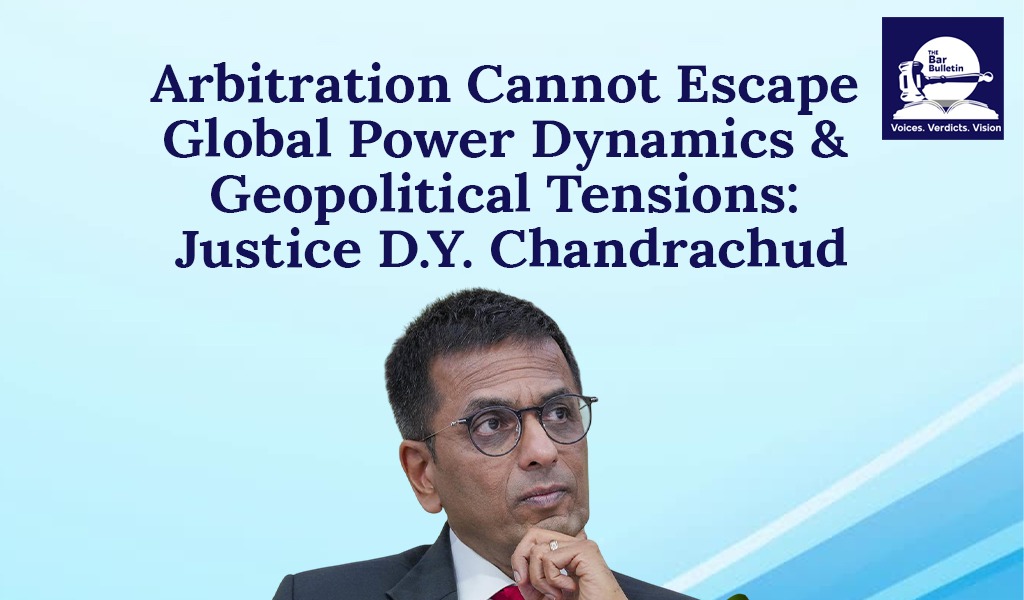

At Dubai Arbitration Week 2025, JSA Advocates & Solicitors hosted a breakfast session on “Interplay between Arbitration and International Relations in Light of Geopolitical Shifts”, featuring a keynote address by Dr Justice D.Y. Chandrachud, Former Chief Justice of India.
Justice Chandrachud delivered a comprehensive overview of how geopolitics continues to influence international arbitration. Talking about the complex relationship between arbitration and geopolitical power dynamics, Justice Chandrachud remarked that “the effectiveness, neutrality and enforceability of arbitration are critically influenced by the dynamics of the underlying state power and judicial and geopolitical tensions”.
Justice Chandrachud highlighted five key areas where geopolitical issues increasingly influence arbitral processes and outcomes.
(1) Forum Shopping
Justice Chandrachud noted that geopolitical considerations now drive seat selection in arbitration.
“The choice of the arbitral seat itself can be a geopolitical decision, with parties often selecting locations known for having arbitration-friendly law and a reputation for neutrality. Among these destinations are Singapore, London, and Stockholm, including so many of the newly emerging destinations, including Dubai and Bahrain.”
(2) Enforcement Challenges
Moving to enforcement, he highlighted how geopolitical tensions often determine whether an award can be realised in practice.
“Geopolitical tensions and the dynamics of power significantly impact the enforcement of arbitral awards against state or state-owned entities. A powerful state may well resist enforcement by invoking doctrines such as sovereign immunity, making it difficult for an award creditor to access frozen assets.”
(3) Threats to Arbitrator Impartiality
Justice Chandrachud then turned to the tribunal, noting that arbitrator impartiality is under unprecedented scrutiny. This places tremendous responsibility on arbitrators to insulate their decision-making from geopolitical narratives.
“The impartiality of arbitrators can be put under pressure, particularly in an increasingly polarized world or a multipolar world, as we now inhabit. In disputes with significant political elements, concerns about the neutrality of the arbitral tribunal do arise, requiring careful processes of selection and a commitment to legal principle over political considerations.”
(4) Sanctions Disrupting Proceedings
The fourth issue he flagged was the influence of sanctions, a tool increasingly used by states to exert geopolitical pressure.
“Geopolitical conflicts often lead to economic sanctions, which can complicate or even halt arbitral proceedings. Sanctions may create procedural issues as well, such as difficulties in paying an arbitral institution or legal representatives of a party, and can, on occasion, be a substantive defence, like force majeure.”
(5) State Resistance
Finally, he addressed the growing trend of states resisting arbitration to guard their sovereign authority. “States do resist arbitration due to concerns over their sovereignty, namely that their sovereignty may be undermined by an international tribunal’s decision.”
Justice Chandrachud noted that powerful nations often reshape treaty frameworks to insulate themselves, while weaker states are left far more vulnerable. “Powerful nations may exert influence to shape the legal frameworks of international investment agreements to protect their interests or use diplomatic channels to influence outcomes. Weaker states, on the other hand, may be more vulnerable to claims.”
After outlining how geopolitical forces shape arbitration, Justice Chandrachud highlighted how arbitration steps in as a law-bound remedy where political or diplomatic channels fall short.
“International arbitration provides a necessary law-bound mechanism for resolving large-scale energy and investment disputes where diplomatic solutions may be limited. Arbitration provides a neutral platform where investors and states can have their grievances heard and redressed without having to resort to diplomatic protection by home governments, which historically may have been involved in gunboat diplomacy.”
He also outlined how international arbitration reinforces international law, citing UNCLOS as a framework for maritime disputes, even if enforcement remains challenging. He also noted the evolution of arbitration in response to global shifts such as climate-related disputes and human rights considerations. Reflecting on the transformation from a bipolar to a multipolar world, he remarked, “Technology has become an extraordinarily influential arbiter in modern geopolitical order.”
He concluded by reminding the community that the neutrality and credibility of arbitration rest on the integrity and judgment of the practitioners who uphold it.
“While international arbitration aims to be an impartial and rules-based system, its processes and outcomes are inherently connected to the landscape of global power dynamics, which is continuously shifting. And this covers the entire gamut from the initial drafting of agreements to the enforcement of awards… As professionals involved in the complex dynamics between arbitration and geopolitical tensions, each one of us present here and the wider community beyond has a critical role to play in the success of international arbitration.”