


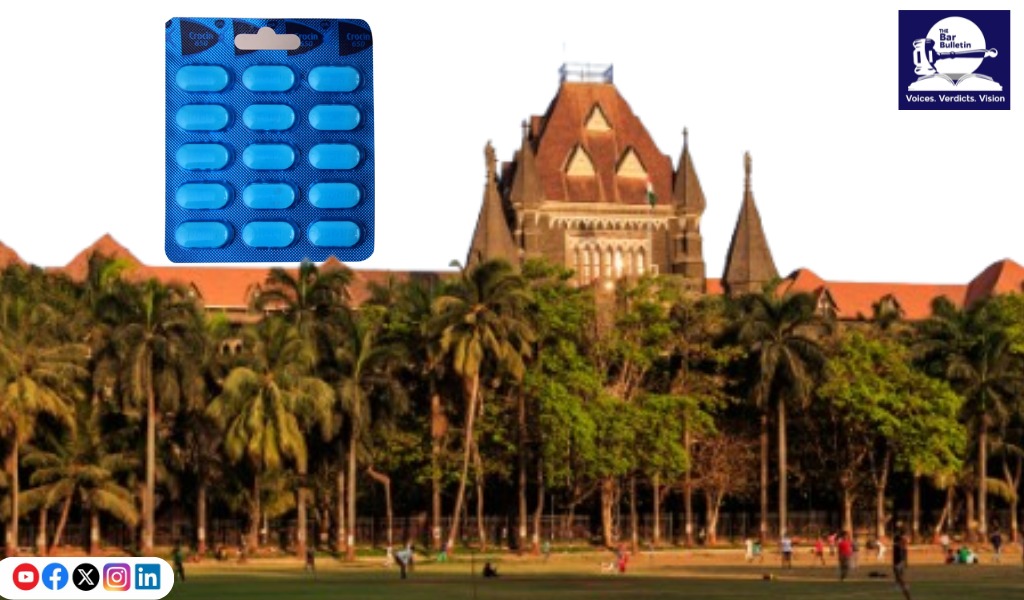

In a significant ruling with far-reaching implications for cross-border intellectual property transactions, the Bombay High Court ruled that the sale of the famous pain-relief brand ‘Crocin’ to a UK company amounts to an export and is therefore not liable to sales tax under the Indian Sales Tax Regime. Accordingly, the Court overturned the Maharashtra Sales Tax Tribunal order dated May 05, 2010, that had held the overseas sale taxable at 4% under the Bombay Sales Tax Act, 1959.
The Court clarified that registration does not determine where a trademark exists or is located for purposes of taxation, and registration is not even compulsory for a trademark to exist in law. What matters is the legal situs of the asset, which moves with the owner. Thus, the Court asserted that the overseas transfer of the trademark extinguished all rights of the Indian seller and shifted the trademark’s situs (location) to the UK by legal fiction.
The Division Bench comprising Justice M.S. Sonak and Justice Advait M. Sethna observed that since the assignee, SKB, was a UK-incorporated company, the trademark was deemed to have moved to the UK as soon as it was assigned, and this movement of the asset outside India satisfied the legal requirement of an export under Section 5 of the Central Sales Tax Act.
The Bench referred to the 6th constitutional amendment in Article 286, to observe that the State shall not impose any tax on the sale or purchase of goods when it takes place in the course of import or export, out of the territory of India. Further, noting the pre-amendment in the said Article, the Bench added that the sale or purchase, in relation to goods, was restricted to physical goods, which, post the amendment, is not confined to only tangibles, but would also include intangibles.
Briefly, the Applicant company, engaged in the manufacture and/or marketing of pharmaceuticals, owned the trademark “Crocin” registered under the Trade and Merchandise Marks Act, 1958. By a Brand Acquisition Agreement in January 1996, the Applicant sold this trademark to SKB, a Company incorporated under the Laws of the United Kingdom. Pursuant to the execution of the agreement in London, the SKB, i.e., the buyer/assignee of the trademark ‘Crocin’, preferred an application to the Registrar of Trademarks, Mumbai, requesting to enter the name of SKB in the trademark register as Proprietor of the said trademark ‘Crocin’.
In the meantime, the Commissioner of Sales Tax held that the assignment of the said trademark is a local sale in Maharashtra, liable to sales tax @ 4% as per the Schedule Entry C-I-26 appended to the Bombay Sales Tax Act, 1959. When the appeal against the said determination was pending consideration before the Maharashtra Sales Tax Tribunal, an assessment order was passed for the period 1995-1996, resulting in an extra demand to the tune of Rs. 99.67 lacs, which had arisen mainly due to the levy of sales tax at 4% on the said monetary consideration. Later, the Tribunal also held that the sale of the trademark ‘Crocin’ was eligible to tax, being a local sale within the State of Maharashtra.
Cases Relied On:
Mahyco Monsanto vs. Union of India [2016 SCC OnLine Bom 5274]
Sun Pharmaceuticals Industries Ltd. vs. Cipla Ltd [2009 (108) DRJ 207]
Appearances:
Advocates Ishaan V. Patkar, Vinit V. Raje, and Jindagi Shah, for the Applicant/ Taxpayer
Advocates Jyoti Chavan and Himanshu Takke, for the Respondent/ Revenue