


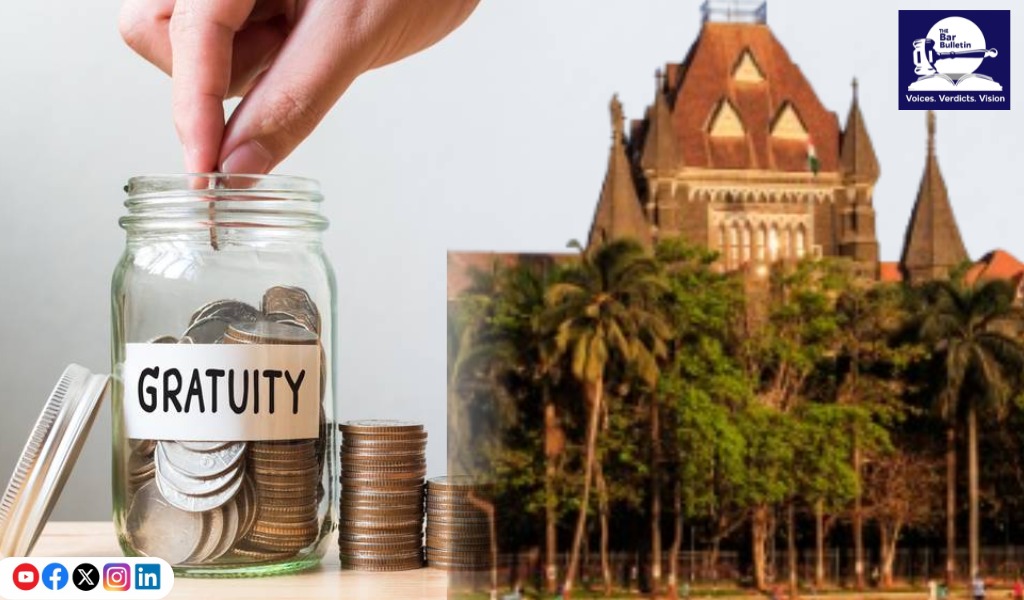

The Bombay High Court ruled that the drastic power of forfeiting gratuity, which is property rightly owned by the employee, can be undertaken strictly within the statutory framework of the Gratuity Act, 1972. The Court clarified that the mere allegation that, after cessation of employment, the respondents joined the rival company and indulged in the act of disclosing trade secrets, is no basis for forfeiting gratuity, when even the services of the respondents were not terminated on such allegations.
The Court reiterated that gratuity is not a bounty, but property belonging to a person akin to the property under Article 300A of the Constitution. Referring to the decision in the case of State of Jharkhand vs. Jitendra Kumar Srivastava [(2013) 12 SCC 210], the Court held that the employees must be put on notice before taking the drastic action of forfeiting their gratuity, which has civil consequences.
A Single Judge Bench of Justice Manish Pitale observed that the alleged act involving moral turpitude committed by the respondents took place after they ceased employment with the petitioner. Thus, even if they violated the stipulations in their relieving letter, allegedly disclosing trade secrets and confidential business information of the petitioner company, such an act committed by the respondents cannot be treated as having been done in the course of their employment, for taking recourse to Section 4(6)(b)(ii) of the Gratuity Act.
The Bench quoted Section 4(6)(b) of the Gratuity Act to state that an employer would be able to forfeit gratuity payable to an employee wholly or partially, if the service of such employee is terminated for an act constituting an offence involving moral turpitude. However, such power for forfeiting gratuity could be exercised only if the offence or act involving moral turpitude is committed by the employee ‘in the course of his employment’.
Briefly, the petitions are filed against ex-employees, which arise out of concurrent orders passed by the Controlling Authority (Labour Court) and Appellate Authority (Industrial Court), under the provisions of the Payment of Gratuity Act, 1972, whereby it was held that the petitioner-company was not justified in forfeiting gratuity payable to the respondents, by taking recourse to Section 4(6)(b)(ii) of the Gratuity Act and accordingly, the petitioner-company was directed to pay the gratuity with simple interest at the rate of 10% per annum, till payment of such amounts.
Case Distinguished:
Ramchandra S. Joshi vs. Bank of Baroda, Mumbai [2010 (6) Mh.L.J. 421]
Appearances:
Advocates Anand Pai, Sahil Gandhi, Riddhi Shah, Triveni Jawale, and Markand Gandhi, for the Petitioner
Advocates Sonal Rane and Suraj Bansode, for the Respondents