


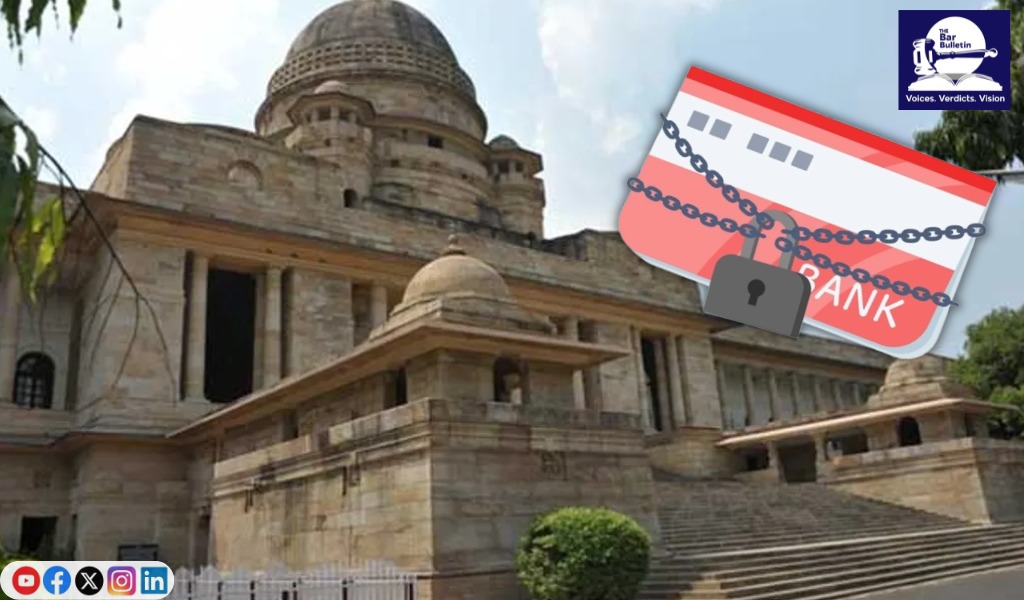

The Bombay High Court (Nagpur Bench) has held that investigating agencies have no authority to debit freeze bank accounts under Section 106 of the Bharatiya Nagarik Suraksha Sanhita, 2023 (BNSS), and accordingly quashed multiple such freezing orders issued in cyber-fraud related cases.
A Division Bench of Justice Anil L. Pansare and Justice Raj D. Wakode delivered a common judgment on November 20, 2025, in a batch of writ petitions where individuals and entities challenged the freezing of their accounts after alleged fraudulent amounts were credited. The Court noted that in several cases, banks had frozen accounts even without receiving any formal communication from the investigating agency, remarking that it was “a mystery” how banks acted on their own.
Relying heavily on the Kerala High Court’s ruling in Headstar Global Pvt. Ltd. v. State of Kerala which was upheld by the Supreme Court, the Bench reiterated that Section 106 BNSS only empowers a police officer to seize property, similar to Section 102 CrPC, but does not permit attachment or debit freezing of bank accounts. Any attachment of proceeds of crime must be done only under Section 107 BNSS, and that too through an order of the jurisdictional Magistrate.
The Court explained the key distinction:
Section 106 BNSS : Seizure by police to secure evidence (with ex post facto reporting to Magistrate)
Section 107 BNSS : Attachment/forfeiture, permissible only through a Magistrate’s order after hearing concerned parties
Accordingly, the Court held that debit freezing of accounts is not permissible under Section 106, and all such orders passed by investigating agencies were liable to be quashed.
The Bench also referred to the Citizen Financial Cyber Frauds Reporting and Management System issued by the Ministry of Home Affairs, emphasizing that banks are permitted only to place disputed amounts on lien, not freeze entire accounts. Banks, it warned, must act strictly in accordance with this framework unless a competent authority specifically orders freezing.
While quashing the freezing orders, the Court permitted petitioners to seek compensation for wrongful freezing through appropriate proceedings, which would be decided on merits.
The writ petitions were partly allowed and disposed of with these significant clarifications.
Appearances:
WP 321/2025
Mr. Mahendra Limaye, Counsel for the petitioner.
Mr. S.A. Chaudhari, Counsel for respondent no.1.
Ms M. Lalsare, Counsel for respondent no.4 (through VC).
WP 664/2025
Mr. Mahendra Limaye, Counsel for the petitioner.
Mr. S.A. Chaudhari, Counsel for respondent no.1.
Mr. S.G. Karmarkar, Counsel for respondent no.2.
Mr. R.S. Suryawanshi, Counsel for respondent no.3.
WP 660/2024
Mr. Mahendra Limaye, Counsel for the petitioner.
Mr. S.A. Chaudhari, Counsel for respondent no.1.
WP 315/2025
Mr. Mahendra Limaye, Counsel for the petitioner.
Mr. S.A. Chaudhari, Counsel for respondent no.1.
Mr. P.G. Mewar, Counsel for respondent no.3.
WP 424/2025
Mr. Mahendra Limaye, Counsel for the petitioner.
Mr. S.A. Chaudhari, Counsel for respondent no.1.
Mr. V.A. Patait, Counsel for respondent no.3.
Mr. A. Sambaray, Counsel for respondent no.4.
WP 665/2025
Mr. Mahendra Limaye, Counsel for the petitioner.
Mr. S.A. Chaudhari, Counsel for respondent no.1.
Mr. K.N. Lad, Counsel for respondent no.3.