


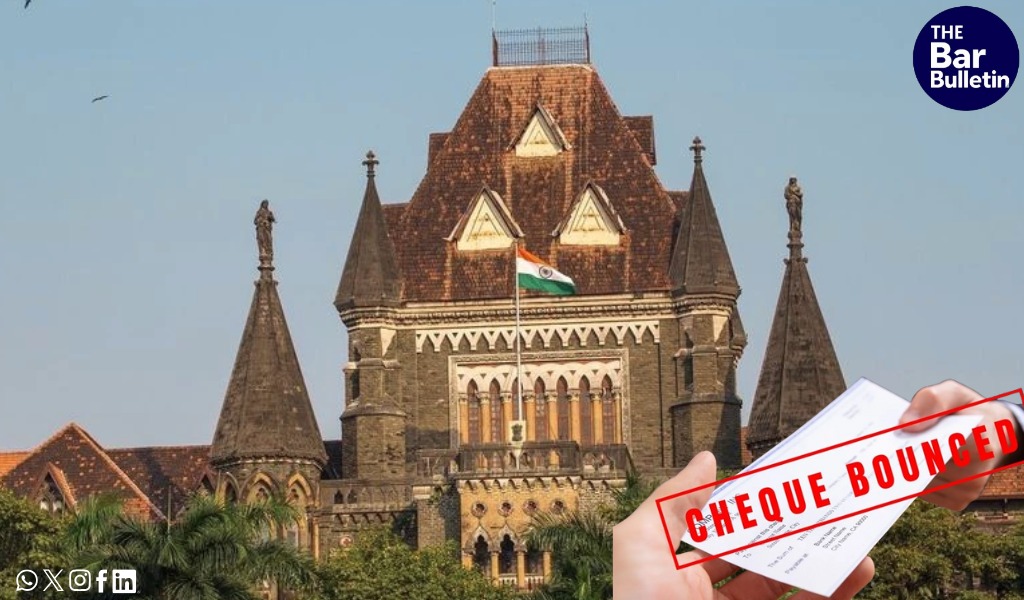

The Bombay High Court has clarified that for an offence under Section 138 of the Negotiable Instruments Act, 1881 (NI Act) to be established, the cheque must be issued in discharge of a legally enforceable debt or liability. In the absence of any evidence proving that the accused had undertaken the liability of a third party, the presumption under Section 139 of the NI Act cannot be invoked against them.
Secondly, the Court held that to prosecute partners or directors of a firm or company for an offence committed by the entity, the complaint must contain specific averments detailing the role of each accused individual in the commission of the offence.
Citing the Supreme Court’s decision in N.K. Wahi v. Shekhar Singh [(2007) 9 SCC 481], the Court reiterated that a mere designation or a blanket statement that they are in charge of the business is insufficient. There must be clear and unambiguous allegations about how each director or partner was responsible for the conduct of the business during the transaction in question.
The High Court held that the judgment of acquittal passed by the Additional Sessions Judge did not suffer from any patent perversity and was not based on a misreading or omission of material evidence. Accordingly, the Court refused to reverse the acquittal.
A Single Judge Bench of Justice Dr. Neela Gokhale noted that the Complainant, in his cross-examination, admitted his inability to specify which of the Accused partners was in charge of the firm’s affairs, rendering his general statement about their undertaking of liability irrelevant. The Bench observed that no witness could prove beyond a reasonable doubt that any of the Accused had taken over Mr. Pagaria’s liability, and there was no documentary evidence to support this claim.
Furthermore, the Bench found no infirmity in the Sessions Court’s finding that there was no prior financial relationship or privity of contract between the Complainant and the Accused. A significant discrepancy was also observed that the Complainant failed to provide any explanation for how the initial loan of Rs. 56.50 Lakh grew to the cheque amount of Rs. 78 Lakh, with no details on the interest rate, making the assertion that the cheque was for the repayment of the loan seem “far-fetched”.
Finally, the Bench concluded that the complaint contained only a “bald averment” that the partners were responsible for the firm’s day-to-day affairs, without any specific details about the role of each accused partner in the transaction.
Briefly, the case originates from a complaint filed under Section 138 of the NI Act, where the Appellant (Original Complainant) had given a hand loan of Rs. 56.50 Lakh to one Hirachand Raichand Pagaria. The Complainant alleged that the Respondents (Original Accused), who were partners in a firm and close friends of Mr. Pagaria, undertook to satisfy this loan.
Consequently, Respondent No. 3 issued a cheque for Rs. 78 Lakh on behalf of the partnership firm. After requests to delay the deposit, the cheque was ultimately deposited and was dishonoured, and a legal notice was sent but not replied to, leading to the complaint. The Trial Court convicted the Accused, but the Additional Sessions acquitted them on appeal.
Appearances:
Advocate Abhishek Pungliya, for the Appellant
APP Poonam P. Bhosale, along with Advocates Subhash Jha, Siddharth Jha, and Sumit Upadhyay, for the Respondent
