


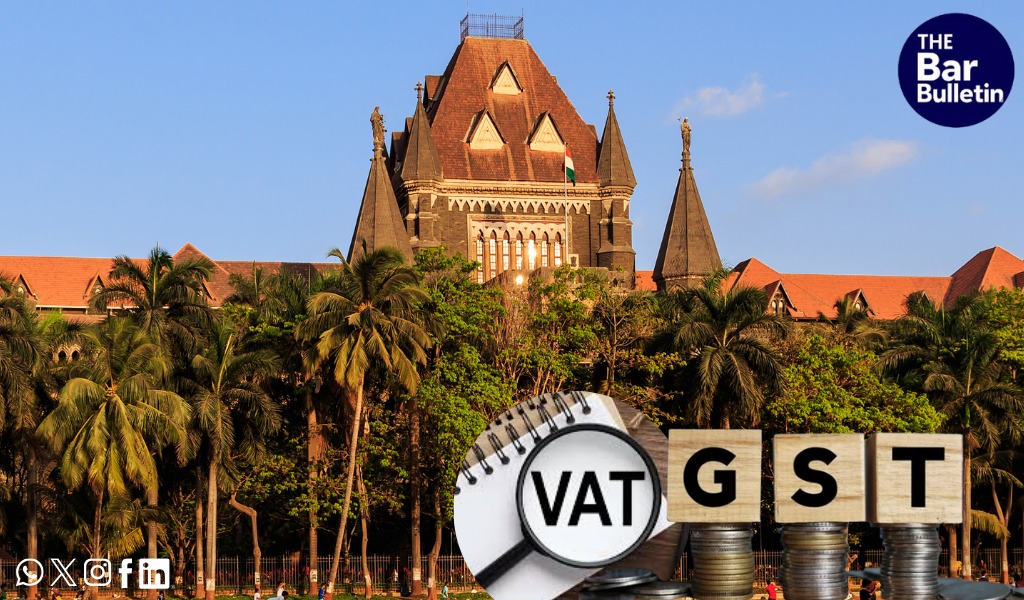

The Bombay High Court has held that once a bank’s security interest is duly registered with the Central Registry of Securitisation Asset Reconstruction and Security Interest of India (CERSAI), its dues will have priority over claims raised by State tax authorities, including those relating to Goods and Services Tax (GST) and Maharashtra Value Added Tax (MVAT).
A Division Bench of Justices Manish Pitale and Shreeram V. Shirsat allowed two writ petitions filed by Bharat Co-operative Bank (Mumbai) Ltd., challenging demand notices, prohibitory orders and communications issued by State tax authorities seeking to assert priority over mortgaged properties.
The Court noted that in both cases, the bank’s security interests in the subject properties were registered with CERSAI as early as 2015, 2016 and 2018, whereas the impugned tax demand notices and prohibitory communications were issued much later, between 2020 and 2025. Despite this, the State authorities attempted to enforce recovery of tax dues by claiming precedence over the bank’s secured interest.
Relying on the Full Bench judgment in Jalgaon Janta Sahakari Bank Ltd. v. Joint Commissioner of Sales Tax, (2022) SCC online Bom 1767, the Court reiterated that Sections 26E and 31B of the SARFAESI Act confer clear statutory priority on secured creditors once their security interest is registered with CERSAI. The Bench rejected the State’s argument that the Full Bench ruling applied only to MVAT dues and not to GST, holding that the principle of priority extends to all government dues, whether payable to the Central or State Government.
The Court observed that the Full Bench had unambiguously clarified that secured creditors’ claims take precedence over “all revenues, taxes, cesses and other rates” once CERSAI registration exists, leaving no scope for artificial distinctions between different tax statutes.
Accordingly, the Court quashed the impugned demand notices, prohibitory orders and communications issued by the tax authorities in both writ petitions. It held that the bank’s dues had priority and that the State could not restrain the bank from enforcing its security interest.
Significantly, the Bench also noted the increasing number of similar petitions being filed and advised the concerned departments to frame a Standard Operating Procedure (SOP). The Court suggested that tax authorities should refrain from issuing demand notices in cases where banks already hold prior CERSAI-registered security interests, and should withdraw such notices where they have already been issued.
All pending applications were disposed of accordingly.
Appearances:
Ms.Namita Shetty with L.S. Shetty, for the Petitioner.
Mr. Himanshu Takke, AGP, for Respondent Nos. 1 and 2.
Mr. Dilip Shinde with Moham Kumbhar and Mukund Mone, for Respondent Nos. 7 and 8 in WPL/172/2026.
Mr. Dhruv Bhinde i/by Shreyash Chaturvedi, for Respondent Nos. 3 and 4 in WPL/446/2026.
