


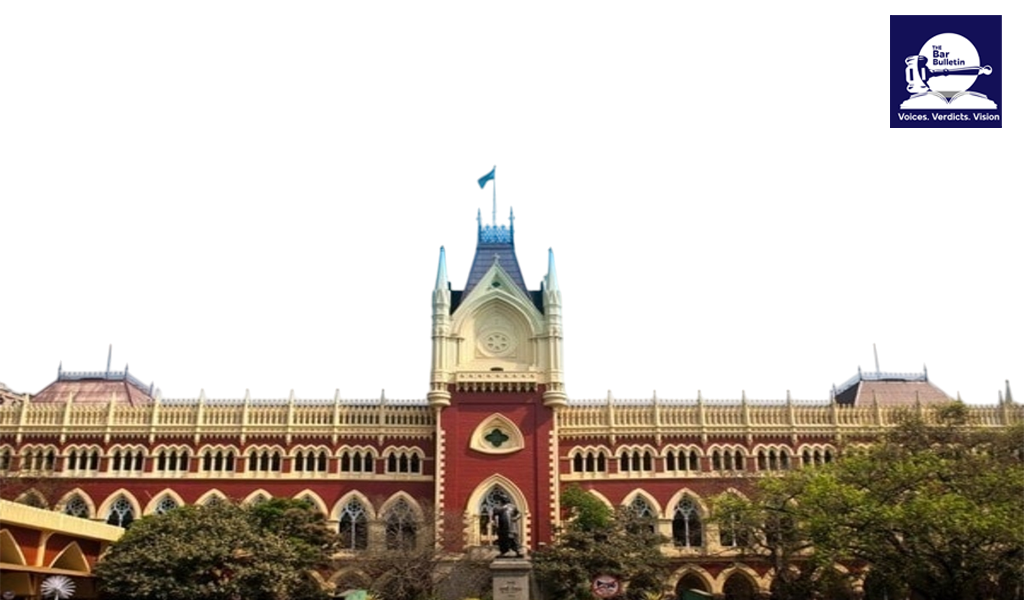

The Calcutta High Court has set aside an arbitral award passed against the Kolkata Metro Rail Corporation Limited (KMRCL) in its dispute with ITD-ITD Cem Joint Venture, holding that the award was vitiated by perversity, bias, and patent illegality.
Justice Sabyasachi Bhattacharyya held that the arbitral tribunal acted in violation of fundamental principles of law by relying on its own professional knowledge instead of tangible evidence, and by applying ‘double standards’ in assessing expert reports filed by the two parties.
The dispute arose from the East-West Metro tunnelling accident of August 31, 2019, that caused severe ground subsidence and property damage in central Kolkata. The contractor, ITD, blamed unforeseeable soil conditions, while Kolkata Metro held the contractor responsible for improper operation and inadequate greasing of the tunnel boring machine (TBM). The arbitration clause was invoked by ITD to decide the dispute of respective liabilities.
The award, delivered by a three-member tribunal in August 2023, was challenged under Section 34 of the Arbitration and Conciliation Act, 1996. In that award, the Tribunal had accepted ITD’s claim, rejecting post-retrieval expert reports produced by Metro Railways as biased and delayed.
On Applicability of the Evidence Act the Court held that Section 45 of the Evidence Act has no application in arbitration proceedings since Section 19 of the 1996 Act exempts the arbitral tribunal from strict adherence to the rules of evidence. However, Justice Bhattacharyya observed that even under such flexibility, the tribunal was bound to assess the evidence on record fairly and uniformly, something it failed to do.
The court refused to consider the KMRCL allegation that ITD produced new documents at the argument stage and it vitiated the award. The Court noted that no specific documents were identified and found that the tribunal’s reasoning was primarily based on expert reports already on record. This ground, the Court held, was insufficient to vitiate the entire award.
Justice Bhattacharyya found that the tribunal had substituted its own professional engineering knowledge for the evidence presented. The tribunal reliance on its “engineering point of view,” was found to be violative of judicial neutrality. Once appointed as arbitrators, the members were required to adjudicate solely on the basis of material evidence, the court added. Importing personal expertise, the Court said, hits at the very foundation of the fundamental policy of Indian law.
The Court further considered the issue ‘whether the tribunal violated principles of equality by discarding the expert reports produced by Metro Railways while accepting those produced by ITD/Claimants’. The Court held that the tribunal violated Section 18 of the Arbitration Act by accepting the pre-retrieval expert reports produced by ITD, while rejecting the post-retrieval reports of KMRCL. The High Court observed that the delay in producing these reports was justified since the Tunnel Boring Machine (TBM) had to be retrieved in pieces over a long period. Discarding these reports on the ground of delay or authorship was held to be arbitrary and case of double standards. Justice Bhattacharyya concluded that this unequal treatment strikes at the root of party equality and constitutes patent illegality.
The Court also considered the issue, ‘whether the relevant Contractual clauses were overlooked and/or the tribunal re-wrote the Contract’. The Court found that the tribunal ignored vital clauses of the General and Special Conditions of Contract that squarely placed responsibility for safety, stability, and site operations on the contractor. The contract, particularly Clauses 3.4, 4.1, and 4.16, made it clear that the contractor bore all risks irrespective of the Engineer’s approval. By shifting liability onto KMRCL, the tribunal, the Court said, had “re-written the contract” in contravention of Section 28(3) of the Arbitration Act, therefore the award is vitiated by patent illegality.
The Court also struck down the tribunal’s declaratory award recognising ITD’s entitlement to future and unquantified monetary claims. Justice Bhattacharyya termed this “futuristic in a sarcastic sense” and held that such adjudication on potential future disputes was legally unsustainable, thus vitiated the award.
Concluding that the award was based on unequal treatment, disregard of material evidence, and misapplication of contract terms, the Court allowed the petition filed by KMRCL under Section 34, and set aside the arbitral award in its entirety, without costs.
Appearances
Petitioner- Mr. Jishnu Chowdhury, Sr. Adv., Ms. Sreya Basu Mallick, Adv., Mr. Aritra Basu, Adv., Mr. Ankit Dey, Adv., Ms. Atri Mondal, Adv.
Respondent- Mr. Jishnu Saha, Sr. Adv., Mr. Anal Kr. Ghosh, Adv., Ms. Neelina Chatterjee, Adv., Ms. Ahana Bhattacharyya, Adv.
