


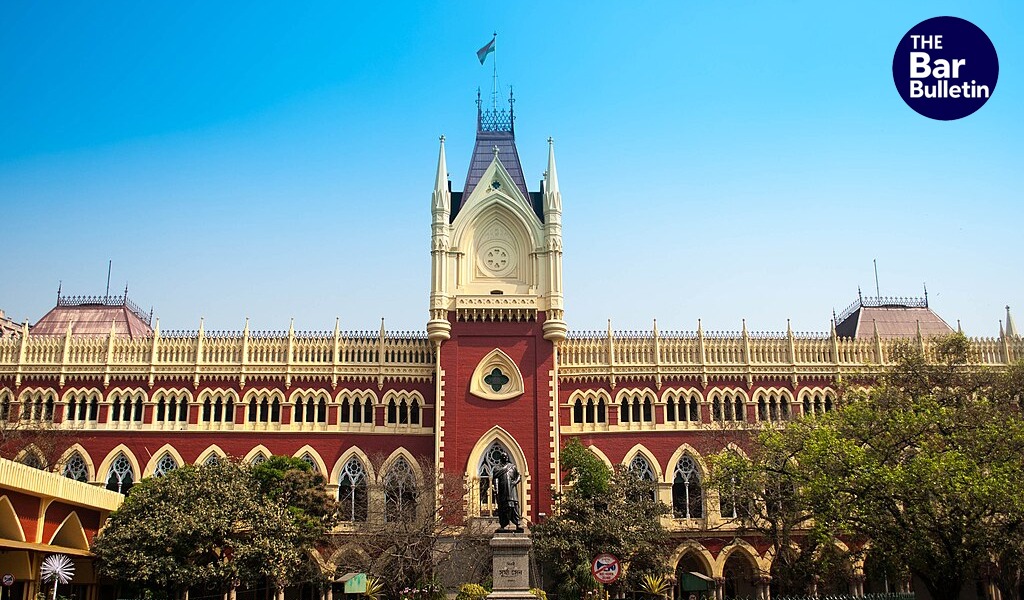

The Calcutta High Court has held that mere possession of bank property, without any evidence of resulting prejudice, is insufficient to establish gross misconduct, especially when the employee offers a plausible and unrebutted explanation of innocence or lack of knowledge. Therefore, to sustain a charge of ‘doing an act prejudicial to the interest of the bank’, the employer (bank) must prove not only the commission of the act (such as unauthorized possession of property) but also that the said act actually caused prejudice to the employer’s interests, business, or reputation.
The Court therefore upheld the Single Judge’s order for reinstatement with full back wages, modifying it only to the extent that any superannuation benefits and compensation already paid to the respondent must be adjusted against the amounts of back wages payable to him.
The Division Bench comprising Justice Lanusungkum Jamir and Justice Rai Chattopadhyay noted that the primary issue was whether the unauthorized possession of bank property for approximately 11 months, by itself, constituted an ‘act prejudicial to the interest of the bank’ under Clause 19.5 (j) of the Bipartite Settlement. The Bench observed that while the respondent conceded that the materials were recovered from his residence, the appellant Bank had the burden to demonstrate that an act was done by the employee which was prejudicial to the bank’s interest.
The Bench noted that the Bank failed to produce any evidence, either factual, numerical, or material, before the enquiry officer, the Tribunal, or the Court to show that any prejudice was actually caused to the bank’s business or reputation due to the respondent’s actions. Conversely, the respondent had consistently pleaded innocence and a lack of knowledge, stating the items were inadvertently carried with his personal belongings during his transfer.
The Bench found no convincing material presented by the appellant to disbelieve the respondent’s explanation, and held that the Disciplinary and Appellate authorities erred in concluding that the mere recovery of bank property from the employee’s custody was sufficient to establish the misconduct.
Lastly, the Bench reiterated the established legal principle that an appellate court should not interfere unless the Single Judge’s order suffers from ‘palpable illegality or gross miscarriage of justice’. The Bench reviewed the Single Judge’s reasoning for setting aside the Tribunal’s award of lump sum compensation and ordering reinstatement with back wages. It found no gross, apparent and palpable illegality in the Single Judge’s decision to warrant interference.
Briefly, the respondent No. 1, an employee of the appellant Bank, was transferred from the Bhawanipur branch to the Ballygunge branch on January 17, 2000, after which, a police raid on his residence resulted in the recovery and seizure of a rubber stamp, blank letterheads, and blank passbooks belonging to the Bhawanipur branch. The respondent was arrested and a police case was initiated, though he was later released on bail.
Later, on January 5, 2002, the Bank issued a chargesheet against the respondent for ‘doing acts prejudicial to the interest of the Bank’, constituting gross misconduct under Clause 19.5 (j) of the Bipartite Settlement. Following a departmental enquiry, the Disciplinary Authority ordered the respondent’s removal from service, reasoning that the unauthorized possession of bank property was established, irrespective of the outcome of the criminal proceedings.
Thereafter, the respondent raised an industrial dispute, and the Central Government Industrial Tribunal-cum-Labour Court found the termination illegal, but granted a lump sum compensation of Rs. 2,00,000 instead of reinstatement. Dissatisfied, the respondent approached the High Court, where the Single Judge upheld the finding of illegal termination but set aside the compensation, directing reinstatement with full back wages.
Appearances:
Advocates Suchayan Bandhopadhyay and S. K. Banerjee, for the Appellants
Advocates Suvadip Bhattacharjee, Balaram Patra, and Ashok Prasad, for the Respondents
