


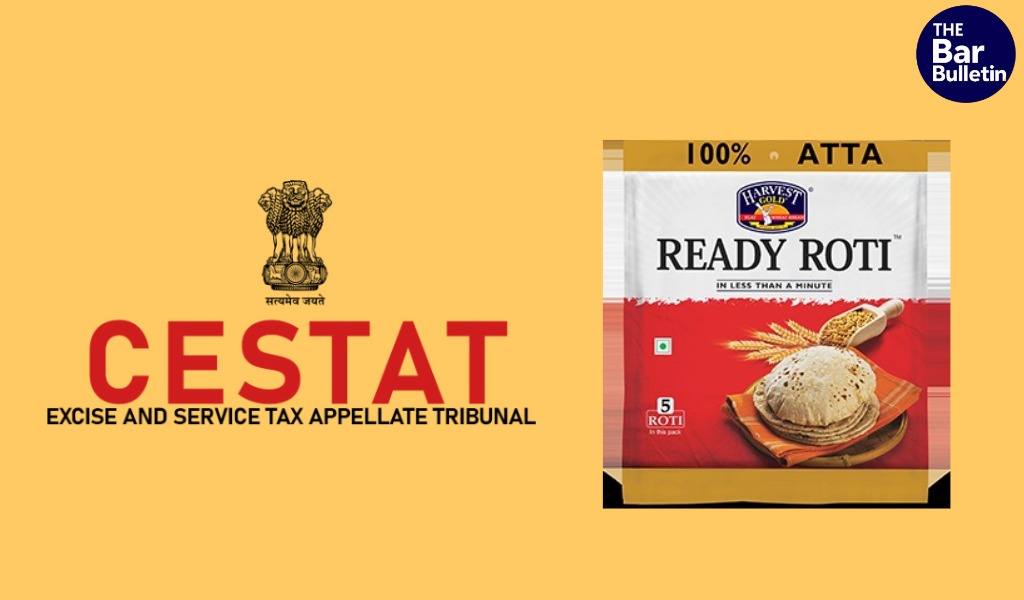

The New Delhi Bench of the Customs, Excise & Service Tax Appellate Tribunal (CESTAT) has held that an incomplete or unfinished article, which possesses the essential character of the finished article, must be classified under the same tariff heading as the finished article. This principle is derived from Rule 2(a) of the General Rules for the Interpretation of the First Schedule to the Central Excise Tariff Act, 1985.
The CESTAT clarified that since a finished ‘Roti’ is a form of bread classifiable under CETH 1905 90 90, the appellant’s ‘Ready Roti’, being an unfinished product with the essential character of a roti, is also correctly classifiable under the same heading. Consequently, the demand for duty, interest, and penalty was set aside.
The Division Bench comprising Ajay Sharma (Judicial Member) and P.V. Subba Rao (Technical Member) observed that the central issue was the correct classification of ‘Ready Rotis’, whether as bread under CETH 1905 90 90 or as a miscellaneous edible preparation under CETH 2106 90 90. It noted that breads can be either leavened (like buns and pizza bases) or unleavened (like rotis and parotas), and that rotis are commonly referred to as ‘Indian unleavened flat breads’.
Addressing the Revenue’s argument that the product was only partially cooked and required further heating, the Tribunal referred to Rule 2(a) of the General Rules for the Interpretation of the Central Excise Tariff. This rule stipulates that any reference to an article in a tariff heading includes the article in its incomplete or unfinished state, provided that, as presented, it possesses the essential character of the complete or finished article.
The Tribunal observed that the ‘Ready Rotis’ were not in the form of flour or dough but had undoubtedly acquired the essential character of rotis, merely needing a few more minutes of cooking to be complete. Therefore, the product was deemed to be squarely covered by this interpretation rule.
Briefly, the appellant began manufacturing a product named ‘Ready Roti/Halka Fulka’ in September 2015 without obtaining Central Excise registration or paying any duty, and classified the product under Central Excise Tariff Heading (CETH) 1905 90 90, which attracted a NIL rate of duty.
The dispute arose when officers from the Central Excise department visited the appellant’s factory, believing the product was a ready-to-eat packaged food classifiable under CETH 2106 90 90, which was subject to a 12.5% duty. Consequently, a Show Cause Notice was issued, proposing a recovery of central excise duty amounting to Rs. 8,33,772 for the period from September 2015 to June 2017, invoking the extended period of limitation under Section 11A(4) of the Central Excise Act, 1944.
The Assistant Commissioner reduced the demand to Rs. 2.77 Lakh, but confirmed the interest and an equal penalty. This order was subsequently upheld by the Commissioner (Appeals).
Appearances:
Advocate Priyamwada Sinha, for the Appellant/ Taxpayer
AR, Bhagwat Dayal, for the Respondent/ Revenue
