


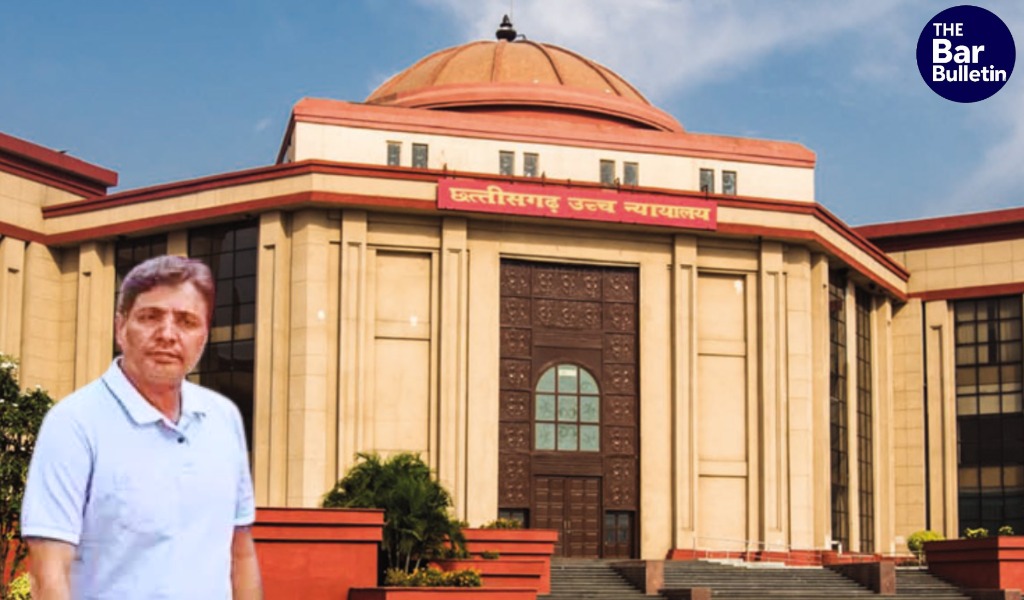

The High Court of Chhattisgarh at Bilaspur granted bail to businessman Anwar Dhebar, an accused in the alleged multi-crore Chhattisgarh liquor scam, holding that prolonged incarceration and lack of progress in trial warranted his release notwithstanding the seriousness of the allegations.
Justice Arvind Kumar Verma allowed Dhebar’s second bail application filed under Section 483 of the Bharatiya Nagarik Suraksha Sanhita, 2023 in connection with Crime registered by the Economic Offences Wing/Anti-Corruption Bureau (EOW/ACB) for offences under Sections 420, 467, 468, 471 and 120-B IPC along with Sections 7 and 12 of the Prevention of Corruption Act, 1988.
According to the prosecution, a large-scale liquor syndicate allegedly operated in Chhattisgarh between 2019 and 2023, manipulating the procurement and distribution of liquor through government-licensed outlets. It was alleged that illegal commissions were collected from distillers and suppliers with the collusion of excise officials and intermediaries, causing significant loss to the State exchequer while generating unlawful gains for conspirators.
The State contended that Dhebar acted as a principal operator and financial beneficiary of the syndicate, with investigation suggesting illegal proceeds running into hundreds of crores. The prosecution also claimed that illegal sale of unaccounted liquor and manipulation of procurement chains resulted in massive financial impact, with the overall scam amount estimated to exceed ₹3,000 crore, and potentially crossing ₹4,000 crore as further investigation progressed.
Opposing bail, the State argued that the investigation was ongoing and involved complex financial trails, digital evidence, hawala transactions and benami investments. It further submitted that releasing the accused could lead to tampering with evidence or influencing witnesses, given the scale of the alleged conspiracy and the applicant’s influence.
The applicant, on the other hand, contended that he had been in custody since 5 April 2024 and had already undergone prolonged incarceration while the trial had not even commenced. His counsel submitted that the charge-sheet had been filed and multiple supplementary charge-sheets had followed, yet charges had not been framed and cognizance against all accused was still pending, making early commencement of trial unlikely.
The Court noted that the applicant had remained in judicial custody for about 22 months, while the prosecution proposed to examine over 1,100 witnesses and relied on voluminous documentary evidence, indicating that the trial would take considerable time. The Court also observed that the Supreme Court had earlier granted liberty to the applicant to renew his bail plea if no substantial progress occurred in the trial within four months, and that such contingency had now arisen.
Relying on precedents including Union of India v. K.A. Najeeb, Manish Sisodia v. Directorate of Enforcement, and Sanjay Chandra v. CBI, the Court reiterated that prolonged pre-trial detention cannot be allowed to become punitive, and that the constitutional guarantee of personal liberty under Article 21 requires courts to consider bail where trials are unlikely to conclude within a reasonable time.
The Court further noted that investigation against the applicant had substantially culminated with the filing of charge-sheets and that the prosecution case was largely based on documentary evidence already in the possession of investigating authorities, reducing the necessity for continued custodial detention.
While acknowledging the gravity of allegations and describing the applicant as a principal conspirator according to the prosecution, the Court held that seriousness of the offence alone cannot justify indefinite detention prior to trial. It emphasised that “bail is the rule and jail the exception,” particularly where the accused has already spent a significant period in custody and the trial is unlikely to conclude soon.
Accordingly, the High Court directed that Anwar Dhebar be released on bail upon furnishing a personal bond of ₹1 lakh with one solvent surety of the like amount, subject to conditions including surrender of passport, cooperation with investigation and trial, non-interference with witnesses, and restriction on leaving the country without court permission.
The Court clarified that the bail was granted solely on the ground of prolonged incarceration and delay in trial, and that its observations should not be construed as a comment on the merits of the prosecution case.
Appearances:
Harshwardhan Parganiha, Mayank Jain, Madhur Jain, Arpit Goel and Harshit Sharma, Advocates appeared for the applicant.
Additional Advocate General Praveen Das appeared for the State of Chhattisgarh.
