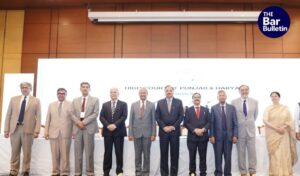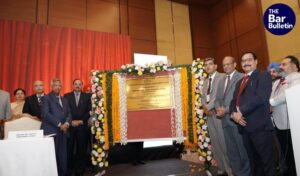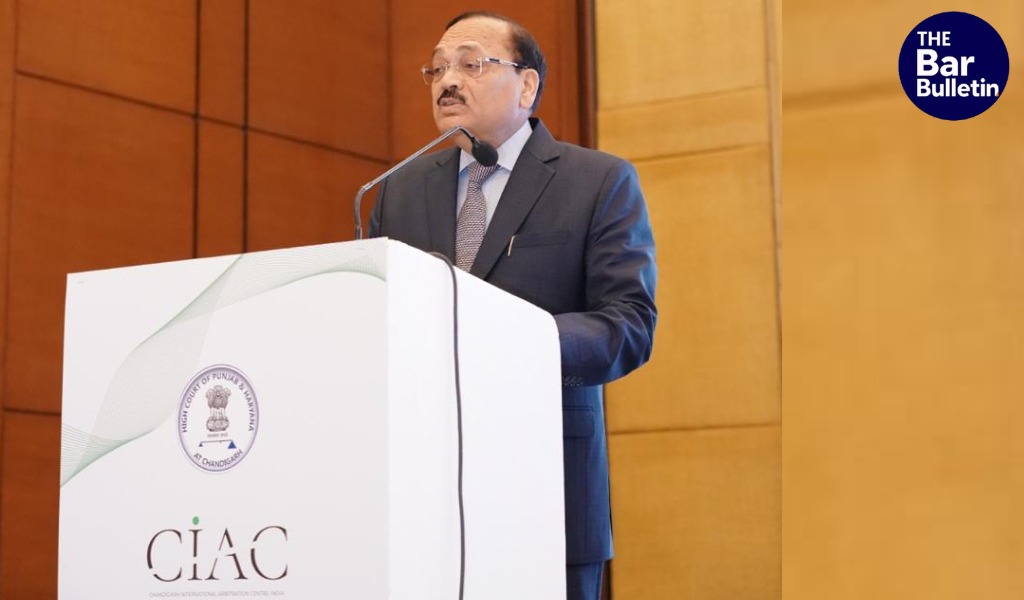

The inaugural edition of India International Disputes Week (IIDW) 2026 commenced in Chandigarh with the launch of the Chandigarh International Arbitration Centre (CIAC), bringing together judges, arbitration experts, policymakers, practitioners and international delegates from across jurisdictions to deliberate on the future of global dispute resolution. The week-long conference, hosted under the aegis of the Punjab and Haryana High Court, seeks to strengthen India’s position as an emerging hub for arbitration and cross-border dispute resolution.
Welcoming the gathering, Chief Justice of the Punjab and Haryana High Court Justice Sheel Nagu described the event as an important institutional milestone for the region and the country’s dispute resolution ecosystem. Addressing the gathering of judges, senior advocates, international delegates, and members of the bar, Justice Nagu said the conference symbolised the growing global engagement of India’s legal fraternity and the country’s aspiration to play a larger role in international arbitration.
He highlighted the evolution of the Chandigarh Arbitration Centre, which currently forms the backbone of arbitration activity in the region. According to him, the centre already has a diverse and experienced panel of arbitrators comprising former High Court judges, former district judges, technocrats, bureaucrats and senior advocates.
Justice Nagu noted that the institution currently has 373 empanelled arbitrators, including 104 former High Court judges, 66 former district judges, 116 advocates, and 87 former civil servants and technocrats, ensuring that arbitration matters are handled by professionals with deep legal, administrative and technical expertise.
Tracing the growth of the centre, he said:
“What began as a modest initiative conducting four or five arbitration sittings a day has today evolved into a vibrant institutional mechanism. At present, nearly 30 to 40 arbitration proceedings are conducted daily, reflecting the growing trust of litigants, professionals and commercial entities in institutional arbitration.”
Justice Nagu further announced that additional infrastructure is being developed for the new arbitration centre. He revealed that 15 acres of land in Chandigarh has been allotted to the High Court for the establishment of a dedicated arbitration complex.
“The Chandigarh International Arbitration Centre is envisioned as a state-of-the-art institution developed on the lines of leading global arbitration centres such as the Singapore International Arbitration Centre.”
Justice Nagu emphasised that India International Disputes Week is more than a conference.
“It is a platform for dialogue, collaboration and innovation. It brings together diverse legal traditions, global institutions and industry leaders to reflect on the challenges and opportunities of cross-border dispute resolution.”
Delivering the keynote address, Chief Justice of India Justice Surya Kant reflected on India’s expanding economic footprint and the growing importance of robust dispute resolution institutions.
He described the launch of the Chandigarh International Arbitration Centre as a moment of both professional and personal significance, recalling his long association with the Punjab and Haryana High Court where he began his career as an advocate and later served as Advocate General and judge.
Justice Surya Kant observed that in a rapidly globalising economy disputes are inevitable.
“Disputes are not signs of weakness. They are natural by-products of growth. A mature economy is not one without disagreements; it is the one that resolves disagreements with credibility.”
He noted that as Indian businesses expand globally, investors increasingly ask a simple but decisive question before committing capital.
“If something goes wrong, where will I go? Will I be heard fairly? Does the legal system guarantee protection of my investments?”
The Chief Justice emphasised that a credible dispute resolution system is therefore indispensable for sustaining economic growth.
While acknowledging that India’s arbitration system once faced scepticism internationally, he said the past decade has witnessed substantial reform through legislative changes and judicial discipline.
“Legislative amendments and judicial discipline have worked in tandem. Courts have repeatedly affirmed the principle of minimal intervention while remaining vigilant where natural justice demands scrutiny.”
He stressed that credibility of arbitration systems depends not only on laws but also on institutional performance.
“Investors do not merely read legislative texts. They examine practices. They ask whether arbitral awards are enforced promptly, whether tribunals are constituted efficiently, and whether timelines are respected.”
The Chief Justice said the newly launched CIAC must aspire to the highest standards.
“It must stand for neutrality beyond doubt, efficiency beyond promise and procedural integrity beyond reproach.”
Justice Surya Kant also emphasised the growing importance of mediation within India’s dispute resolution architecture, particularly after the enactment of the Mediation Act, 2023.
“Arbitration and mediation are not competing pathways. They are complementary instruments in a single architecture, one delivering finality, the other flexibility.”
He further highlighted initiatives such as “Mediation for the Nation”, launched through the National Legal Services Authority, aimed at expanding awareness and use of mediation across India.
Concluding his address, the Chief Justice said the true measure of India’s dispute resolution institutions will lie in the trust they inspire.
“Trust is the true seat of jurisdiction. If we uphold neutrality, predictability and efficiency, India will not merely resolve disputes, it will command global confidence.”
Attorney General for India R. Venkataramani, addressing the conference, congratulated the organisers for hosting an ambitious five-day programme covering a wide range of themes including arbitration, mediation, digital evidence, enforcement, and commercial dispute resolution.
Reflecting on global arbitration discourse, the Attorney General cautioned against simply replicating foreign models.
“We keep referring to London, Paris and Singapore as examples. But India stands apart in its diversity, geographic scale and justice needs. Comparisons can only go so far.”
He suggested that India should develop its own distinctive approach to dispute resolution.
“The world needs more centres of excellence in arbitration. No single city whether Singapore, Paris or London can alone meet global demand.”
The Attorney General also called upon lawyers to rethink their professional role in dispute resolution.
“As members of the legal fraternity, we must ask ourselves a fundamental question, are we conflict sustainers, or are we agents of service in resolving disputes?”
International arbitration practitioners participating in the conference welcomed the launch of CIAC while highlighting the need for continued institutional reforms.
Rajeev Fokeer Sharma, Partner at FTPA and Vice-President of the Association of South Asian Lawyers, noted that nearly half of global arbitration users today are based in the Asia-Pacific region.
However, he observed that Indian cities still do not feature among the world’s leading arbitration seats.
“Surely that must change, and surely it can change.”
According to Sharma, foreign arbitration users look for a familiar and predictable legal framework when choosing a seat.
“A French arbitration practitioner looks at whether the legal system provides the same assurances that exist in his own jurisdiction.”
He suggested that India could draw inspiration from aspects of the French arbitration system, including clear legal frameworks and supportive judicial oversight.
Shwetha Bidhuri, Director and Head at the Singapore International Arbitration Centre (SIAC), highlighted India’s growing participation in international arbitration.
She noted that India has consistently been among SIAC’s top three foreign users for many years.
“Over the past decade, SIAC has administered more than 1,500 India-related cases involving over 2,100 Indian parties.”
She also pointed out that Indian arbitrators are gaining increasing recognition globally.
“In 2024, Indian arbitrators were the third most frequently appointed nationality at SIAC.”
She also welcomed the launch of CIAC as an important step toward strengthening India’s arbitration ecosystem.
Manuj Bharadwaj, former international civil servant with the World Trade Organization and the United Nations, emphasised the economic significance of effective dispute resolution systems.
“Effective dispute resolution is not merely a legal function, it is an economic imperative.”
He explained that investor confidence depends on the predictability and credibility of legal systems.
“Every investment decision carries an underlying question, if a dispute arises, how effectively will it be resolved?”
According to Bharadwaj, strong arbitration systems can also contribute to India’s economic ambitions by enabling the export of legal services.
Dr Satvinder S. Juss, Barrister and Master of the Bench at Gray’s Inn, observed that India has made significant strides in strengthening its arbitration framework through legislative reforms, institutional development and increasing judicial support for arbitration.
He noted that international legal communities view India’s evolving arbitration landscape positively and are keen to engage with its growing dispute resolution ecosystem.
Meanwhile, Judge Manpreet Monica Singh of the Harris County Civil Court, Texas, emphasised the importance of collaboration between the Indian and American legal communities.
Highlighting the role of diaspora lawyers, she said such partnerships could strengthen global cooperation in the field of law and dispute resolution.
Representatives of the Sikh National Bar Association and South Asian Bar Association of North America also welcomed India’s rising influence in the global legal community and expressed their willingness to collaborate with Indian institutions.