


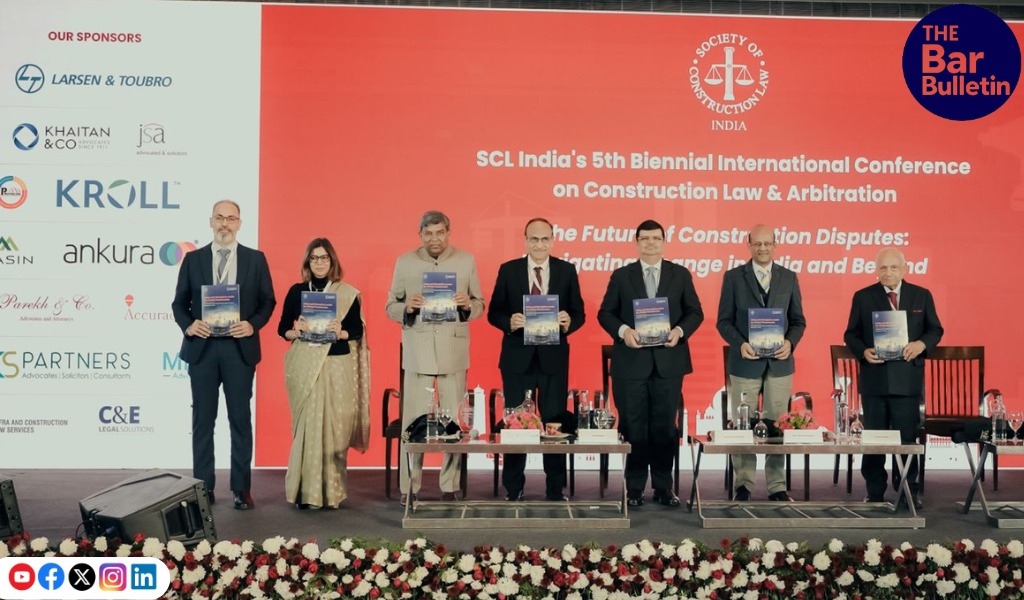

The Society of Construction Law – India (SCL India) inaugurated its 5th Biennial International Conference on Construction Law & Arbitration at The Lalit, New Delhi, bringing together leading judges, global arbitrators, engineers, senior practitioners, and policy experts for one of Asia’s most significant gatherings on construction law.
Delivering the Special Address, Mr. Arun Chawla, Director General of the Indian Council of Arbitration (ICA), highlighted the scale of India’s construction sector, projecting its 2025 value at USD 1.21 trillion, contributing 8–9% of GDP and employing over 71 million people. He announced the creation of ICA’s Construction & Infrastructure Dispute Resolution Committee, chaired by Senior Advocate Ratan K. Singh, to develop best practices and strengthen India’s institutional arbitration framework. Stressing the sector’s economic importance, Mr. Chawla called for dispute-resolution systems that are “efficient, credible, modern, and internationally benchmarked,” while flagging the dual challenges posed by artificial intelligence in document-heavy construction arbitration.
Dr. Lalit Bhasin, President of the Society of Indian Law Firms and Chairman, CIArb–India, urged the strengthening of arbitral institutions in India and emphasised the revival of consensual dispute-resolution processes consistent with India’s ethos. Litigation delays, he noted, make arbitration indispensable, but institutional capacity must grow to inspire global confidence.
In a keynote address, Attorney General of India, R. Venkataramani, called for a comprehensive, standalone legislation for the construction industry, warning that fragmented laws—from real estate to consumer protection, insolvency, and labour—create conflicting remedies and institutional silos. He proposed the creation of a Construction Regulatory Authority and urged deeper practitioner involvement in academic development to strengthen future capacity.
Philip L. Bruner, Director at JAMS Global Engineering & Construction, traced arbitration’s evolution and reiterated its suitability for technical construction disputes, offering flexibility, expertise, and equitable outcomes.
Hon’ble Justice Tejas Karia of the Delhi High Court highlighted the increasing complexity of infrastructure disputes in an era of globalised contracting, climate-related risks, and sophisticated engineering frameworks. He identified emerging categories of disputes—including transnational project risk and cross-jurisdictional interoperability—and underlined the growing importance of Dispute Avoidance and Adjudication Boards (DABs) and technology-enabled dispute-resolution systems. India, he noted, is positioned to become a global hub for infrastructure arbitration.
The inaugural session set a reform-oriented tone for the three-day conference, which will feature nine thematic sessions on delay analysis, defects liability, cross-examination practices, record-keeping, linear-project delays, and mediation-based early dispute resolution.
DAY 1
The Society of Construction Law (SCL) India commenced the first set of technical sessions at the 5th SCL India International Construction Law & Arbitration Conference, bringing together global leaders in construction law, arbitration, engineering, quantum, and project administration.
The day featured three intensive sessions examining the foundational controversies shaping construction arbitration today: (1) Proof and causation, (2) Delay analysis, and (3) Claims for head-office overheads and profitability.
The sessions were led by eminent jurists and practitioners including Bruce Reynolds, Michael E. Schneider, Ratan K. Singh, Justice Michael Black KC, Justice Dato’ Mary Lim Thiam Suan, Mohan Pillay, Gaurav Juneja, Jon Prudhoe, Andrew Rigney KC, Dhirendra Negi, James Taylor, Philip Bruner, Roger Stewart KC, Mayank Thakur, Lakshman Ramaiah, and Narottam Sharma.
SESSION 1: Proof in Construction Disputes: Testing the Evidence Used to Prove Causation and Loss
Organised by the Society of Construction Law
Opening the conference, Bruce Reynolds, Michael E. Schneider, Ratan K. Singh, Justice Michael Black KC, and Justice Mary Lim examined the evidentiary foundations of construction arbitration.
The panel underscored that proof of causation, though central to construction disputes, is often treated superficially. They highlighted the central evidentiary pillars:
• Documentary evidence
• Fact witnesses
• Expert testimony
• The conduct and responsibility of counsel
Echoing global jurisprudence, the panel stressed that causation functions differently in construction than in criminal or tort law.
Michael E. Schneider remarked:
“In commercial and construction contracts, causation is less about moral responsibility and more about establishing the pathways through which delay or disruption translates into financial consequences.”
Ratan K. Singh emphasized the analytical gaps that persist in construction disputes:
“Causation frequently fails to receive the sophisticated treatment it deserves. It gets lost in the maze of paperwork instead of being treated as a structured, evidence-backed inquiry.”
On document production, the panel noted that effective disclosure is the backbone of causation.
Justice Michael Black KC cautioned:
“Documents must be produced not in volume but in relevance. What matters is the material connection between events and the claimed loss.”
Expert evidence was also critically examined. The panel reiterated that experts must present impartial views.
Justice Dato’ Mary Lim said:
“An expert must balance advocacy with independence. Their duty is to the tribunal — not to the party paying their fees.”
The session concluded with an important reminder about counsel’s central role in ensuring fairness.
Bruce Reynolds noted:
“The job of counsel is not to impress the client; it is to assist the tribunal. Professionalism and civility are part of due process.”
SESSION 2: Delay Analysis Perspectives of Arbitrators, Lawyers, Experts & Industry
This high-engagement session brought together Gaurav Juneja, Mohan Pillay, Jon Prudhoe, Andrew Rigney KC, Dhirendra Negi, and Ajit Mishra.
Mohan Pillay: Understanding the Event and the Remedy
Starting with a crisp insight, Pillay stated:
“If the delay analysis doesn’t get done in the morning, it may never get done.”
He distilled the tribunal’s concerns into two simple core questions:
1. What is the delay event?
2. What remedy is being sought?
He stressed that tribunals want precision, not narrative.
Dhirendra Negi: Distinguish Between Time and Money
Negi emphasized the legal distinction between an extension of time and prolongation costs:
“An excusable delay that entitles a party to time does not automatically entitle it to compensation. The two are governed by different legal principles.”
He also highlighted the difficulties tribunals face when experts use incompatible methodologies, urging early agreement on baselines and approaches.
Jon Prudhoe: The Five Pillars : Notice, Causation, Context, Concurrency, Practicability
Prudhoe focused on what he described as the “five organising principles” of delay analysis.
On causation, he observed:
“Tribunals often receive correspondence bundles instead of causation. The question isn’t what was written, it’s what actually happened to the critical path.”
On concurrency, he added:
“Indian law already has a statutory foundation for concurrency. The principle of reciprocal obligations must be applied more rigorously.”
Andrew Rigney KC: The Tribunal’s Trust in Experts
Rigney underscored why independence is the currency of expert credibility:
“Once the tribunal senses that the expert is advocating rather than analysing, their evidence becomes virtually worthless.”
Gaurav Juneja & Jon Prudhoe: When Should an Expert Be Appointed?
Both practitioners agreed that tribunals are realistic about party-driven evidence, but trust collapses when counsel shapes the expert’s opinion.
Prudhoe cautioned:
“If the tribunal feels the expert’s report has been influenced by the lawyers, the report may be disregarded entirely.”
Ajit Mishra: Practical Lessons from the Infrastructure Sector
Mishra laid out a structured, step-based approach from an industry perspective, insisting on:
• early expert engagement,
• appropriate choice of method (prospective vs retrospective),
• rejecting flawed dynamic logic-driven methodologies,
• focusing on methods capturing the true critical path.
SESSION 3: Claims for Head-Office Overheads & Profitability
This session was led by leading global authorities:
James Taylor, Philip Bruner, Roger Stewart KC, Mayank Thakur, Lakshman Ramaiah, Narottam Sharma, and Rohit Singhal.
Roger Stewart KC: “Judges and Arbitrators Are Common Jury-Persons in Damages”
Stewart opened with a crisp reminder:
“The assessment of damages is a question of fact — seldom disturbed on appeal.”
He urged parties to avoid “windfall claims,” stressing the importance of accurate records and cautioning against destructive defence tactics.
Quoting Lord Blackburn, he reiterated the classic principle of compensation:
“Place the injured party, as nearly as possible, in the position he would have been in had the wrong not occurred.”
Lakshman Ramaiah: The Reality of HO-OH Records
Ramaiah illustrated with practical examples that contractors rarely maintain project-specific HO-OH accounting:
“There is no such thing as a ‘head-office ledger’ for each project. Insisting on actuals often means insisting on records that don’t exist.”
Using hypothetical scenarios, he demonstrated the mismatch between formula outcomes and actual corporate accounting.
Narottam Sharma: Supreme Court Clarifies the Law — Unibros & Batliboi
Sharma unpacked the Supreme Court’s 2023 rulings which have reshaped HO-OH claims:
“Formulae cannot be applied in a vacuum. The contractor must prove actual loss.”
He highlighted the now well-established four-part test for loss of profitability:
1. Delay
2. Attribution
3. Contractor’s capability
4. Evidence of lost opportunity
Mayank Thakur: What Contractors Must Prove
Thakur explained the evidentiary burden for “loss of opportunity”:
“You must show work was available in the market, and you could not take it because your resources were blocked. Without this, the claim collapses.”
He emphasized that formulas like Hudson and Emden help only after loss is proven, not before.
James Taylor & Philip Bruner: International Best Practices
Taylor and Bruner focused on quantification and the global trends in head-office claims, reminding delegates that tribunals increasingly prefer:
• retrospective analysis
• verified overhead records
• cross-checked formula outcomes
• consistency with past financial performance.
Bruner emphasised:
“The tribunal’s duty is to ensure fairness, not generosity. Claims must be reasonable, evidence-backed, and commercially grounded.”
Day 1 of the SCL India Conference highlighted a decisive shift in the field greater emphasis on causation, more rigorous delay analysis, and heightened evidentiary thresholds for overheads and profitability claims.