


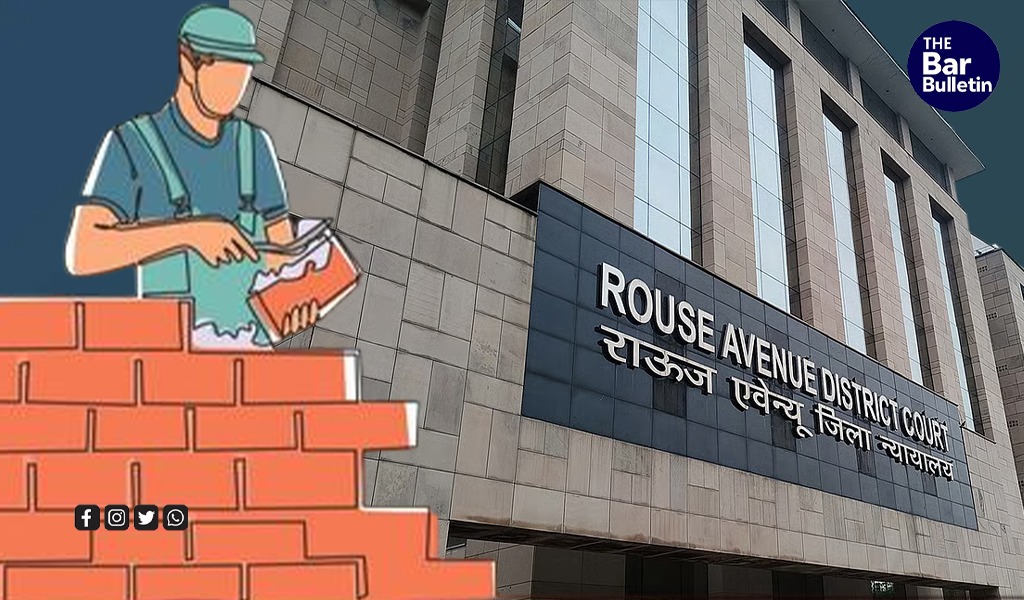
The Rouse Avenue District Court discharged former Assam MP Kirip Chaliha from a criminal case arising out of the death of a labourer during renovation work, holding that criminal liability for rash and negligent acts cannot be vicariously fastened on a property owner in the absence of material showing direct supervision or control over the work.
The prosecution case arises from an FIR registered under Sections 288 and 304A read with Section 34 IPC, alleging that a wall collapsed during renovation work, resulting in the death of a labourer. It was alleged that basic safety measures, including safety gear and helmets, were not provided. The flat owner, a former Member of Parliament, sought discharge from the case.
While considering the discharge application filed under Section 274 BNSS, the Court reiterated that the principles governing framing of charge are well settled and referred to the Supreme Court’s decision in Union of India v. Prafulla Kumar Samal, (1979)3 SCC 4, where it was held that at the stage of framing of charge, the judge is only required to see whether the material on record discloses a prima facie case and that any detailed evaluation of evidence would amount to an impermissible mini-trial.
Explaining the scope of Section 304A IPC, the Court noted that criminal liability for causing death by negligence arises only where the rash or negligent act is the “direct or proximate cause of death,” adding that “mere contravention of rules does not make a person liable unless the act by which the death is caused was the efficient cause of death.”
On the facts, the Court recorded that the renovation and construction work was being carried out under the direct supervision of the contractor. The Court observed that there is no iota of doubt regarding the rashness and negligence of the contractor in the incident in question. However, such criminal liability cannot be vicariously imposed upon the flat owner.
The Court also dealt with a document relied upon by the flat owner to show that the contractor was solely responsible for the renovation work. While clarifying that the nature and genuineness of the document could only be examined during trial and any finding at this stage would amount to holding a mini-trial, the Court noted that its contents had not been denied by the contractor.
In view of the settled legal position and the absence of material indicating supervision or control by the flat owner, the court allowed the discharge application and held that no prima facie case was made out against him.
At the same time, the Court held that a prima facie case under Sections 288 and 304A IPC was made out against the contractor, observing that he was duty-bound to ensure safety measures for the workers and had failed to do so.
Since the matter had been transferred to the Rouse Avenue District Court solely due to the involvement of a former MP, Additional Judicial Magistrate Ms. Neha Mittal t noted that upon his discharge, it no longer retained jurisdiction to proceed with the case. The file was accordingly directed to be placed before the Principal District and Sessions Judge, RADC, New Delhi, on January 19, 2026, for appropriate orders.
Appearances:
Lalit Pingolia, Addl. PP for the State
Abhinav Akash, Counsel for Accused No.1
R.H.A. Sikander, Counsel for Accused No.2 (via VC)
