


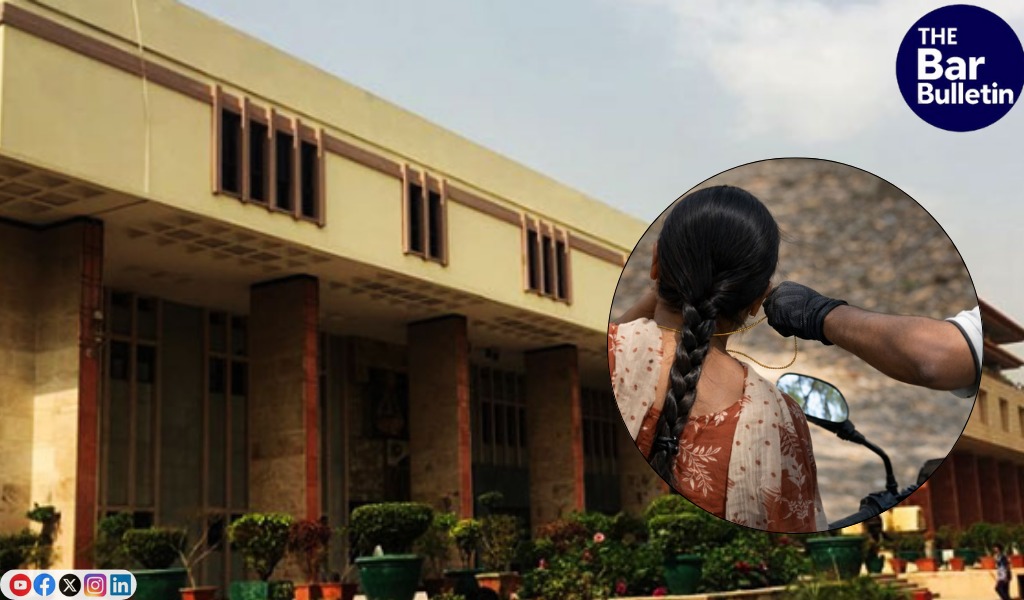

In an appeal filed before the Delhi High Court under Section 378(3) of the Criminal Procedure Code, 1973, against a judgment of acquittal dated 29-11-2014 by Additional Sessions Judge, Karkardooma Courts, a Single Judge Bench of Justice Manoj Kumar Ohri upheld the acquittal of the respondent and dismissed the appeal while holding that an appellate court must be slow to interfere against acquittal unless the findings of the Trial Court are perverse.
On 30-09-2011, the complainant was going for a walk when the respondent came, pointed a knife at his neck, and snatched his gold chain. Even though the respondent tried to flee, the complainant raised an alarm, and the public nearby caught the respondent and started beating him. The police officers patrolling nearby arrived at the spot and recovered a gold chain and a knife from the respondent. Thereafter, the respondent was arrested, and a First Information Report (FIR) was registered. Subsequently, charges were framed against the respondent under Sections 392/411 of the Indian Penal Code, 1860 (IPC).
The Trial Court observed that no public witnesses were included in the investigation, even though the prosecution’s case was that the public caught the respondent. It was found that the police did not make any sincere efforts to involve the public, and a ‘stock plea’ that they were asked to join the investigation, but none of them agreed, was put forward.
The Court noted that there were 2-3 shops near the incident spot and that the Investigating Officer agreed he did not inquire with the shopkeepers of those shops. It was stated that the shopkeepers could have helped prove the prosecution’s case beyond doubt. The IO had also failed to prove an explanation regarding said failure.
The Court noted that there was nothing on record to show that a notice had been served upon the public, who apparently refused to join the proceedings. It was said that since no one from the public joined the investigation, even though the proceedings went on for quite some time, a doubt was cast on the veracity of the case.
It was noted that the complainant stated the chain lock broke during the incident, but the seizure memo did not include this detail. The Court also noted other inconsistencies in the complainant’s deposition and stated that the versions put forth by the complainant were mutually inconsistent.
The Court stated that the quality of the investigation weakened the case and that there were also discrepancies regarding the place and time of the respondent’s arrest. It was said that the identification of the weapon was also doubtful since the complainant could not identify the knife when it was produced in Court.
The Court opined that the prosecution had failed to establish the guilt of the respondent and that the view taken by the Trial Court was plausible, well-reasoned, and supported by evidence. Further, the Court stated that an appellate court must be slow to interfere in an appeal against acquittal unless the Trial Court’s findings are perverse. Thus, the Court upheld the respondent’s acquittal under Sections 392/411 of the IPC and dismissed the appeal.
Appearances:
For Appellant – Mr. Pradeep Gahalot, APP
For Respondent – Mr. RPS Bhatti
