


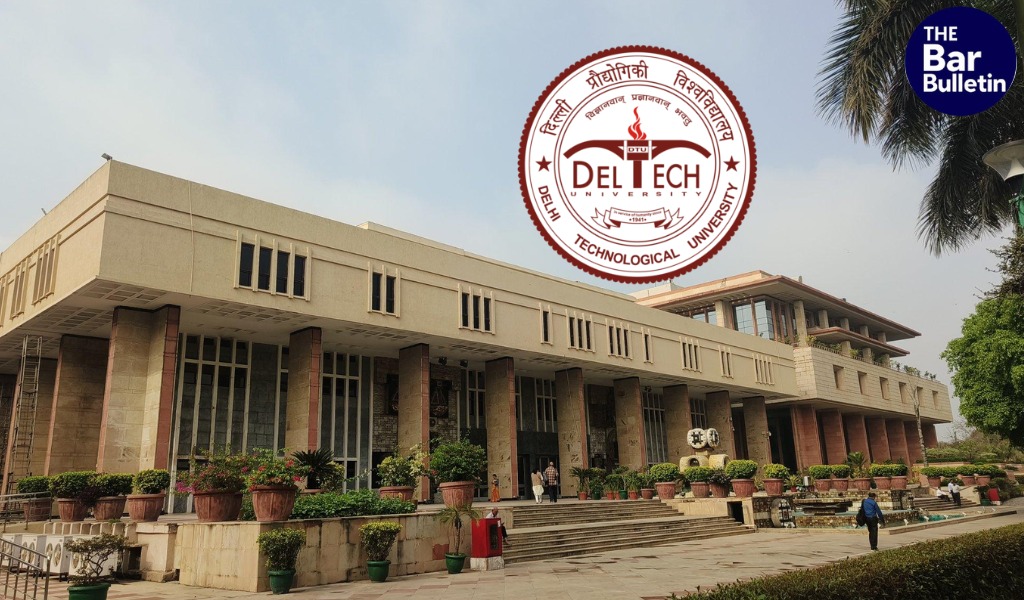

In a writ petition before the Delhi High Court by a contractual employee of the Delhi Technological University (University) seeking to convert a long-standing contractual agreement into a right to absorption and to halt a recruitment process that was open to the public at large, a Single Judge Bench of Justice Sanjeev Narula held that the petition did not warrant exercise of the Court’s jurisdiction under Article 226 of the Constitution and dismissed the same for being devoid of merit.
The petitioner was engaged by the University as a Junior Office Assistant under an appointment memorandum dated 26-05-2014. The engagement was contractual and the initial tenure was limited, subject to extension depending upon administrative requirements. The contractual engagement was extended from time to time through successive officer orders and hence, the petitioner continued with the University for several years.
On 06-11-2025, the University issued an advertisement inviting applications to fill several posts, including Junior Office Assistant, through a fresh selection process. Apprehending that his contractual agreement would be terminated, the petitioner submitted a representation requesting the regularisation or continuation of his services, which was rejected by the University by an order dated 19-12-2025. Aggrieved, the petitioner sought quashing of the said order, a direction for regularisation, and the quashing of the said advertisement.
The petitioner contended that over time, he had been treated as regular workforce and been given extended EPF along with other service-related benefits that are ordinarily provided to regular staff, which demonstrated that the engagement was not project-based, but integrated into the institutional framework. The petition was opposed by the University by contending that the engagement arose from an individual application addressed to the Vice Chancellor and that the terms of appointment clarified that the engagement would not confer any right to claim extension, absorption, or regular appointment.
The Court referred to Secretary, State of Karnataka & Ors. v. Umadevi & Ors. (2006) 4 SCC 1, and stated that it highlighted that regularisation cannot be permitted to become a parallel avenue of entry into public service. It was said that Articles 14 and 16 required public posts to be filled through a recruitment process that is open, fair, and competitive, so that all eligible candidates have an equal opportunity to be considered.
The Court stated that jurisprudence draws a critical distinction between appointments that are ‘illegal’ in the sense discussed in Umadevi (supra) and appointments that are ‘irregular’, where the route of entry was broadly transparent and public-facing, but suffered from procedural imperfections.
Further, the Court noted that the record did not demonstrate that the petitioner entered service after any public advertisement or through any open selection process conducted by the University. It was found that the engagement traced backed to an individual request made to the Vice-Chancellor. The Court said that where the entry into service itself is not preceded by any open invitation of applications, the courts cannot convert such engagement into permanent public employment by directing regularisation.
The Court held that an engagement that begins without any public recruitment process cannot be brought within the exception of an ‘irregular appointment’ without diluting the discipline insisted on by Umadevi (supra). It was said that prolonged continuation may reflect administrative necessity or institutional convenience, but it does not metamorphose an engagement made outside the constitutional scheme into a lawful appointment capable of being regularised through judicial direction.
Regarding challenge to the advertisement by the University, the Court stated that the decision to fill regular posts through a public recruitment process is not a wrong to be restrained, but what is required by Articles 14 and 15. It was said that the courts must be slow to impede such recruitment merely because a contractual employee presently occupies the post, since such restraint would convert a contractual arrangement into a route of entry into public service, which is impermissible by law.
Thus, the petition was dismissed by the Court for being devoid of merit.
Appearances:
For Petitioner – Mr. Puneet Rathi, Mr. Shahrukh Qureshi
For Respondent – Mrs. Avnish Ahlawat (SC), Mr. N.K. Singh, Ms. Aliza Alam, Mr. Mohnish Sehrawat
