


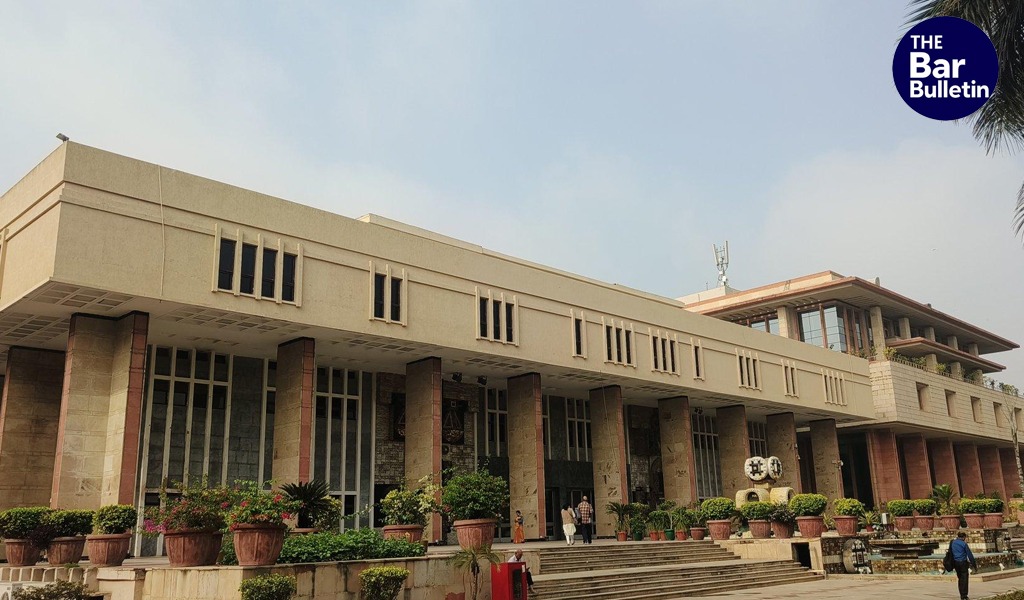

In an intra-court appeal filed before the Delhi High Court to seek an exception to an order dated 30-10-2023 passed by the Single Judge whereby a writ petition instituted by the appellant was dismissed, a Division Bench of Chief Justice Devendra Kumar Upadhyaya and Justice Tejas Karia found no force in the appeal and dismissed the same while mentioning that the appellant could take recourse to appropriate civil or criminal action or by approaching the authority concerned.
The appellant was an advocate enrolled with the Bar Council. She had been a regular practitioner since 2000 and had represented government agencies, in addition to serving on the senior panel of various authorities. The appellant had filed the writ petition with a prayer to direct the respondents to remove the lock and hand over possession of Chamber No. 279A at Patiala House Courts to her. She had also prayed for directions to the Bar Council of Delhi to act against advocates who had engaged in illegal and criminal activities by trespassing on the chamber in question.
It was asserted that in 2013, the appellant was approached by a person who told her that he was an allottee of the said chamber and asked her to rent the same, to which she agreed. One day, upon returning from Tis Hazari Court, she found that the said allottee, along with ten other persons, had occupied the chamber after breaking the lock.
The appellant also stated that even the office bearers of the New Delhi Bar Association (NDBA) had threatened to have her vacate the chamber instead of helping her, and a lock was also placed on the chamber. The case files of various government departments became inaccessible to the appellant, which adversely affected her profession.
After the police refused to come to her aid, the appellant filed a representation with NDBA requesting the removal of the lock, but she received no reply. On 06-03-2023, the appellant received a call informing her that her files and other belongings had been thrown out and were lying on the street.
Thereafter, the Single Judge directed the District Judge In-Charge of Patiala House Court to access the chamber and enable the appellant to remove her belongings before putting a lock thereon. During the proceedings, the District Judge filed a report stating that the appellant’s belongings had been removed, and hence, the Single Judge directed that the keys of the chamber be handed over to the allottee who wished to use the same along with his associates.
It was also observed in the impugned order that the appellant was put in permissive possession of the chamber and that, in the absence of any right, the writ petitioner filed by her was not maintainable. The Single Judge dismissed the writ petition, stating that the allottee would be bound by the undertaking given before the Court, which restrained him from subletting the chamber.
Considering the prayer ‘B’ made by the appellant, the Court opined that the petition was not maintainable since a direction was sought to the NDBA, which is not a public body, so as to be covered under Article 12 of the Constitution of India. It was said that a Bar Association does not perform any public function and is a purely private entity, which cannot be termed as ‘State’ or its instrumentality.
Thus, the Court held that ‘mandamus’ could not be issued to NDBA in exercise of its jurisdiction under Article 226. It was stated that the appellant could take appropriate steps by instituting criminal proceedings to put the criminal law machinery in motion. Further, the Court said that a person approaching the Court must first approach the authorities and, only upon their failure, file a petition seeking a writ of mandamus.
The Court noted that the appellant had neither represented her cause to the Bar Council of Delhi nor was the Bar impleaded as a party before the Single Judge. Hence, the Court agreed with the order of the Single Judge dismissing the writ petition as not maintainable.
Thus, the petition was dismissed.
Appearances:
For Appellant – Mr. Shishir Pinaki, Mr. Rakesh Singh, Mr. Shavnam Singh
For Respondent – Mr. Ashish Garg, Mr. Govind Singh
