


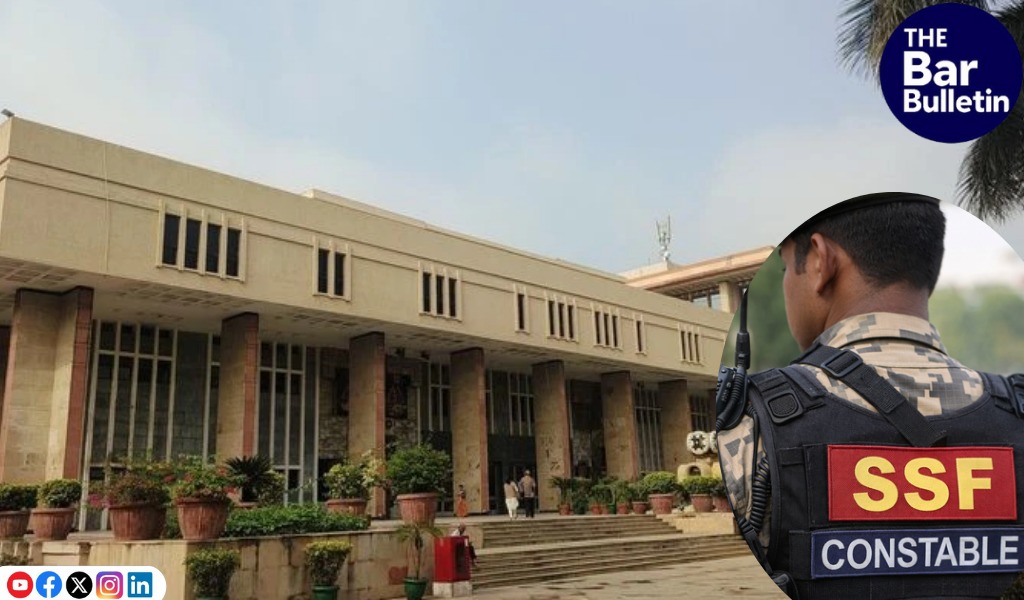

The Delhi High Court has dismissed a writ petition by affirming the impugned order of the Central Administrative Tribunal Principal Bench, New Delhi (hereinafter referred to as the ‘Tribunal’), which has set aside the proceedings and major penalty imposed on Om Prakash Verma, a Constable in the Secretariat Security Force (SSF). The Court held that the departmental inquiry was conducted in clear violation of mandatory safeguards under Rule 14 of the CCS (CCA) Rules, 1965, rendering the entire disciplinary action unsustainable.
The dispute arose after the respondent, who was deputed as a Junior Reception Officer (JRO) in the Secretariat Security Organisation, was repatriated to his parent cadre upon expiry of his deputation on April 4, 2018. The respondent failed to report back immediately and remained absent on several dates, citing illness and submitting medical certificates belatedly. Alleging unauthorised absence, misuse of biometric attendance and disobedience of lawful orders, the Disciplinary Authority initiated proceedings under Rule 14 of the CCS (CCA) Rules by memorandum dated August 8, 2018. Following an inquiry, a major penalty of reduction to two lower stages in pay till retirement with cumulative effect was imposed by order dated June 19, 2019, which was upheld in appeal and review.
The Division Bench comprising Justice Navin Chawla and Justice Madhu Jain concurred with the Tribunal. The Court observed that conducting substantive stages of the inquiry in the absence of the Presenting Officer, failure to question the delinquent on material circumstances, and absence of a reasoned assessment of evidence vitiated the inquiry. Relying on Supreme Court precedents, including State of U.P. v. Saroj Kumar Sinha, (2010) 2 SCC 772, and Roop Singh Negi v. Punjab National Bank (2009) 2 SCC 570, the Court reiterated that a departmental inquiry is a quasi-judicial process and must strictly adhere to principles of natural justice.
Holding that judicial review is warranted where the decision-making process itself is fundamentally flawed, the High Court upheld the CAT’s order, dismissed the writ petition, and directed the authorities to grant all consequential benefits within eight weeks. There was no order as to costs.
Appearances:
For the Petitioners – CGSC Shashank Dixit with Advocate Kunal Raj.
