


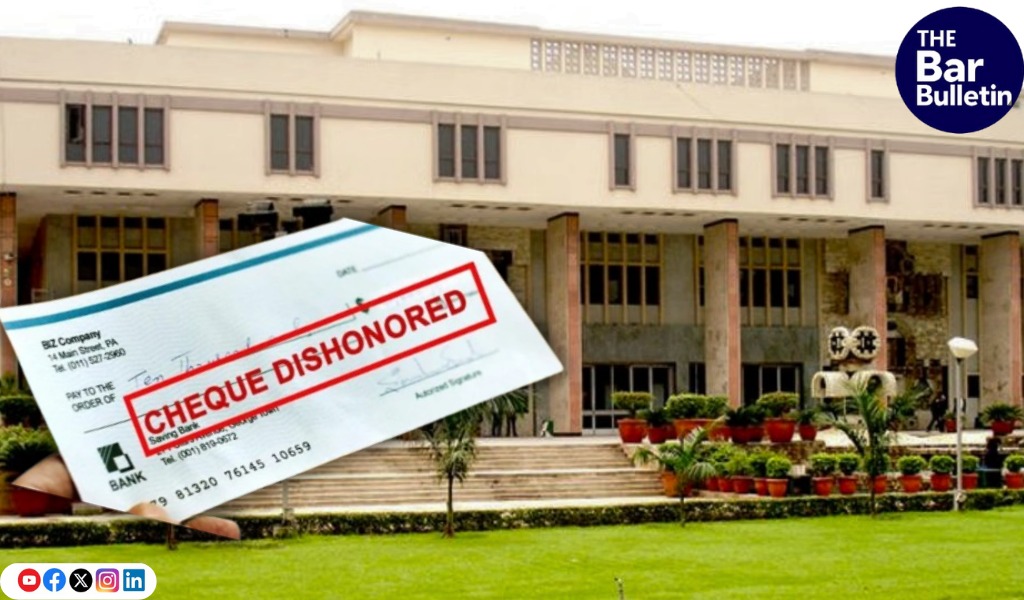

The Delhi High Court has refused to quash multiple criminal complaints filed under Sections 138 and 141 of the Negotiable Instruments Act, 1881, against Dinesh Kumar Pandey, a former director and signatory of cheques issued by borrower companies, holding that his plea of resignation prior to dishonour raises disputed questions of fact which cannot be adjudicated at the quashing stage.
Justice Sanjeev Narula, exercising jurisdiction under Section 528 of the Bharatiya Nagarik Suraksha Sanhita, 2023, held that the complaints disclosed the basic ingredients of offences under the NI Act and that the petitioner had failed to place unimpeachable material on record to warrant interference at the threshold.
The complaints were instituted by M/s Singh Finlease Pvt. Ltd., a non-banking financial company, in relation to loan facilities extended to two private limited companies. The cheques issued towards repayment were dishonoured in March 2024 due to insufficiency of funds, following which statutory notices were issued and criminal proceedings initiated. Petitioner, who had been a director at the time of sanction of loans and execution of documents and was also a signatory to the cheques, was arrayed as an accused.
The petitioner contended that he had resigned from the boards of the borrower companies prior to the dishonour of the cheques and could not be held vicariously liable under Section 141 of the NI Act. He relied on Form DIR-12 filings and extracts from the Ministry of Corporate Affairs portal to claim that his resignations were duly recorded and effective before the offence was complete.
Rejecting the plea, the Court held that for the purpose of Section 141, liability is not confined to the date of dishonour alone, as the offence under Section 138 is a composite one involving several stages. The Court noted that the petitioner’s resignations closely followed the onset of defaults and their timing and bona fides were disputed by the complainant. It further observed that the petitioner was an admitted signatory to the cheques and had actively participated in negotiating the loan facilities and executing related documentation.
The Court reiterated that while quashing may be permissible where unimpeachable and incontrovertible material clearly establishes a lack of responsibility at the relevant time, the present case did not fall within that narrow exception. Holding that the statutory presumptions under Sections 118 and 139 of the NI Act operated in favour of the complainant, the Court dismissed the petitions.
Accordingly, the High Court declined to interfere with the summoning orders and directed that the criminal proceedings against the petitioner shall continue in accordance with law, and the petitioner’s defence would have to be tested at trial.
Appearances
Petitioner- Mr. Atul Jain, Mr. Deepanshu Raheja & Mr. Binay Kumar Joshi, Advs. with petitioner in person.
Respondents- Mr. Sanjay Lao, Standing Counsel (Crl.) with Ms. Priyam Agarwal, Mr. Abhinav Kumar Arya & Mr. Aryan Sachdeva, Advs. with Insp. Ashwani Kumar, SHO/M.S. Park.
