


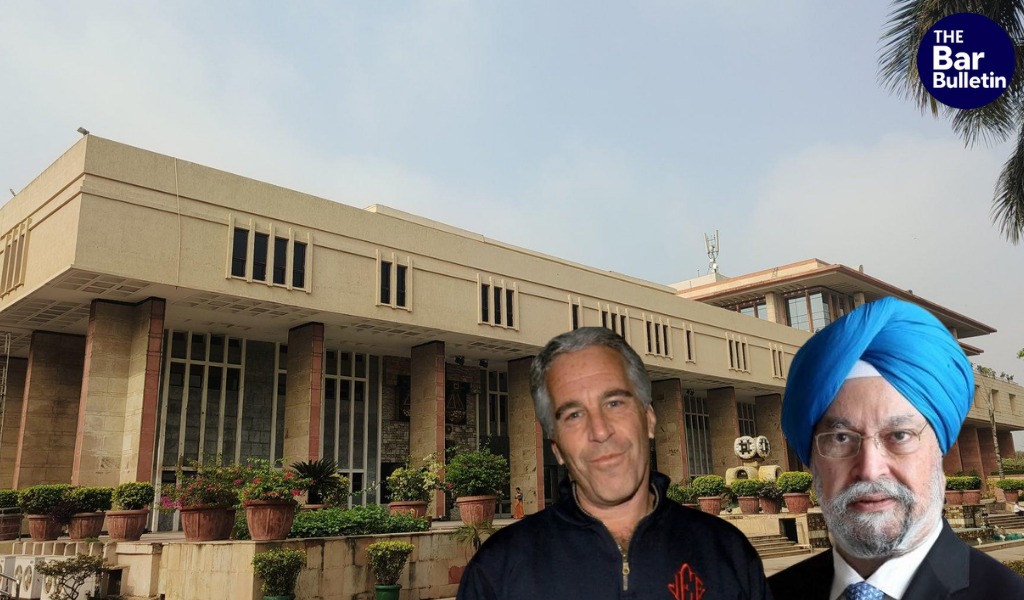

The Delhi High Court today granted interim relief in a defamation suit filed by the daughter of Union Minister Hardeep Singh Puri, seeking the removal of online content linking her to allegations associated with Jeffrey Epstein. The Court directed the takedown of allegedly defamatory videos, tweets and online material, while restraining defendants from further publishing or circulating similar content, while clarifying that the takedown order will operate within the Indian domain only.
“A prima facie case has been made out… The balance of convenience is in favour of the plaintiff and irreparable injury shall be caused if defendants are not restr ained.”
The Court was dealing with a dispute involving online videos, tweets and digital content, where the plaintiff sought both removal of existing material and a global blocking order against intermediaries and content creators. At the outset, the Court issued summons in the suit and recorded that certain defendants had already voluntarily removed the content.
“Learned counsel appearing for defendant number 11 submits that upon a telephone conversation, the defendant has already removed the content even before filing of the present case…Likewise, learned counsel appearing for defendant number 2 submits that the defendant has also removed the entire content from their Twitter account.”
Journalistic Freedom vs Defamation
During the hearing, one of the defendants argued that the content constituted fair journalism, based on questions raised from publicly available material.
“The video… is in the nature of journalistic freedom and only questions have been asked… Fair journalism has to be permitted.”
However, the plaintiff countered that journalism cannot be a shield for unverified allegations.
“No doubt fair journalism has to be permitted, but journalism cannot be sterilised in any manner.”
The Court observed that the matter required consideration and proceeded to grant interim protection.
During the hearing, a key issue that emerged was the balance between journalistic freedom and protection of reputation. Counsel for one of the defendants contended that the impugned videos were part of legitimate journalistic inquiry, merely raising questions based on material already available in the public domain, including a tweet by another defendant.
It was argued that journalists are entitled to question, investigate and report on matters of public interest, especially where public figures are involved, and that such content cannot automatically be treated as defamatory.
However, senior counsel for the plaintiff opposed this line of argument, submitting that unverified allegations cannot be repackaged as journalism to escape liability.
Without making a final determination on the issue, the Court observed that the matter required deeper examination at trial, particularly on:
• whether the content crossed the line from inquiry to imputation,
• the extent of verification undertaken, and
• the impact on the plaintiff’s reputation.
Interim Injunction Granted
The Court held that a prima facie case was made out and that irreparable harm would be caused if the content continued to circulate. Accordingly, the Court restrained defendants from:
• publishing or disseminating the impugned content, and
• directed removal of specified URLs within 24 hours.
The Court further directed intermediaries (social media platforms) to take down the content if the original uploaders fail to comply. The Court also permitted the plaintiff to notify additional identical content for removal.
Global Takedown Issue Deferred
A key issue before the Court was whether it could pass a global takedown order. The plaintiff relied on precedent to argue that such orders are permissible, especially where the content originates from India. However, intermediaries opposed this, stating that the issue is pending before a Division Bench and has wider implications. The Court declined to grant a global injunction at this stage and restricted the operation of its order.
“The present injunction order operates within the Indian domain.”
For content uploaded from outside India, the Court directed geo-blocking within India rather than global removal. The Court directed defendants to file replies within four weeks and listed the matter for further consideration before the Joint Registrar on May 7, 2026 and before the Court on August 7, 2026.
Appearances:
Ms. Puri was represented by Senior Advocate Mahesh Jethmalani , Senior Advocate Mohit Mathur , Senior Advocate Pramod Kumar Dubey and Senior Advocate Sunil Dalal with Advocate Mr. Saurabh Agarwal , Mr. Ravi Sharma , Mr. Shantanu Aggarwal , Ms. Madhulika Rai Sharma , Mr. Manas Arora and Ms. Prachi Dubey
Meta represented by Senior Advocate Arvind Datar