


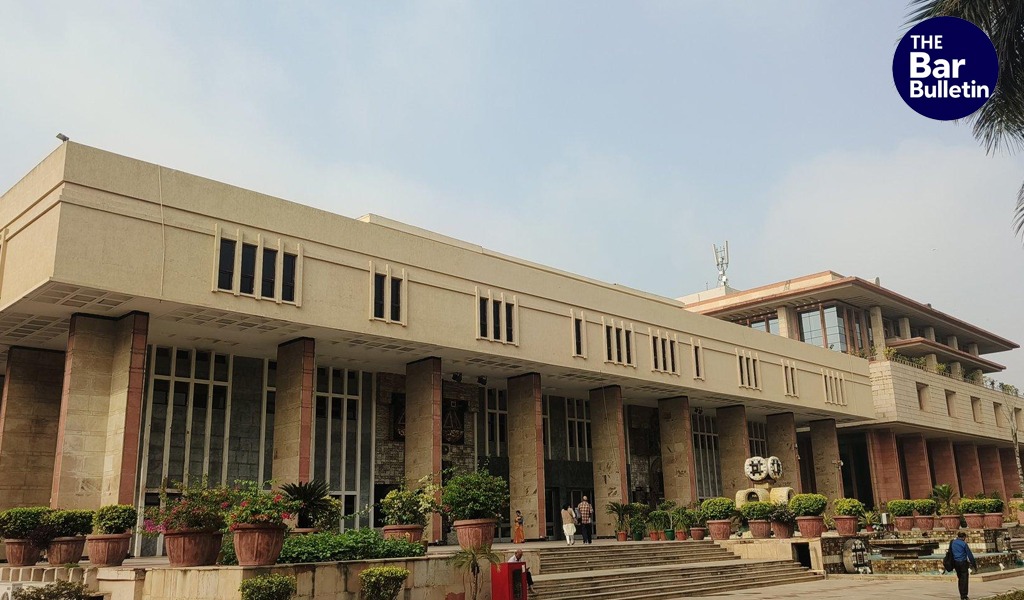

The High Court of Delhi has dismissed the appeal and upheld the arbitral award as well as the judgment of the Single Judge, observing that once the appellant had executed discharge vouchers accepting the amount in full and final settlement without protest, the claim stood discharged by accord and satisfaction and was not arbitrable, and no case of coercion or economic duress was established.
The case arose from a fire incident on February 13, 2013, at the appellant’s premises, which was insured under a policy issued by the respondent. The appellant claimed Rs. 270,830,874.13 towards loss, whereas the surveyor appointed by the respondent assessed the loss to be Rs. 121,821,908, which was paid. The appellant, after accepting the surveyed amount, invoked arbitration to claim the balance amount.
Before the Arbitral Tribunal, the respondent submitted that the appellant had executed discharge vouchers dated March 30, 2014, and July 2, 2014, accepting the amount in full and final settlement, thereby extinguishing further claims. On the other hand, the appellant, while not disputing execution, alleged that the vouchers were signed under financial distress and coercion due to non-release of funds.
The Arbitral Tribunal held that the execution of discharge vouchers and acceptance of payment without protest amounted to accord and satisfaction and rejected the plea of coercion, passing a nil award. Further, upholding the award, the single judge noted that the appellant had accepted the surveyor’s assessment and had not objected at the relevant time, and that the finding on the absence of coercion was a question of fact not warranting interference.
Aggrieved by the award, the appellant approached this court and submitted that the discharge vouchers were obtained under economic duress and financial distress and therefore could not be treated as voluntary. It was further submitted that the appellant had no option but to accept the amount due to delay in settlement and pressing financial circumstances. Per contra, the respondent submitted that the vouchers were executed voluntarily. Further, the appellant had accepted the surveyor’s assessment in full and final settlement, and there was no material on record to establish coercion or undue influence.
Hearing the submission of both sides, the bench of Justice C. Hari Shankar and Justice Om Prakash Shukla noted that the plea of coercion was not supported by any evidence and mere financial distress would not amount to coercion in law. The bench also observed that the appellant had accepted the assessed amount without demur, which indicated voluntary acceptance. The Court further held that the finding of the Arbitral Tribunal on the absence of coercion was a finding of fact based on the appreciation of evidence and could not be interfered with in a petition under Section 34 of the Arbitration and Conciliation Act, 1996 or in an appeal, in the absence of perversity or patent illegality.
Relying on the principle that execution of discharge vouchers in full and final settlement results in accord and satisfaction, the court held that no arbitrable dispute survived between the parties and accordingly dismissed the appeal.
Appearances:
For Appellant- Senior Advocate Sudhir Nandrajog, with Advocate Bhaskar Tiwari, Advocate Ramakant Shukla and Advocate Priscilla Kom.
For Respondents- Advocate Saurav Agrawal, Advocate Rajat Dasgupta, Advocate Sidhika Dwivedi, Advocate Anadi Mishra, Advocate Raadhika Chawla and Advocate Tushar Nair.
