


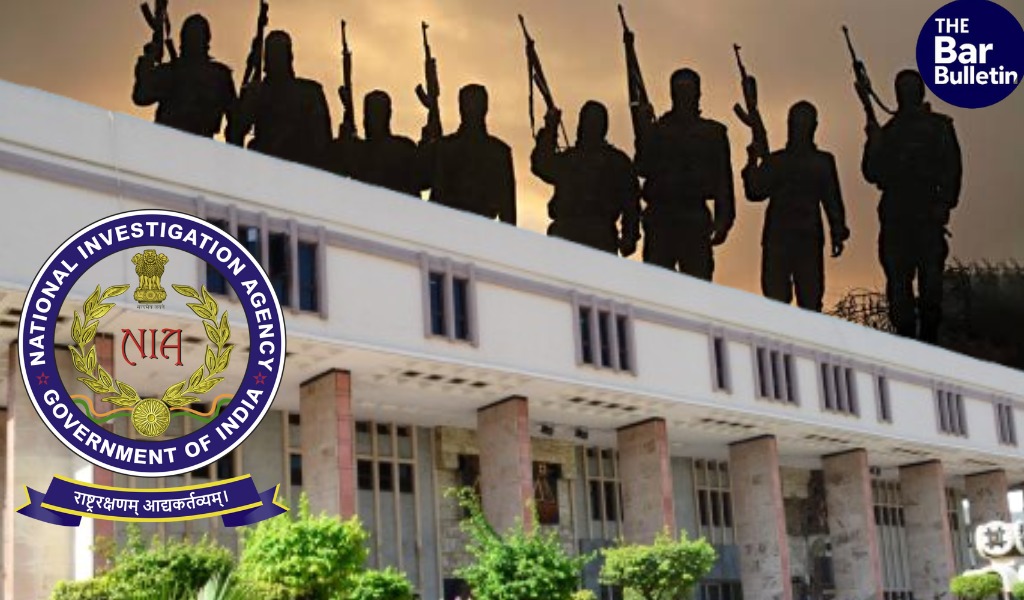

The Delhi High Court has dismissed a batch of criminal appeals filed by several Kashmiri separatist leaders and co-accused challenging orders framing charges in the National Investigation Agency’s 2017 Kashmir terror-funding case, holding that appeals against charge-framing orders are not maintainable under Section 21 of the National Investigation Agency Act, 2008.
A Division Bench of Justice Vivek Chaudhary and Justice Manoj Jain, while deciding multiple connected appeals, upheld the preliminary objection raised by the NIA on maintainability and declined to examine the merits of the challenge.
The appellants had relied on Supreme Court jurisprudence to argue that an order framing charge is not an interlocutory order but an “intermediate order” and therefore appealable. Rejecting this contention, the High Court drew a clear distinction between the revisional jurisdiction under the Code of Criminal Procedure and the statutory appellate framework under the NIA Act.
The Bench held that while the concept of an “intermediate order” may be relevant in the context of criminal revision, Section 21 of the NIA Act permits appeals only against final orders, such as judgments or sentences, and not against interlocutory or charge-framing orders. The Court emphasised that the NIA Act constitutes a special statutory regime aimed at expeditious investigation and trial of offences affecting national security, and therefore consciously restricts appellate intervention at interim stages.
The Court further observed that allowing appeals at the stage of framing charges would defeat the legislative object of the Act. It noted that while Section 21(4) expressly provides a right of appeal against bail orders, no similar statutory right exists against orders framing charges, indicating legislative intent.
Clarifying that accused persons are not left without remedy, the Bench noted that challenges to charge-framing orders, in exceptional cases, may still be raised by invoking the inherent jurisdiction of the High Court under Section 482 of the CrPC (now Section 528 of the Bharatiya Nagarik Suraksha Sanhita, 2023), but not through an appeal under the NIA Act.
In view of the above, the High Court dismissed all the appeals on the ground of maintainability, without expressing any opinion on the sufficiency or admissibility of the evidence relied upon by the NIA.
Appearances:
Shahid Yousof v. NIA
For the Appellant: Mr. Nitai Hinduja, Ms. Aditi Sarswat & Mr. Jawahar Raja, Advs.
For the Respondent: Mr. Akshai Malik SPP, NIA with Mr. Khawar Saleem, Advs.
Syed Ahmad Shakeel v. NIA
For the Appellant: Mr. Nitai Hinduja, Ms. Aditi Sarswat & Mr. Jawahar Raja, Advs.
For the Respondent: Mr. Akshai Malik SPP, NIA with Mr. Khawar Saleem, Advs
Masarat Alam Bhat v. NIA
For the Appellant: Ms. Nitya Ramakrishnan, Sr. Adv. Ms. Warisha Farasat, Ms. Suvarna Swain, Ms. Stuti Rai & Ms. Rupali Samuel, Advs.
For the Respondent: Mr. Sidharth Luthra, Sr. Adv. with Mr. Akshai Malik (SPP) with Mr. Ayush Agarwal & Mr. Khawar Saleem, Advs. Mr. B. B. Pathak, DSP, NIA.
