


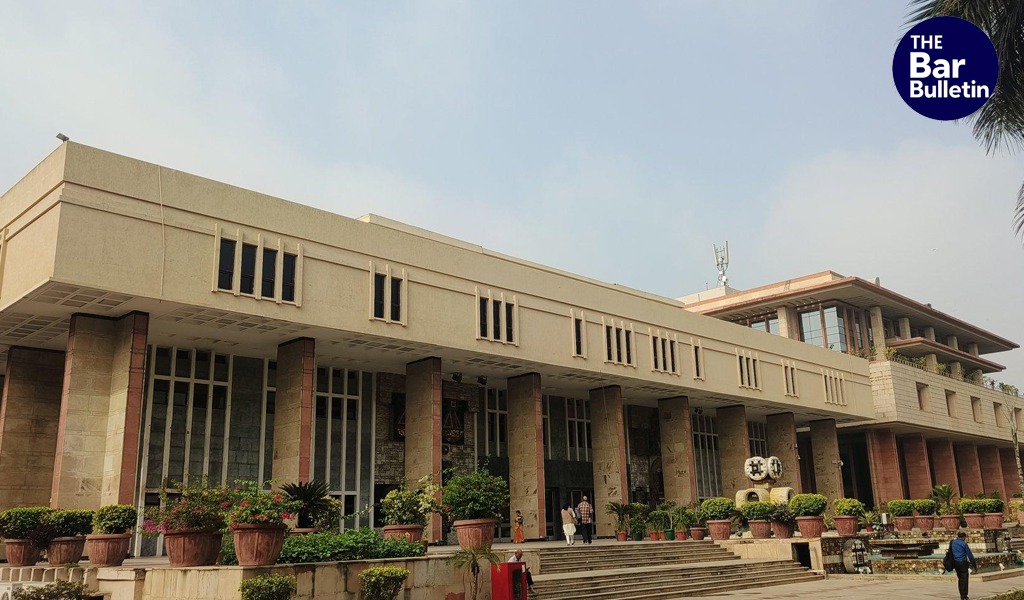

The Delhi High Court has ruled that the Election Commission of India (ECI) does not have the authority to decide any internal rival claims with respect to any unrecognised political party. The Court highlighted that the ECI will not recognise any rival faction of a registered, unrecognised party in case of internal disputes, as it is not for the ECI to resolve these disputes. Such inter se disputes between a registered and unrecognised party would have to be resolved in a civil suit.
The Court clarified that in case, the ECI takes any decision on the issue of rival claims raised by different factions of an unrecognized political party, such decision would be beyond the power/jurisdiction of the ECI as the ECI is not vested with the power/jurisdiction to entertain or adjudicate claims of rival sections or groups of unrecognised political parties, each of whom claims to be that party.
A Single Judge Bench of Justice Mini Pushkarna observed that while Clause 15 of the Election Symbols (Reservation & Allotment) Order, 1968, empowers ECI to decide disputes between rival sections or groups of a “recognised political party” each of whom claims to be that party, there is no corresponding provision that empowers ECI to decide disputes between rival sections or groups of a “unrecognized political party”, like the petitioner herein.
The Bench also reiterated that Section 29A(9) of the Representation of the People Act, 1951 (RP Act), only obliges a political party to inform the ECI of any changes in the registration details, so that a correction can be made by the ECI in its record, and communications can be addressed accurately. However, there is no specific duty imposed upon the ECI to give any finding concerning the internal affairs of a political party.
Any information that is provided to the ECI in terms of Section 29A(9) of the RP Act is only for the purposes of providing the information to the ECI with respect to any change in the name, head office, office bearers, address, etc. of a registered political party, and the ECI receives such information so that the record of the ECI with respect to a registered political party is updated, added the Bench.
However, the Bench cautioned that the ECI does not verify or examine the veracity of such information that may be provided to the ECI. Further, no faction or any person can claim any special equity based on any such information that may be in the record of the ECI, when there are internal disputes within the unrecognised registered political party with regard to any issue.
Briefly, the petitioner, a registered unrecognised political party, which was founded by Dr S. Ramadoss in 1989, had elected Dr R. Anbumani as the President of the party for a period of three years, and such election & appointment were duly informed to the respondent-ECI, in terms of the requirements of Section 29A(9) of the RP Act. Thereafter, Dr S. Ramadoss took charge as President of the party, and the ECI was informed about the said change in the post holder of the President.
Subsequently, the Disciplinary Action Committee of the petitioner party issued a Report alleging an unauthorised “anti-party” conduct and actions of Dr R. Anbumani, and based upon recommendations of the Disciplinary Action Committee, a public announcement was issued by Dr S. Ramadoss, removing Dr R. Anbumani from the post of Acting President and from the basic membership of the petitioner party, with immediate effect.
The ECI, however, held that the term of the office bearers of the petitioner party is valid up to August 01, 2026, and that Dr R. Anbumani is the President of the petitioner party.
Appearances:
Senior Advocate Balbir Singh, along with Advocates M.P. Devnath, Abhishek Anand, Rahul Kumar, Dr K. Arul, Charu Trivedi, and Hridyanand Ojha, for the Petitioner
Senior Advocates Sidhant Kumar, Shagun Chopra, Saurabh Kirpal, Rajshekhar Rao, along with Advocates Tushar Gupta, Nitya Gupta, S. Balu, Karuna Karan, Vinoba Boopathi, Aditi Gupta, Lakhvinder Singh, Junaid Aamir, and Aaliya Waziri, for the Respondent
