


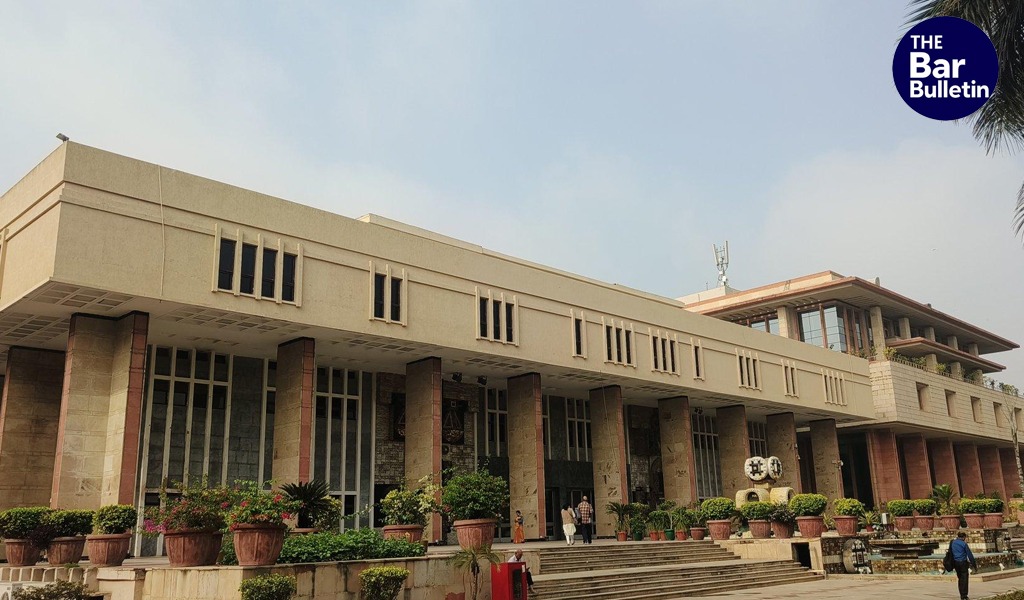

The Delhi High Court has asserted that the litigant, being dominus litis, is entitled to approach the jurisdiction of his choice, where cause of action arises in two or more jurisdictions, however, it is upon the Court’s discretion to exercise such jurisdiction, while keeping in mind whether it constitutes an appropriate and convenient forum for adjudication or not.
Applying the doctrine of forum conveniens to determine if it is the most appropriate and convenient forum for the adjudication of the dispute, considering the factual matrix of the case, the Court clarified that a mere fact that an order is passed by an authority located within a court’s jurisdiction does not obligate the court to entertain the writ petition, especially when the substantial cause of action and the convenience of the parties point to a different forum.
The Division Bench of Justice Vivek Chaudhary and Justice Manoj Jain found that both the petitioner and the State Authority, on whose report the criminal cases and impugned proceedings were initiated, are situated in the State of West Bengal.
Thus, the Bench opined that the criminal cases forming the predicate offences for issuance of the Detention Order are pending within the territorial jurisdiction of the High Court of Calcutta, and the relevant records pertaining to the petitioner, his alleged criminal antecedents, and the said cases are also located in West Bengal.
Since the petitioner has failed to disclose any cogent reason justifying invocation of the jurisdiction of this Court, the High Court refused to exercise its discretionary extraordinary jurisdiction, applying the doctrine of forum conveniens, and disposes of the present petition with liberty to the petitioner to approach the appropriate Court/forum.
The Bench observed that Clause (2) of Article 226 is an enabling provision that supplements Clause (1). While it allows a High Court to issue writs even if the seat of the Government or authority is outside its territory, it does not mean the constitutional mandate of Article 226(1) can be completely neglected.
The Bench also noted that even if a small part of the cause of action arises within a High Court’s territorial jurisdiction, this is not a determinative factor compelling the court to decide the matter on merits. Accordingly, it concluded that a litigant, being dominus litis, can choose a jurisdiction where a cause of action arises, but the Court retains the discretion to exercise such jurisdiction based on whether it is an appropriate and convenient forum for adjudication.
Briefly, the petitioner, a resident of West Bengal, was arrested in 2024 in connection with three separate criminal cases under the Narcotic Drugs and Psychotropic Substances Act, 1988. To prevent further illicit trafficking, proceedings were initiated under the Prevention of Illicit Traffic in Narcotics Drugs and Psychotropic Substances Act, 1988 (PITNDPS), which resulted in the Detention Order being passed by the Joint Secretary, Department of Revenue, Ministry of Finance, in Delhi.
The petitioner was subsequently detained at Central Jail, Jaipur, Rajasthan. The Central Government also confirmed the detention for a period of one year, following a report from the State Advisory Board (PITNDPS), Rajasthan. The petitioner, through his wife, therefore, sought quashing of detention order.
Appearances:
Advocates Kaustub Narendran, Rohan Naik, Aayush Mitruka, Lisa Mishra, Vipulaaksh Moondra, Arudhra Rao, and Marmik Shah, for the Petitioner
CGSC Abhishek Gupta and Advocate Kumar Kartikya, for the Respondent
