


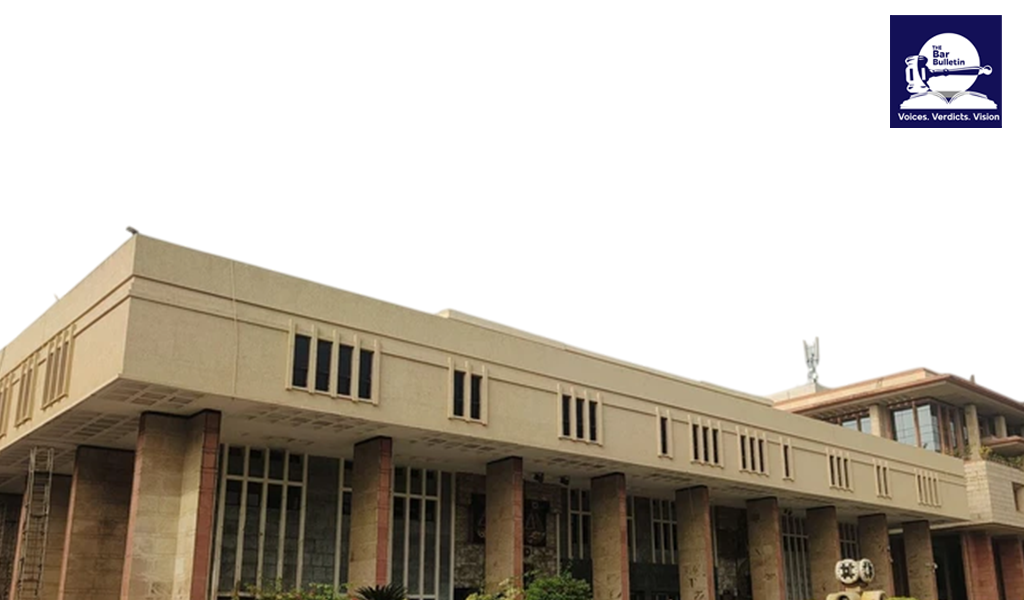

The Delhi High Court clarified that judicial intervention is permissible only in narrow and exceptional situations, such as when the Tribunal acts without jurisdiction, violates fundamental principles of natural justice, or when the statutory remedy is illusory or ineffective. Absent such exceptional circumstances, writ petitions challenging or seeking directions in relation to proceedings before bodies like the DRT or NCLT, especially in matters governed by the SARFAESI Act, the RDB Act, or the IBC, would generally not be maintainable.
The Court noted that the petitioner’s request for consolidation or joint adjudication of matters pending before different DRTs is misconceived, as both the RDB Act and the SARFAESI Act already contain specific mechanisms for transfer and consolidation of proceedings before the appropriate forum. Despite the availability of these statutory remedies, the petitioner failed to exhaust any of them and instead sought to obtain, through writ jurisdiction, relief that properly falls within the domain of the concerned Tribunals.
While explaining that the proceedings under the SARFAESI Act and the RDB Act, on one hand, and those under the IBC, on the other, operate under separate statutory schemes with distinct objectives and procedural frameworks, the Court observed that once the NCLT admits a matter under the IBC, a statutory moratorium comes into force, during which proceedings before other forums cannot continue. Therefore, the petitioner cannot attempt to bypass the statutory framework upon mere apprehension of conflicting findings or parallel adjudication.
The Court noted that the petitioner’s grievance is essentially that, while a co-guarantor has already been discharged by the DRT pursuant to a settlement with the respondent bank, his own interlocutory applications have wrongly remained pending. However, the Court clarified that this delay does not justify invoking the writ jurisdiction, particularly when no specific DRT order is under challenge.
Finding that the present petition does not challenge any specific order of the DRT, and instead, the petitioner merely seeks a direction for the expeditious disposal of the interlocutory applications pending before the concerned DRTs, preferably after consolidating them, through which he seeks discharge from his guarantor liability and release of the mortgaged property, the Court referred the present petition as an abuse of process of law.
The Division Bench comprising Justice Harish Vaiyanathan Shankar and Justice Anil Kshetarpal reiterated that bypassing effective statutory remedies, particularly under specialised frameworks such as the SARFAESI Act and the Recovery of Debts and Bankruptcy Act, undermines the legislative scheme and hampers the recovery process of banks and financial institutions. Reference was made to the decision in the case of Celir LLP vs. Bafna Motors (Mumbai) (P) Ltd. [(2023) SCC OnLine SC 1209].
Further, reference was also made to the decision in the case of PHR Invent Educational Society vs. UCO Bank [(2024) SCC OnLine SC 528], where the Supreme Court has reaffirmed that High Courts should ordinarily avoid entertaining writ petitions in matters arising under the SARFAESI Act, 2002 and the Recovery of Debts and Bankruptcy Act, 1993, since both statutes are comprehensive codes that provide effective alternative remedies.
Therefore, observing that the conduct of the respondent indicates a deliberate attempt at forum shopping, driven more by a fear of an adverse decision than by any genuine jurisdictional grievance, the Bench concluded that the petitioner’s conduct in first filing the present writ petition and then moving a frivolous application to transfer the matter from a duly assigned Division Bench to a Single Bench, constitutes a blatant abuse of the judicial process.
Refusing to tolerate such procedural impropriety and an improper attempt to influence the choice of forum, the Bench dismissed the petition and imposed a cost of Rs. 1 lac to be deposited in the Poor Patients’ Fund under the aegis of AIIMS, New Delhi, within two weeks.
Briefly, the petitioner is the erstwhile (suspended) Director of one M/s KMG A to Z Systems Pvt Ltd., which had availed of certain credit facilities from a consortium of banks led by the Respondent Punjab National Bank (PNB), being a participant lender. In connection with the said facilities, the petitioner executed a personal guarantee and further mortgaged his immovable property as collateral security. Upon default in repayment by the borrower company, the banks had initiated recovery proceedings before the DRT.
During the pendency of these recovery proceedings, the PNB, being the majority lender in the consortium, entered into a settlement with one of the co-guarantors, whereby the said co-guarantor was released from his personal guarantee and his mortgaged property was discharged for a consideration of Rs. 7.40 crores. Now, the petitioner alleged that the settlement was entered into unilaterally and without his consent, and that such selective discharge of one co-surety has the legal consequence of discharging or reducing his own liability as a co-guarantor, by operation of Sections 133, 134, 139 and 141 of the Indian Contract Act, 1872.
Thereafter, the petitioner approached the concerned DRTs seeking his discharge as a guarantor and release of the mortgaged property. During its pendency, the PNB instituted personal insolvency proceedings against the petitioner under Section 95 of the IBC. The petitioner challenged this, alleging that the insolvency proceeding is based on the same debt that forms the subject matter of the recovery actions before the DRTs. Contending that continuation of the insolvency proceedings before the NCLT, while his applications seeking discharge of the guarantee remain pending before the DRTs, would result in multiplicity of proceedings, the petitioner filed a writ seeking expeditious adjudication.
Appearances:
Advocates Dr Pankaj Garg, Yaksh Garg, and Yashna Ahuja, for the Petitioner
Advocates Saurabh Kushawaha and Rohit Arya, for the Respondent