


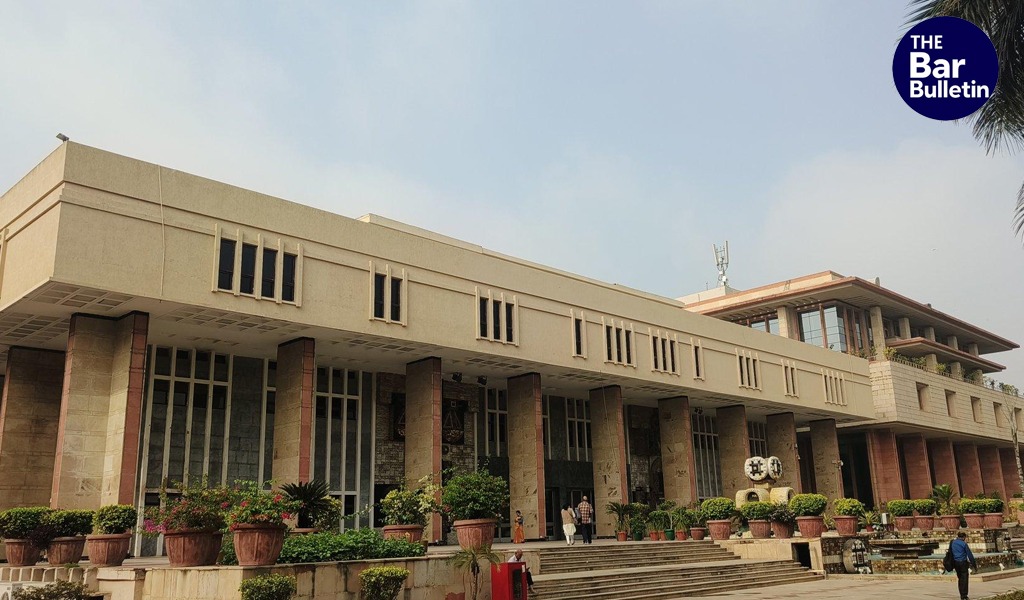

The Delhi High Court has clarified that a claim for pay parity under the principle of ‘Equal Pay for Equal Work’ cannot be sustained when there is a fundamental and admitted difference in the minimum educational qualifications required for the posts being compared. The Court held that educational qualification serves as a valid and rational basis for classification, and differential pay structures are permissible on this ground.
To successfully claim equal pay, the petitioners must establish a ‘wholesale identity’ with the compared cadre in terms of recruitment, qualifications, and responsibilities; and a mere similarity in designation or a broad overlap in job functions is insufficient, added the Court.
The Court held that in light of the admitted difference in educational qualifications for Laboratory Technicians employed by the Municipal Corporation of Delhi (MCD) hospitals and those under the Central Government, there was no merit in the petitioner’s claim for pay parity. The Court therefore upheld the orders passed by the Central Administrative Tribunal (CAT).
The Division Bench comprising Justice Anil Kshetarpal and Justice Amit Mahajan observed that the scope of judicial review in matters of pay fixation and parity is extremely limited, as determining pay scales is a complex exercise. It noted that the doctrine of ‘Equal Pay For Equal Work’ is not an abstract principle and cannot be claimed merely based on similar designations when there are material differences in educational qualifications, recruitment processes, or service conditions.
The Bench further observed that the admitted difference in minimum educational qualifications, i.e., Matriculation for MCD technicians versus a B.Sc. degree for Central Government technicians, constitutes an ‘intelligible differentia’ and is a valid ground for classification and different pay structures.
The Bench also noted that a mere administrative proposal to amend recruitment rules does not create an enforceable legal right until the rules are formally amended. Regarding the anomaly where a promotional post carries a lower pay scale than the feeder post, the Bench observed that while this requires correction, the appropriate forum for such issues is the Anomalies Committee, not the Court.
Briefly, the petitioners, an association representing Laboratory Technicians in Municipal Corporation of Delhi (MCD) hospitals, claimed entitlement to the pay scale of Rs. 5000-8000 with effect from January 1, 1996, based on the recommendations of the Fifth Central Pay Commission (5th CPC). The claim was premised on achieving parity with Laboratory Technicians working under the Central Government, including those in institutions like the National Institute of Communicable Diseases.
The matter was initially brought before the High Court in 2005 and was later transferred to the Central Administrative Tribunal (CAT), which dismissed the Original Application on November 21, 2018, and a subsequent Review Application on April 25, 2019. The petitioners challenged these dismissal orders.
Opposing this, the respondents (MCD) argued that Pay Commission recommendations are not automatically applicable to MCD employees unless specifically adopted and that there is a material difference in the educational qualifications required for the posts; MCD requires 10th Class/Matriculation, whereas the Central Government requires a Bachelor of Science (B.Sc.) degree for the same post.
Appearances:
Advocates Ramesh Rawat and Rohit Bhardwaj, for the Petitioner
CGSC Dr. Monika Arora, along with Advocates Subhrodeep Saha, Prabhat Kumar, Anamika Thakur, and Abhinav Verma, for the Respondent
