


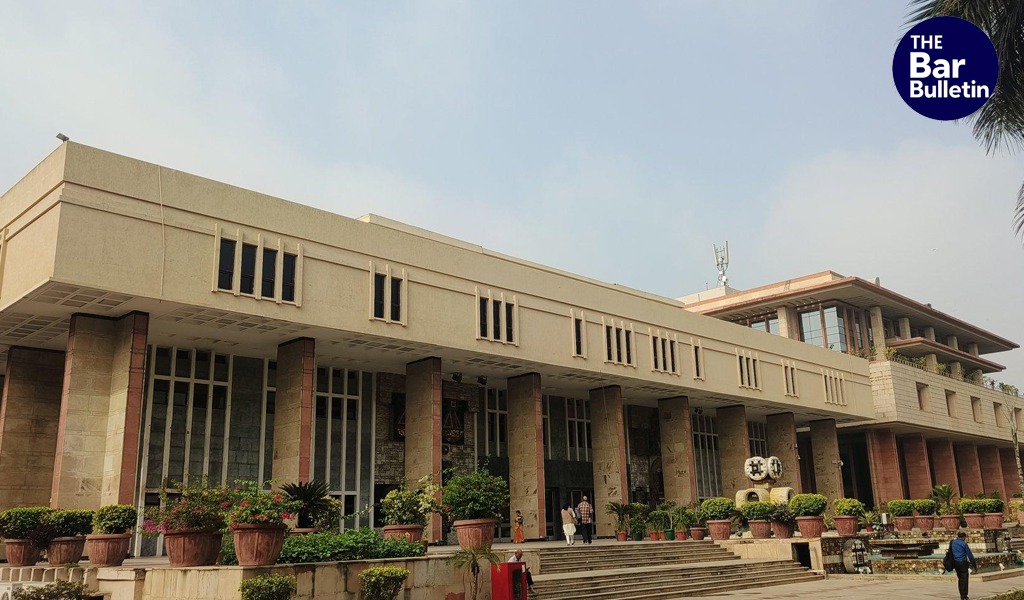

In a review application filed before the Delhi High Court to seek review of the judgment dated 29-08-2025 passed by this Court, a Division Bench of Justice Anil Kshetarpal and Justice Harish Vaidyanathan Shankar dismissed the application while holding that the applicant was at liberty to raise all objections available in law before the competent court at the appropriate stage.
Through the impugned judgment, the Court had dismissed a petition filed by the appellant to challenge the dismissal of its application under Order VII Rule 11 of the Code of Civil Procedure, 1908 (CPC). The said judgment also disposed of another petition filed against an order passed on an application under Order XII Rule 1A of CPC, whereby the transposition of respondent 2 as a plaintiff in the civil suit was permitted.
It was asserted that the perpetual leaseholder of the suit property had died intestate on 07-11-1950, and during the lifetime of his widow, the entire property was mutated in their son’s name. However, the said mutation was not challenged by her during her lifetime.
Thereafter, the son’s granddaughter filed an application under Order XXIII Rule 1 of the CPC, stating that she was satisfied with the Letter of Administration granted on 18-11-1978 with respect to the Will dated 07-06-1976 executed by her grandfather (the son), and sought the withdrawal of the suit.
The appellant contended that the power to revoke or annul a Letter of Administration vests exclusively in the Court under Section 263 of the Indian Succession Act, 1925, and that, consequently, the civil suit was not maintainable.
The civil suit was filed by the son’s granddaughter (original plaintiff), being the great-granddaughter of the perpetual leaseholder, seeking relief of declaration, partition, and permanent injunction, whereas the great-grandson of the perpetual leaseholder filed an application seeking his transposition as a plaintiff, which was allowed.
The Court held that it was well-settled that mutation entries of properties in revenue records are primarily maintained for fiscal and administrative purposes and that they do not confer, extinguish, or determine ownership or title over such an immovable property. It was also noted that, even though a perpetual lease may not confer absolute title or ownership, it does create a legally enforceable interest in immovable property.
Further, the Court said that at the stage of consideration under Order VII Rule 11 of the CPC, the Court merely examines the averments contained in the plaint, and that cases involving complex issues can only be concluded after comprehensive adjudication. Hence, the plaint cannot be rejected at the threshold. The Court thus held that the acceptance of the Letter of Administration by the original plaintiff was not a valid ground for the rejection of the plaint.
The Court held that the reliance placed by the appellant on Section 263 was misplaced since the said provision does not act as a bar to the institution or continuation of a civil suit raising issues that may be related to succession or title, but only provides the circumstances under which a Letter of Administration may be revoked or annulled.
The Court stated that it is neither advisable nor prudent to non-suit a party at the preliminary stage in matters covering complex issues regarding succession, title, and competing claims of parties. It was noted that the impugned order mentioned for the suit to be decided uninfluenced by the observations made, and thus, the Court held that the applicant was at liberty to raise all such objections available in law before the competent court at the appropriate stage.
Hence, for lack of merit, the Court dismissed the review application.
Appearances:
For Applicant – Mr. A.S. Chandhiok, Mr. Archit Mishra, Mr. Digvijay Rai, Mr. Kunal Kalra, Mr. Rahul Mourya
For Respondents – Mr. Ruchir Mishra, Mr. Mukesh Kumar Tiwari, Ms. Poonam Shukla, Ms. Reba Jena Mishra
