


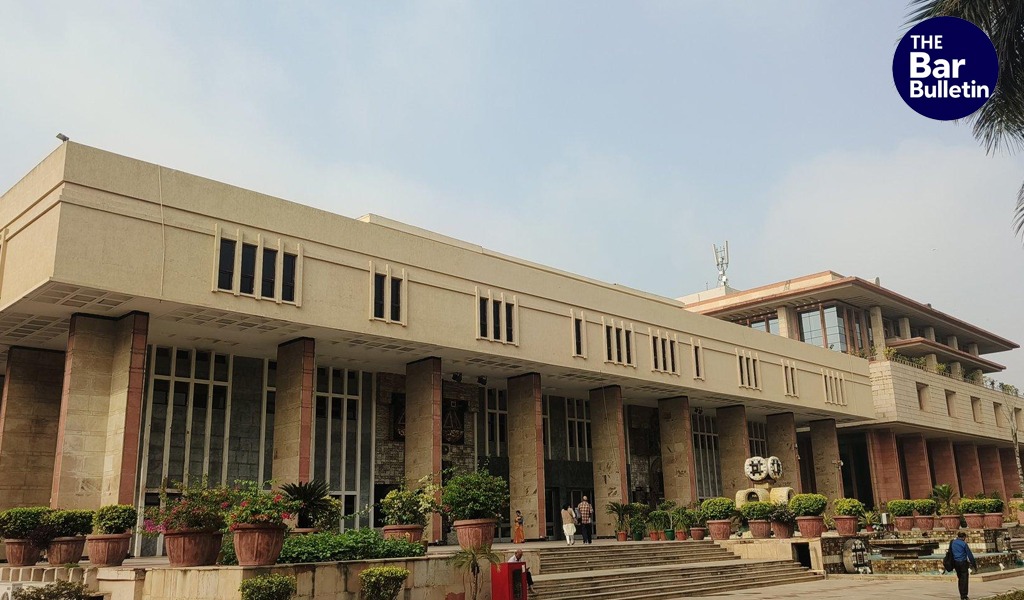

The Delhi High Court has reiterated that appointment of an incompetent Inquiry Officer may not vitiate the entire proceedings and that such right can be waived, and further that in relation thereto even the principle of estoppels and acquiescence would apply. The Court also reiterated that where a party, despite knowledge of the defect in the jurisdiction, participates in the proceedings without any kind of objections by his conduct, such a party disentitles himself from raising such a question in subsequent proceedings. Reference was made to the decision in the case of H.V. Nirmala v. Karnataka State Financial Corporation [(2008) 7 SCC 639].
Therefore, refusing to apply the Doctrine of Waiver and Acquiescence in the facts of the instant case, the Court held that it was not open to the respondent (delinquent employee) to challenge the dismissal order, as he submitted to the said order and participated in the de novo inquiry.
The Court even went to observe that where the appointment of an Inquiring Officer may have something to do only for carrying out the procedural aspect of the matter, strict adherence to the rules may not be insisted upon and further that the superior Courts in a case of such nature may not permit such a question to be raised for the first time.
Having participated in the disciplinary proceedings pursuant to the dismissal order, on conclusion of the said inquiry proceedings not only at the end of the Inquiring Authority but also at the end of Disciplinary Authority, the Court pointed out that even if the delinquent (respondent) has challenged this initiation of de novo inquiry in statutory appeal, the same is of no avail to him, in view of the settled legal principle that issue of jurisdiction etc., has to be raised by the party concerned at the first instances itself and not at any subsequent stage.
The Division Bench comprising the Chief Justice Devendra Kumar Upadhyaya and Justice Tejas Karia observed that what all is required by the Disciplinary Authority for exercising its powers under Regulation 7(1) of the Punjab National Bank Officer Employees’ (Discipline & Appeal) Regulations, 1977, for ordering inquiry afresh is that it should record reasons for remitting the case for the said purpose. As a matter of fact, an opinion as to whether a de novo inquiry is required or the Inquiry Report ought to be accepted is to be formed by the Disciplinary Authority.
Further, for ordering a de novo inquiry, the only requirement under Regulation 7(1) is that the Disciplinary Authority should record its reasons. Such an opinion, of course has to be based on some material on record; however, having regard to the language in which Regulation 7(1) is couched, it is not for the Court, in exercise of its jurisdiction of judicial review, to go into the sufficiency of material, added the Bench.
The Bench noticed that there is no provision in the Regulations for furnishing a copy of the Inquiry Report in respect of which the Disciplinary Authority forms its opinion that matter requires de novo inquiry. It is on the basis of the facts and circumstances and founded on some material that the Disciplinary Authority has to form its opinion by giving reasons, which are to be recorded in writing.
Briefly, before the merger of the Bank of India with the Punjab National Bank, the respondent was working as Manager (MMG/S-II) at New Bank of India till 1990. While working in the said position, a charge-sheet was issued against him alleging that he acted in manner unbecoming of an Officer of the Bank, abused his position and status in the Bank, which constituted misconduct under Regulation 24 of the New Bank of India Officer Employees (Conduct) Regulation, 1982, which are punishable.
The statement of allegations, which accompanied the Articles of Charge, states that the respondent directly or indirectly helped the firm M/s Vishal Super Insulators to secure financial assistance from the Bank without disclosing to the recommending authority or the sanctioning authority. It was also stated in the allegation that limit of financial assistance was enhanced within a period of one and a half month from Rs.4,00,000/- to Rs.7,50,000/-, which was without jurisdiction, without examining the operation of the account which showed divergence of fund to the sister company and further that concerned branch of the Bank frequently allowed excess drawing in the sanctioned limit recommended by the respondent.
The statement of allegations also mentioned that in respect of credit facility to M/s Everest Promoters Private Limited to the tune of Rs.19,75,000/-, the respondent did not convey the fact that only photocopy of title deed was held in the account and that he helped his sister’s construction company to secure the housing loan.
Though the respondent denied the allegations mentioned in the charge-sheet, disciplinary proceedings proceeded against the respondent, and based on this Inquiry Report, the Disciplinary Authority passed an order imposing the penalty of dismissal from service of the Bank, upon the respondent. When the matter reached the High Court, the Single Judge quashed the punishment order of dismissal from service.
Case Relied On:
H.V. Nirmala vs. Karnataka State Financial Corporation [(2008) 7 SCC 639]
Cases Distinguished:
K.R. Deb vs. The Collector of Central Excise, Shillong [1971 (2) SCC 102]
Appearances:
Senior Advocate Saurabh Mishra, along with Advocates Bitu Kumar Singh, Rajeev Ranjan and Gunjan Kumar, for the Appellant
Advocate Dr. Ashwani Bhardwaj, for the Respondent
