


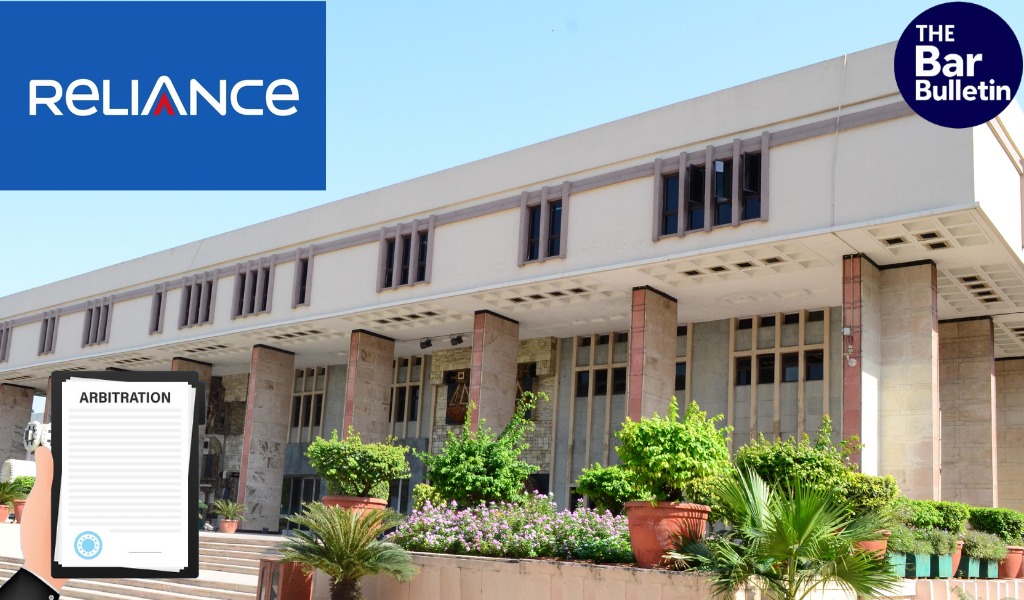

The Delhi High Court has clarified that an appeal under Section 50(1)(b) of the Arbitration and Conciliation Act, 1996 is maintainable against any order that refuses to enforce a foreign award under Section 48 of the 1996 Act. The Court determined that the Single Judge’s order, despite being termed a dismissal for being ‘premature’ and ‘inexecutable’, was substantively a refusal to enforce the award under Section 48. This conclusion was based on the Single Judge’s explicit invocation of Section 48(2)(b) to justify the refusal, stating that enforcement would not be in compliance with the ‘fundamental policy of Indian law’.
Drawing an analogy from the Supreme Court’s decision in Chintels India Limited v. Bhayana Builders Pvt Ltd. [(2021) 4 SCC 602], the Court reasoned that the phrase “under Section 34” in Section 37(1)(c) refers to the entire section, not just specific grounds within it. Similarly, a refusal “under Section 48” for the purpose of an appeal under Section 50(1)(b) encompasses any refusal made in the context of an enforcement proceeding governed by Section 48, not just a refusal based on the specific grounds listed in Section 48(1) or 48(2).
Thus, the fact that the appellant argues on merits that the Single Judge’s grounds were outside the scope of Section 48 does not negate the maintainability of the appeal itself; rather, that is the core question to be decided in the appeal on merits, added the Court, while pointing out that the order passed by the Single Judge constitutes an order “refusing to enforce a foreign award under section 48”. The matter was directed to be listed for a hearing on the merits of the appeal.
The Division Bench comprising Justice Navin Chawla and Justice Madhu Jain observed that the Single Judge dismissed the enforcement petition on several grounds. It was held that the Final Partial Award 2016 (FPA) was a mere declaratory award that could not be executed like a money decree because it did not quantify a specific sum and required more than ‘mere arithmetic’ to determine liability.
The Bench found that the Single Judge noted that the determination of the Cost Recovery Limit (CRL), an essential element for computation, had not attained finality, rendering the liability of the respondents inchoate. The enforcement was also found to be contrary to the FPA 2016 itself and subsequent awards, as the Arbitral Tribunal had indicated that findings could only be implemented after all outstanding issues were resolved.
Importantly, the Single Judge held that the Court could justifiably refuse to execute the award under Section 48(2)(b) read with Explanation 1(ii) of the A&C Act, as enforcing it would not be adopting of a judicial approach and would be contrary to the principles of natural justice, added the Bench, while considering the arguments on the maintainability of the appeal.
The Bench analysed the scheme of Sections 46 to 50 of the A&C Act, affirming that it is a self-contained code and the right to appeal is strictly limited by the statute. It referred to the Apex Court decisions to establish that an enforcement petition involves a single proceeding where the court decides on enforceability under Sections 47 and 48, and if enforceable, proceeds to execution.
Briefly, the case originates from two Production Sharing Contracts (PSCs) dated 22 December 1994, between the Union of India (appellant), Reliance Industries Limited (respondent no. 1), and Enron Oil and Gas India Limited (later succeeded by respondent no. 2). Disputes arose concerning provisions of the PSCs, including royalties, cess, service tax, ‘Cost Petroleum’ (CP), ‘Profit Petroleum’ (PP), and the ‘Cost Recovery Limit’ (CRL).
When the respondents invoked the arbitration clause, which was governed by the laws of England, the Arbitral Tribunal passed a series of awards, including the Final Partial Award dated 12 October 2016 (FPA 2016), which rendered 63 findings. Subsequent awards and challenges in the High Court of London followed, with certain matters being remanded to the Arbitral Tribunal.
Thereafter, the appellant filed an enforcement petition in the High Court of Delhi to execute the FPA 2016, seeking to recover USD 3,856,734,582. The Single Judge however, dismissed this petition as premature, leading the appellant to file the present appeal under Section 50 of the Arbitration and Conciliation Act.
Appearances:
Attorney General of India R. Venkataramani, Senior Advocate Sanjay Jain, along with Advocates Shravan Yammanur, Mangesh Krishna, Prachi Kaushik, and Harshita Sukhija, for the Appellant
Senior Advocate Harish Salve and Shyel Trehan, along with Advocates Sameer Parekh, Sonali Basu Parekh, Ishan Nagar, Abhishek Thakral, and Ruchi Krishna Chauhan, for the Respondent
