


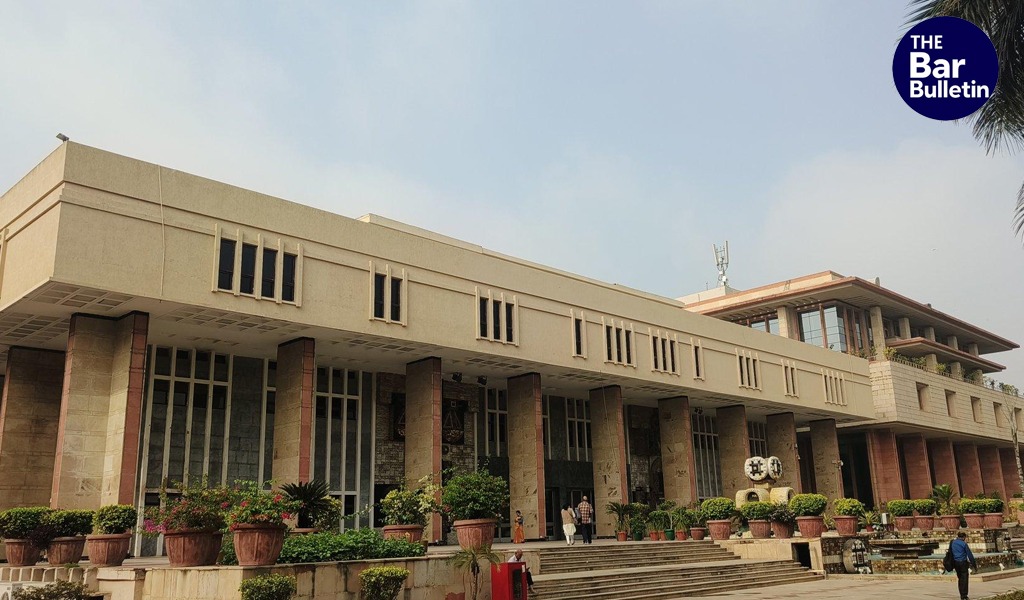

The Delhi High Court ruled that the designation of a place as the venue, coupled with the adoption of supranational rules (like the ICC Rules), is a positive indicator that the place is the juridical seat. Once the seat is determined, it acts as an exclusive jurisdiction clause, vesting supervisory power only in the courts of that seat.
While reaffirming the principles from BGS SGS SOMA JV v. NHPC LTD, which laid down a three-condition test for when a designated “venue” should be construed as the “seat”, the Court clarified that when the seat of arbitration is outside India, the bar under Section 2(2) of the Arbitration Act applies, and the jurisdiction of Indian courts is excluded, rendering Part I of the Act inapplicable.
The Division Bench comprising Justice C. Hari Shankar and Justice Om Prakash Shukla observed from perusal of Clause 22.3 of the Supply Contract, that it expressly designates London as the “seat” of the arbitration. This is an unambiguous choice, leaving no room for interpretation. Therefore, the juridical seat is London, and Part I of the Arbitration Act is excluded by necessary implication.
Further, Clause 14.3 of the Maintenance Services Agreement (MSA) states that arbitration ‘shall take place in London’, and more importantly, Clause 14.4 expressly excludes the application of Part I of the Arbitration Act. The Bench therefore held that this removes any doubt about the parties’ intention, and that both contracts were executed on the same day for a single commercial objective and must be read harmoniously as a composite whole.
The Bench also rejected the argument that the Respondent’s filing of a Section 9 petition conferred exclusive jurisdiction on Indian courts via Section 42. It held that Section 42 is only attracted when the initial application is filed before a court that has jurisdiction in the first place. Since the seat was in London, Indian courts lacked supervisory jurisdiction from the outset.
Briefly, the Appellant was a Special Purpose Vehicle (SPV) incorporated by the first Respondent (a Spanish company) and Reliance Infrastructure Limited (RIL) for the Airport Metro Express Line Project in New Delhi. Disputes arose between the parties, leading the Appellant to notify its intention to invoke a Performance Bank Guarantee. In response, the first Respondent filed a petition under Section 9 of the Arbitration Act before the Delhi High Court seeking to restrain the invocation, but this petition was dismissed. The Appellant subsequently encashed the guarantee.
The Respondents then invoked arbitration in London, alleging wrongful encashment of the Performance Bank Guarantee. The Appellant, however, raised a jurisdictional objection, arguing that the arbitration was effectively between two Indian companies and should be seated in India. The Arbitral Tribunal rejected this objection. Further, relying on Article 37 of the ICC Rules, the Tribunal held that the Respondents, having successfully defeated the jurisdictional challenge, were entitled to recover their costs. Accordingly, the Tribunal ordered the Appellant to pay costs of £80,000 to the Respondents.
The Tribunal also held that the rolling stock supplied by the Respondents failed to comply with the contractual specifications regarding noise levels. However, the Appellant had failed to produce any evidence demonstrating actual financial loss or diminution in value resulting from this breach. As proof of damage was a prerequisite for compensation, the Tribunal held that in the absence of such proof, the Appellant was not entitled to retain the proceeds of the Performance Bank Guarantee. The Tribunal thus directed the Appellant to refund the sum of £4,761,963.50 to the Respondents.
The Appellant challenged the arbitral awards under Section 34 of the Act before the Delhi High Court, which was dismissed by the Single Judge, holding that London was the juridical seat of arbitration for both contracts, not merely a convenient venue.
Appearances:
Advocates Anirudh Bakhru, Rishi Agarwal, Tarini Khurana, and Shruti Arora, for the Appellant
Advocates Shantanu Tyagi, Aishani Das, and Balapragatha Moorthy, for the Respondent
