


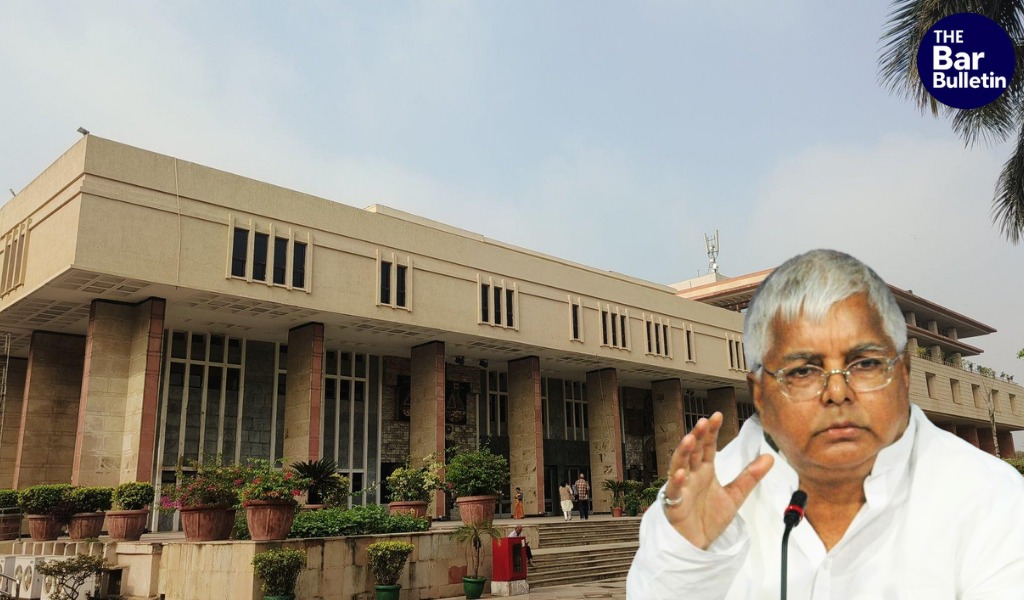

In a writ petition filed by Lalu Prasad Yadav before the Delhi High Court under Article 226 of the Constitution, read with Section 482 of the Code of Criminal Procedure, 1973 (CrPC), for quashing a First Information Report (FIR) registered under Sections 120-B of the Indian Penal Code, 1860 (IPC), read with Sections 11, 12, 13(1)(d), and 13(2) of the Prevention of Corruption Act, 1988, charge sheets dated 07-10-2022, 01-07-2023, and 07-06-2024, as well as three cognizance orders, a Single Judge Bench of Justice Ravinder Dudeja dismissed the petition and held that Section 17A of the Prevention of Corruption Act is prospective and that the bar under it would not be applicable to the present case.
A preliminary enquiry was registered by the Central Bureau of Investigation, New Delhi (CBI) on 23-09-2021 regarding the alleged irregular appointments of Substitutes in Group D posts in various Zonal Railways during 2004-2009. It was alleged that unknown public servants of the Indian Railways appointed and regularized substitutes without adhering to the prescribed guidelines, without issuing any advertisement or public notice, and by showing undue haste in processing applications. Even though several appointees were residents of Patna, they had been appointed to distant railway zones, with applications that were improperly addressed yet approved within a few days.
Seven specific instances were revealed in the enquiry where land situated in Patna was transferred by the appointees or their family members to the family members of Lalu Prasad Yadav, the then Union Minister for Railways, or to M/s AK Infosystems Pvt. Ltd., a company later controlled by his family. The transactions included five sale deeds and two subsequent gift deeds in favour of Smt. Rabri Devi, Smt. Misha Bharti, and Smt. Hema Yadav, daughters and wife of Lalu Prasad Yadav.
Allegedly, 12 individuals were appointed as substitutes across six railway zones in consideration of these transfers. The enquiry noted that the lands were purchased at prices significantly below prevailing circle rates, often paid in cash, and later gifted at substantially higher values. In totality, about 1,05,292 sq. ft. of land valued at approximately Rs. 4.39 crore was allegedly acquired by family members of Lalu Prasad Yadav through these transactions. Hence, the said FIR was lodged, and a charge sheet was filed against Lalu Prasad Yadav, his family members, the appointees, railway officials, and other private individuals.
Lalu Prasad Yadav submitted that the alleged offences were related to 2004 and 2009, whereas the impugned FIR was registered after an unexplained delay of fourteen years. It was also argued that, despite earlier investigations, CBI initiated a fresh preliminary enquiry on 23-09-2021 by concealing the existence of its previous enquiries. It was also asserted that the acts alleged were integrally connected with the official functions of the petitioner as a public servant, attracting protection under Section 17A of the Prevention of Corruption Act, and that prior approvals should have been taken before the enquiry.
The Court noted the petitioner’s submission that the absence of prior approval before the initiation of the preliminary enquiry and the registration of the FIR rendered the entire investigation non est in law, and that no independent challenge was laid to the factual foundation of the allegations or the existence of material collected during the investigation.
The Court found that Section 17A, introduced by Act 16 of 2018, does not display any legislative intent to operate retrospectively by any express or necessary implication. It was said that a provision restricting the initiation of an enquiry or investigation against a public servant regarding recommendations made in the discharge of official functions affects the power of investigation and cannot be retrospectively applied unless the statute mandates it.
The Court found it to be significant that the alleged offences pertained to the period between 2004 and 2009, whereas Section 17A was introduced only in 2018, which meant that the alleged acts could not be construed to be decisions taken by Lalu Prasad Yadav in discharge of official functions, and hence, the requirement of prior approval could not be attracted. It was stated that, as per judicial discipline, the Court is required to give effect to the settled principle that statutes creating new protections or disabilities operate prospectively unless expressly stated otherwise.
Further, regarding the scope of Section 17A, the Court said that it was confined to recommendations or decisions taken by a public servant while discharging official functions, and found that the petitioner was not in a position to make decisions but could only influence them. It was stated that whether Lalu Prasad Yadav exercised de facto influence or issued oral directions was a matter of evidence and could not be used to determine the applicability of Section 17A.
The Court stated that the bar under Section 17A operates against a police officer as it prohibits him from conducting any enquiry, inquiry, or investigation into alleged acts by a public servant without the previous approval of the prescribed authority. It was said that the said bar does not apply to the investigation conducted into all or every offence allegedly committed by a public servant under the Prevention of Corruption Act. The Court held that Section 17A did not envisage a blanket protection and that when the act of any public official is ex facie criminal or constitutes an offence, prior approval of the competent authority would not be required.
The Court perused the procedure for engaging substitutes in Railways and noted that, regarding the engagement of substitutes, the Ministry of Railways repeatedly directed strict control over the number of substitutes engaged and serious efforts to drastically reduce their numbers. It was noted that, as per the prosecution’s case, the formal acts of appointment were attributed to the railway officials against whom the provisions of Section 17A had been admittedly obtained. The Court also stated that the alleged acts could not be construed as recommendations or decisions taken by Lalu Prasad Yadav in discharge of official functions to attract the requirement of prior approval.
It was said that permitting a belated challenge solely on a technical plea regarding prior approval would defeat the orderly administration of criminal justice. The Court said that extraordinary jurisdiction under Article 226 or inherent powers under Section 482 CrPC could not be invoked to derail a prosecution at the threshold of trial.
Thus, the Court held that the absence of prior approval did not vitiate the preliminary enquiry, registration of FIR, investigation, or cognizance orders passed by the Special Judge, and that the bar under Section 17A was not applicable to the present case since the alleged act was not related to any recommendation or decision by Lalu Prasad Yadav in discharge of official functions. Lastly, the petition was dismissed for being devoid of merit.
Appearances:
For Petitioner – Mr. Kapil Sibal (Sr. Adv), Mr. Maninder Singh (Sr. Adv), Mr. Varun Jain, Mr. Navin Kumar, Mr. Sumit Singh, Ms. Aekta Vats, Ms. Aparajita Jamwal, Ms. Janvi Narang, Mr. Satish Kumar
For Respondent – Mr. S.V. Raju (ASG), Mr. D.P. Singh (ASG) (SPP), Mr. Manu Mishra, Ms. Garima Saxena, Mr. Imaan Khera, Ms. Shreya Dutt, Mr. Samrat Goswami, Mr. Hitarth Raja, Ms. Aditi Andley
