


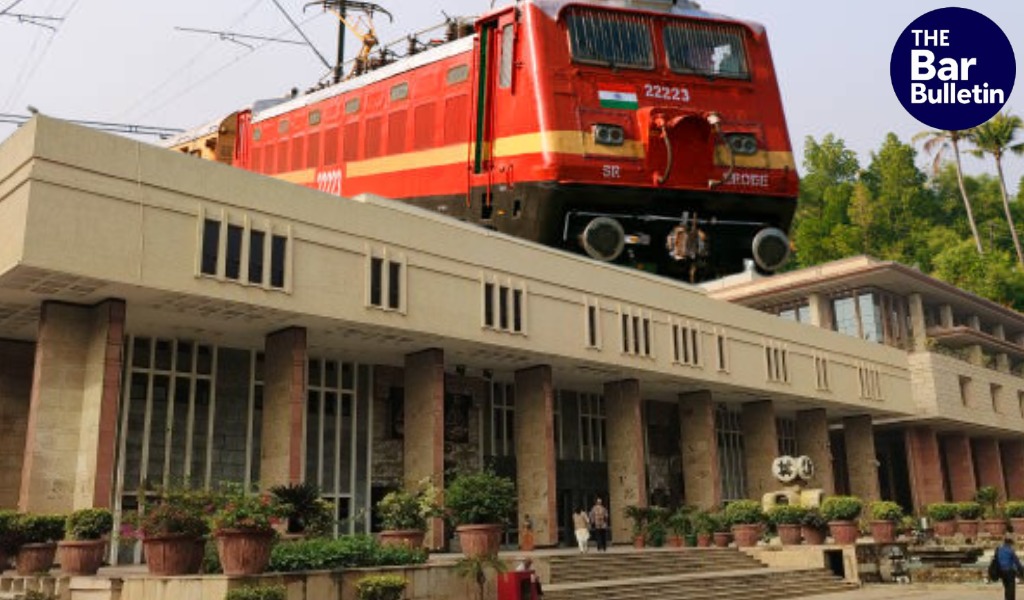

In an appeal filed before the Delhi High Court under Section 23 of the Railway Claims Tribunal Act, 1987, to assail a judgment dated 12-12-2019 by the Railway Claims Tribunal (Tribunal), whereby the appellants’ claim was dismissed on grounds that the deceased was neither a bona fide passenger nor was the alleged incident and ‘untoward incident’, a Single Judge Bench of Justice Manoj Kumar Ohri set aside the impugned judgment and remanded the matter back to the Tribunal for awarding compensation to the appellants.
On 17-12-2017, the deceased was travelling from Boudaki to Delhi Shahdara holding a valid journey ticket. When the train was approaching Shahdara, the deceased allegedly fell from the train and succumbed to the grievous injuries suffered in the incident. The appellants contended that the Tribunal had wrongly accepted the respondent’s theory that the deceased was crossing the railway track when the said incident occurred.
The Court stated that the two issues for consideration were whether the deceased was a bona fide passenger and whether the alleged incident was an ‘untoward incident’ as defined under the Railways Act, 1989.
It was noted that the Tribunal was of the view that since the train in question would have left Bodaki Railway Station at around 3:00 AM, the deceased could not have been a bona fide passenger. The Court disagreed with the said finding and noted that the ticket belonging to the deceased had been handed over to the ASI after the alleged incident. It was said that a mere failure to furnish complete journey details in the claim application does not imply that the deceased was not a bona fide passenger.
Considering the Train Signal Record, the Court said that rather than discrediting the appellant’s case, the timing was consistent with the deceased having travelled on an early morning train. It was said that the Tribunal’s observation was speculative and unsupported by the record and that it was not uncommon for people to undertake a night journey to reach their destination early.
Further, the Court noted the Tribunal’s view that the deceased could not have accidentally fallen from the train and would have come ‘into the grip of some train’ and stated that the Tribunal’s observation regarding the absence of fractures was belied by the record and that the injuries mentioned in the Post-Mortem Report were consistent with high-impact trauma. Regarding the location of the dead body, the Court stated that the DRM report on which the Tribunal relied was premised upon the Naksha Moka, which itself was undated.
The Court stated that the provisions related to the compensation under Section 124A of the Railways Act is a beneficial legislation and need to be construed in a liberal manner. It was held that in the present matter, the respondent had failed to establish that the death of the deceased falls within any of the exceptions carved out under the proviso to Section 124A.
The Court held that the Tribunal had adopted an unduly rigid standard of proof, overlooking the beneficial object of the Act, and hence, set aside the impugned judgment, holding that the Tribunal’s findings were based on conjectures and were contrary to the settled legal position. Thus, the Court allowed the appeal and remanded the matter to the Tribunal for the award of compensation.
Appearances:
For Appellants – Mr. Rajan Sood, Ms. Ashima, Ms. Megha Sood
For Respondent – Mr. Chiranjiv Kumar, Mr. Mukesh Sachdeva
