


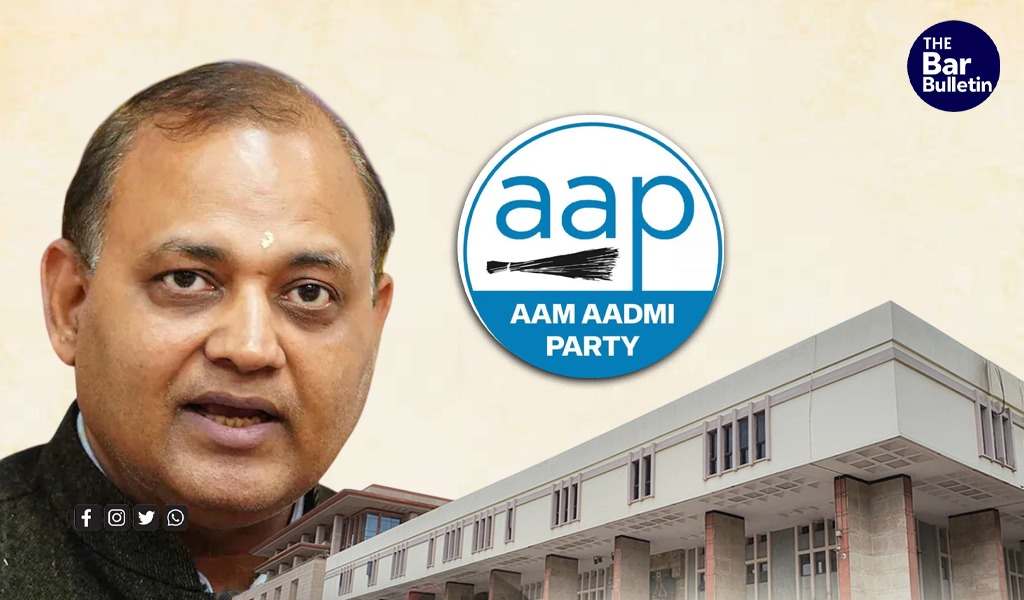

The Delhi High Court dismissed an election petition filed by former Delhi Law Minister and Aam Aadmi Party leader Somnath Bharti, challenging the election of BJP candidate Shri Satish Upadhyay from the Malviya Nagar Assembly constituency in the 2025 Delhi Assembly elections.
Justice Jasmeet Singh, while rejecting the petition at the threshold, held that it suffered from a fatal and incurable defect under the Representation of the People Act, 1951, on account of non-joinder of a necessary party.
Somnath Bharti had approached the High Court under Sections 80, 80A and 81 of the ROPA seeking to declare Satish Upadhyay’s election, held on 5 February 2025 and declared on 8 February 2025, as null and void. Satish Upadhyay had won the election by a margin of 2,131 votes, securing 39,564 votes against Bharti’s 37,433.
In his petition, Somnath Bharti alleged that the election was vitiated by corrupt practices under Sections 123, 127A and 130 of the ROPA. Among other allegations, he claimed that Upadhyay had financially supported and coordinated with Congress candidate Jitender Kumar Kochar, whose campaign, according to the Petitioner, was exclusively directed against him and not against the BJP candidate, with the intent of splitting votes and securing an unfair electoral advantage.
Senior advocates Rajiv Nayar and Jayant Mehta, appearing for Shri Satish Upadhyay, raised a preliminary objection on maintainability, arguing that Somanth Bharti had levelled allegations of corrupt practices against Kochar but failed to implead him as a respondent, as mandatorily required under Section 82(b) of the ROPA. It was contended that this non-compliance attracted mandatory dismissal under Section 86(1) of the Act.
The Court accepted the objection, holding that election petitions are special statutory proceedings governed strictly by the ROPA, which constitutes a self-contained code. Justice Singh observed that once allegations of corrupt practice are made against any candidate, impleadment of such candidate is compulsory, irrespective of whether any relief is sought against them.
Rejecting petitioner’s argument that the allegations were only against the Respondent and that “acceptance of money” did not amount to a corrupt practice, the Court noted that the post-1958 amended Section 123 of the ROPA expressly includes the receipt or agreement to receive gratification within the scope of corrupt practices. The Court held that the allegations in the petition squarely attracted Section 123(1)(B) and therefore triggered the mandatory requirement under Section 82(b).
The High Court also declined to entertain petitioner’s subsequent application seeking either to implead the Congress candidate or to delete the allegations against him, holding that once the 45-day limitation period for filing an election petition expires, such defects cannot be cured by amendment. The Court reiterated that Section 86(1) leaves no discretion with the High Court and mandates dismissal for non-compliance with Sections 81 or 82.
Emphasising judicial discipline and the sanctity of the electoral process, the Court observed that perceived technicalities or harsh consequences cannot override settled law laid down by the Supreme Court.
Accordingly, the election petition, along with the accompanying application, was dismissed. No order as to costs was passed.
Appearances:
For the Petitioner: Mr. Somnath Bharti-in-Person with Mr. Anand Prakash Gautam, Adv
For the Respondent: Mr. Rajiv Nayar, and Mr. Jayant Mehta, Sr. Advs. with Mr. Saurabh Seth, Mr.Sumer Dev Seth, Ms. Neelampreet Kaur, Mr. Abhiroop Rathore, Advs.
