


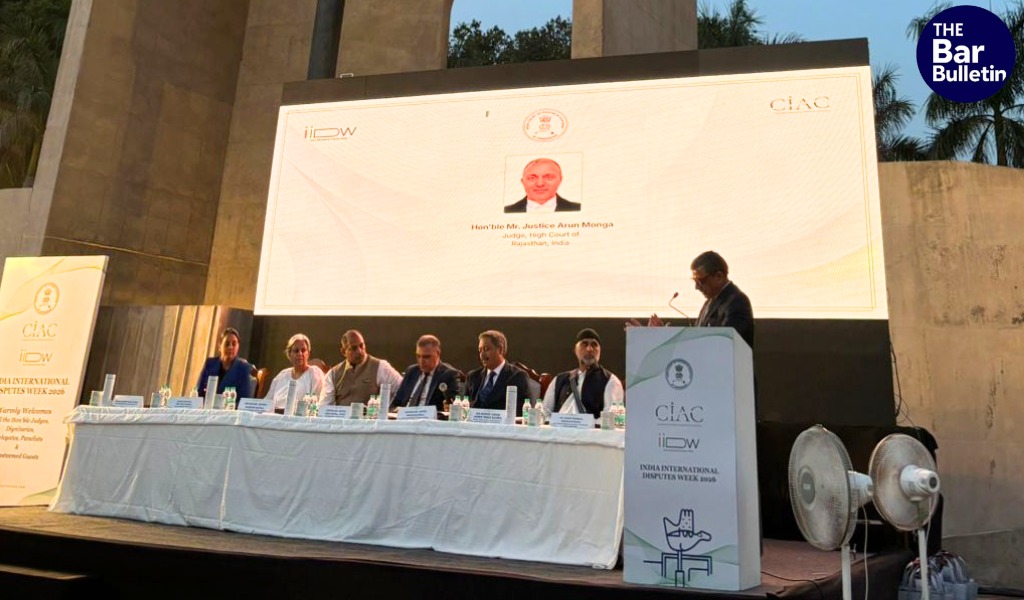

A thought-provoking panel discussion on “Judges: Present and Future” was held at the Chandigarh International Arbitration Centre during the ongoing International Disputes Week 2026, bringing together members of the judiciary to deliberate on the transformation of court processes in an era of digitalisation and artificial intelligence. The session was moderated by Mr. Anand Chhibbar, Senior Advocate of the Punjab and Haryana High Court, who initiated the discussion by highlighting the relevance of understanding how courts must evolve while still drawing guidance from the judgments and jurisprudence created by judges of the past.
Setting the tone for the discussion, Justice Arun Monga, Judge of the Rajasthan High Court, reflected on the transformative shift brought about by the pandemic, noting that the adoption of virtual hearings marked a decisive change in the functioning of courts. “The digital revolution in courts happened largely out of necessity. Earlier, justice was traditionally associated with physical courtrooms, but the pandemic demonstrated that alternate modes of justice delivery are not only possible but beneficial,” he observed. Justice Monga explained that virtual hearings have significantly reduced travel burdens for litigants and lawyers, especially in large states where distances between districts and High Courts can extend hundreds of kilometres.
Continuing his remarks, Justice Monga emphasised that remote adjudication has practical advantages for both litigants and the judiciary. Procedural hearings, short matters and cross-border disputes can now be handled efficiently through video conferencing without requiring parties to travel. At the same time, he cautioned that digital integration must be implemented with strong cyber-security safeguards to protect court records and maintain confidentiality. “Technology is undoubtedly beneficial, but its use must be accompanied by robust cyber-security systems to ensure the safety and integrity of judicial records,” he noted.
Justice Monga further underlined that while technology is here to stay, a balanced approach is necessary. He advocated a hybrid system where both physical and virtual hearings coexist. “Digitalisation cannot completely substitute the traditional courtroom. Final arguments and complex hearings still benefit from physical interaction. The future lies in integrating technology while preserving the essence of courtroom advocacy,” he said, adding that the younger generation of judges and lawyers must become technologically aware in order to adapt to the changing judicial environment.
Adding another dimension to the discussion, Justice Vinod Bhardwaj, Judge of the Punjab and Haryana High Court, addressed the broader question of judicial efficiency and government litigation. He observed that the state remains one of the largest litigants in the country and that a significant portion of litigation could be avoided through more responsible administrative decision-making. “Many disputes reach the courts because administrative authorities hesitate to take decisive responsibility. If stronger decision-making mechanisms are adopted within government departments, a considerable amount of avoidable litigation can be reduced,” he remarked.
Justice Bhardwaj explained that digital tools and improved administrative processes could assist government departments in resolving issues before they escalate into court disputes. At the same time, he pointed out that the often-quoted statistics regarding judicial backlog must be viewed in context, since every case has a procedural lifecycle before it becomes ready for final adjudication. “It is important to understand the procedural journey of a case before labelling it as backlog. Courts must ensure fairness and due process, which naturally requires time,” he said.
The conversation then turned to the role of artificial intelligence in legal practice, with Justice Harkesh Manuja, Judge of the Punjab and Haryana High Court, highlighting both its potential and its limitations. Justice Manuja noted that AI-enabled legal research platforms can significantly assist judges and lawyers in identifying statutory provisions, precedents and legal principles. “Artificial intelligence can certainly enhance legal research and assist the adjudicatory process, provided it is used as a supportive tool rather than a substitute for judicial reasoning,” he stated.
Justice Manuja cautioned, however, that over-reliance on automated systems can create challenges. Referring to instances where AI-generated tools produced inaccurate or non-existent citations, he advised legal professionals to exercise caution. “Technology can guide us, but it cannot replace careful verification. Lawyers must cross-check every citation and reference before relying on AI-generated outputs in court,” he emphasised.
He further pointed out that AI can also assist courts in improving administrative efficiency by summarising pleadings, organising records and identifying clusters of cases involving similar legal issues. Such technological assistance, he noted, can enable courts to dispose of cases more efficiently while allowing judges to focus on the core task of delivering well-reasoned judgments.
Across the discussion, the judges collectively agreed that while artificial intelligence and digital tools are increasingly becoming part of the judicial ecosystem, the ultimate responsibility for justice must remain with human decision-makers.