


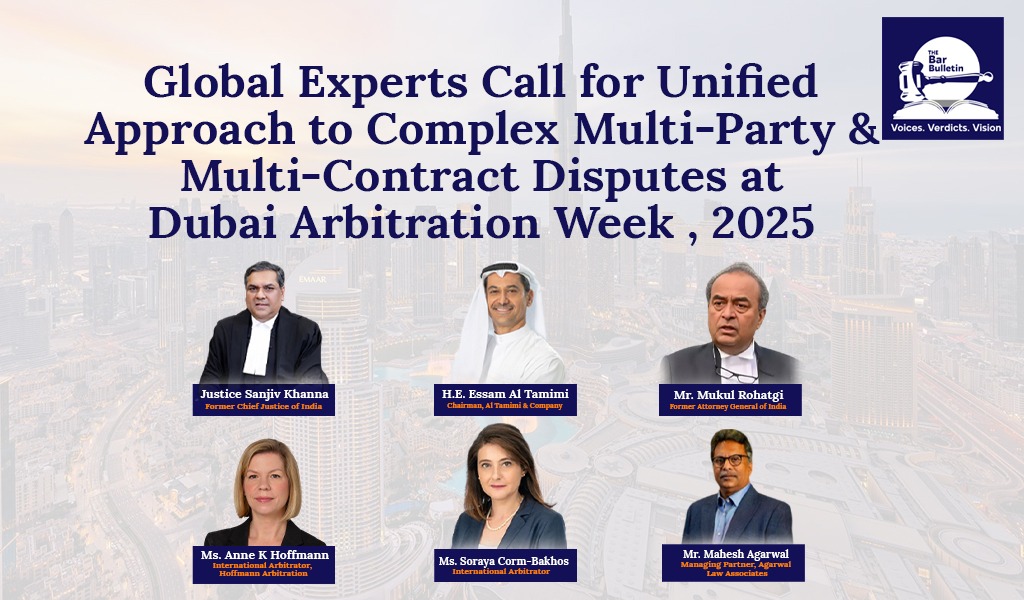

A panel discussion on “Navigating Multi-party & Cross-Border Dispute in Mega Project Arbitration” was held at the Ritz-Carlton, DIFC, Dubai during Dubai Arbitration Week, 2025. The Session was hosted by Lexster Law LLP and Agarwal Law Associates on November 11, 2025, bringing together legal professionals and industry stakeholders.
The distinguished panel comprised:
1) Justice Sanjiv Khanna (Former Chief Justice of India);
2) H.E. Essam Al Tamimi (Chairman, Al Tamimi & Company);
3) Mukul Rohatgi (Former Attorney General for India);
4) Anne K Hoffmann (International Arbitrator, Hoffmann Arbitration);
5) Soraya Corm-Bakhos (International Arbitrator, Corm-Bakhos Arbitration); and
6) Mahesh Agarwal (Managing Partner, Agarwal Law Associates).
Justice Sanjeev Khanna, Former Chief Justice of India, addressed the growing complexity of mega-project disputes and highlighted the need to carefully distinguish between interconnected contractual structures.“A distinction must be made between group of contracts, a composite contract, and group of companies.” He added that multi-party issues such as joinder, consolidation, parallel proceedings and non-signatory participation require a principled approach.
Justice Khanna also stressed the importance of better drafting practices to prevent future conflicts.
“The solution lies at the drafting stage, many disputes arise simply because the contracts never anticipated how they would interact.”
H.E. Essam Al Tamimi, Chairman of Al Tamimi & Company, highlighted the longstanding partnership between India and the UAE, noting the deep contribution of Indian professionals to the country’s growth. “Indian community and Indian legal practitioners have always been a very important part of the UAE, and they have helped the UAE throughout our growth progression — not only in law but throughout the UAE,” he said. Emphasising the strength of this relationship, he added, “If you ask any single person in the UAE, whether individuals or leaders, we’re grateful for the good friendship and the partnership with India over the last 50 or 60 years, or even beyond.”
Highlighting one of the UAE’s boldest reforms, Al Tamimi pointed to the establishment of common law courts within the country. Calling it “a courageous decision no country in the world is able to do,” he emphasised how DIFC and ADGM created unparalleled trust for foreign parties by offering Common law, international judges, and reliable enforcement mechanisms. Recalling the nation’s evolution from not being a New York Convention signatory in 2006 to now hosting “about 82 international law firms,” he said foreign competition only strengthened domestic practitioners: “They only made me better. They did not take anything away from me.”
Mr Mukul Rohatgi, former Attorney General for India, reflected on the shift in India’s arbitration landscape over the past decades. He remarked that under the 1940 Act, “the cases were simple… there were no multiparty contracts, no multi-seated contracts, no disputes of seat versus venue, and there were no non-signatories.” He linked the rise of complex disputes to India’s economic opening in 1993, and this evolution of business has resulted in a large number of issues. Although some questions have been addressed by judgments such as Cox & Kings, new challenges continue to emerge.
Mr. Rohatgi highlighted the practical difficulties arising from fragmented proceedings.
“My experience shows that by and large, a party who is not a signatory does not wish to join the arbitration. They say, we will sort out our own arbitration because we have our own contracts with multiplicity of contracts in regard to one project.” This leads to parallel disputes across different seats and tribunals. This, he said, produces a “wrangle in courts… from the first court to the High Court and the Supreme Court,” often consuming five years before an arbitration can meaningfully proceed. He concluded that India must move towards unified adjudication in complex projects:
“The solution essentially lies in having one composite tribunal… so they can have a holistic look at what is going on.”
Ms Ann K Hoffmann, International Arbitrator, described the growing complexity of multi-party and multi-contract disputes, emphasising that many challenges arise even before arbitrators enter the picture. “What I’ve learned as an arbitrator over the years is that multi-party arbitrations are becoming much more frequent.” She stressed that several complications are avoidable if counsel ensures that large projects use identical arbitration clauses.
“What really is crucial, in my view, is that the same seat is there and the same institution so that decisions can be made by the same team … You’re having a problem if one arbitration clause says you want one arbitrator and the other arbitration clause says you have three arbitrators and you do it all in different places and so on. So identical arbitration clauses, which allow you to consolidate easily…”
She further underscored the practical risks of inconsistent awards, urging counsel to coordinate evidence and submissions across parallel proceedings.
“You can claim as much as you like. If you can’t prove it, you have a great difficulty… if you want to avoid inconsistent awards, you know, that you need to bring support for your claims and that goes across the project between the parties, whether you have managed to consolidate your claims or not.”
Ms Soraya Corm-Bakhos, International Arbitrator, offered a structured overview of how mega-project arbitrations unfold, beginning with complex, multi-tiered dispute-resolution clauses. She explained that such projects typically involve “numerous contracts; construction contracts, JV agreements and multi-tiered dispute resolution clauses” that require parties to exhaust pre-arbitral steps before reaching arbitration. She noted that depending on the drafting, “the pre-arbitral steps may or may not be considered enforceable conditions precedent,” often giving rise to jurisdictional objections when a party alleges non-compliance.
She also highlighted how mediation and expert evidence operate in large construction disputes, questioning whether mediation is always positioned correctly in multi-tiered clauses.
“Mediation is often included as a pre-arbitral step, but in mega-projects, there is very little incentive to mediate before arbitration. The incentive to mediate becomes more appealing to parties when they have exchanged their first pleadings and expert evidence. Then they get a reality shock! That is usually when a party realises their case may not be as strong as they believed and becomes willing to settle.”
Mr Mahesh Agarwal, Managing Partner, Agarwal Law Associates, speaking on the complexity of multi-party, cross-border commercial disputes, noted how global infrastructure projects often trigger interconnected claims across jurisdictions.
“Any small part of the performance of a contract by any party can affect the implementation of the main contract, which is bound to give rise to multiple disputes, or I would say, a chain of disputes.”
He emphasised that while arbitration relies heavily on party autonomy, this very feature complicates coordinated dispute resolution:
“To get different parties into one arbitral clause or consolidation is a huge challenge. Various institutes around the world have made provisions for consolidation. In India, so far as we are concerned, we do not have any such provision. But Indian the Supreme Court has been progressive….”
He further highlighted the issue of confidentiality in such consolidations. Pointing to contract design as the most effective preventive tool, he underlined that the drafting stage, not the dispute stage, is where coordination succeeds or fails.
“The focus has to be on the arbitration clause from the beginning…there should be identical clauses, the seat of arbitration, the venue of arbitration, the choice of arbitrators, the language of arbitration, the choice of law, all these can be uniform when the contract is formed.”