


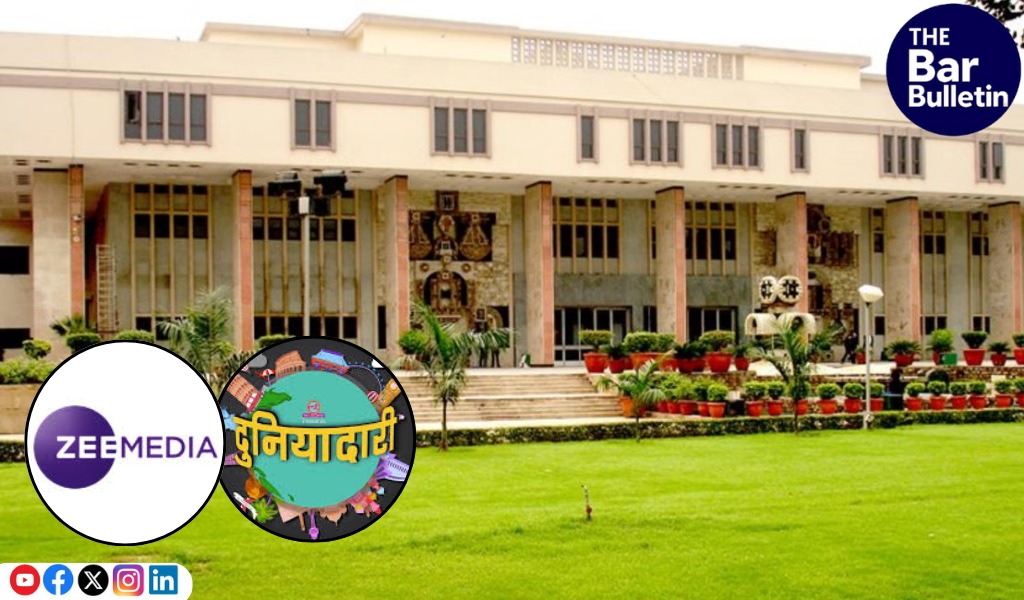

The Delhi High Court ruled that Living Media (Plaintiff) has no exclusivity over the Mark ‘DUNIYADARI’, which is not descriptive, but is suggestive in nature and has not acquired distinctiveness to be protected independently of the Device Mark. The Court held the Impugned Mark, ‘Duniyadari’ to be deceptively similar and likely to create confusion in the minds of the viewers as it is used for the same service for the same class of consumers on the same trade channels.
The Court, therefore, restrained Zee Media Corporation (Defendant), its employees, servants, agents, assignees and officials etc., from using the Impugned Mark for the news programme in any manner which is identical to the Subject Mark as the same amounts to infringement and / or passing-off.
At the same time, the Court clarified that the Defendant is entitled to use the Mark ‘DUNIYADARI’ in the manner which is not identical or deceptively similar to the registered Subject Mark of the Plaintiff and shall not contain any common elements such as the sky, the globe, the clouds, the flags / the monuments of various countries that may cause confusion and deception with the Subject Mark.
The Court observed that a side-by-side comparison between the Impugned Mark and the Subject Mark shows that there are many similarities between the two Marks. The Defendant has proposed a revised Logo / Label by changing the colour of the fonts for the Mark ‘DUNIYADARI’ and removing the flags of various countries. However, the globe behind the Mark ‘DUNIYADARI’ is very similar to the Subject Mark.
Accordingly, the Court said that the Defendant is not entitled to use the Impugned Mark, which is deceptively similar to the Subject Mark as the same amounts to clear infringement and passing-off. However, since the Mark, ‘DUNIYADARI’ is held to be not distinctive, the Plaintiff is not entitled to assert exclusivity / monopoly over the said Mark ‘DUNIYADARI’.
A Single Judge Bench of Justice Tejas Karia observed that the Subject Mark has to be compared as a whole with the Impugned Mark and by doing so there are various deceptive similarities, which can create confusion with regard to the association between the Subject Mark and the Impugned Mark, when there exists none.
Finding that the trade channels for both the Subject Mark and the Impugned Mark are same and also the Class of consumer is identical, the Bench held that there is high likelihood of confusion, if the manner in which the Impugned Mark is used for the same service by the Defendant as that of the Plaintiff.
The Bench observed that the mark ‘DUNIYADARI’ is not generic or descriptive of the news service provided by the parties. It reasoned that the term, meaning ‘Worldliness’, requires an “intellectual leap” to be connected to ‘World News’. At best, the mark is suggestive in nature. Further, the Bench found that, prima facie, there was no evidence to show that the mark ‘DUNIYADARI’ had acquired a secondary meaning to be exclusively associated with the Plaintiff. The viewership figures submitted by the Plaintiff were not deemed significant enough to prove that the mark had lost its original meaning and become a source identifier for the Plaintiff’s services.
The Bench affirmed that the Plaintiff’s registration is for a composite device/label mark. Applying the anti-dissection rule under Section 17 of the Trade Marks Act, it held that the mark must be compared as a whole and the word ‘DUNIYADARI’ cannot be dissected and seen independently for granting protection. The Bench also rejected the Defendant’s claim of being a prior user, stating that use by an “erstwhile group entity” cannot be attributed to the Defendant without evidence of assignment or a formal connection.
At the same time, the Bench agreed with the Defendant that the Plaintiff, having previously argued before the Trade Marks Registry that its device mark was different from another cited mark to secure registration, could not now take a contradictory position and seek a monopoly over the word ‘DUNIYADARI’.
Upon a side-by-side comparison of the Subject Mark and the Impugned Mark as a whole, the Bench found numerous deceptive similarities. These included the colour of the font, the use of a globe in the background, the sky, clouds, and flags/monuments. This led to the prima facie conclusion that the Impugned Mark was deceptively similar to the Subject Mark and the Defendant had “attempted to come as close as possible” to the Plaintiff’s mark.
Briefly, the dispute centres on the Plaintiff’s registered device/logo trademark “DUNIYADARI” used for a news segment on its digital platform “The Lallantop” since March 5, 2020. The Plaintiff alleged that the Defendant, a direct competitor, began broadcasting a news segment of a similar nature under the identical name ‘DUNIYADARI’ written in Gurumukhi script (Impugned Mark) on its regional channel ‘Zee Punjab Haryana Himachal’ starting October 2024.
Appearances:
Senior Advocate Asheesh Jain, along with Advocates Shahrukh Ejaz and Musakan Sehgal, for the Plaintiff
Advocates Rahul Vidhani, Neha Vidhani, Dhruv Sikka, Mokshita Gautam, S. Kumar, Yashika Sehgal, Lakshay Gupta, and Shreya Jain, for the Defendant
