


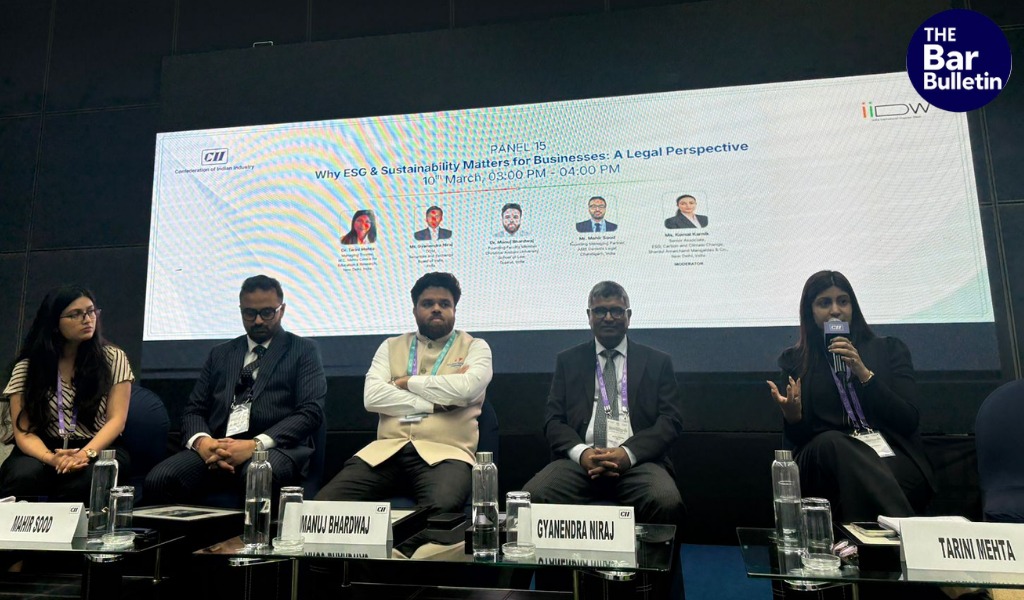

A panel discussion on “Why ESG & Sustainability Matters for Businesses: A Legal Perspective” at the India International Disputes Week (IIDW) brought together regulators, practitioners and policy experts to examine the increasing importance of environmental, social and governance (ESG) considerations in corporate governance, investment decisions and dispute resolution.
Moderated by Komal Karnik, Senior Associate at Shardul Amarchand Mangaldas & Co., the session opened with Dr. Tarini Mehta, Managing Trustee at the M.C. Mehta Centre for Education & Research, who highlighted the urgency of addressing global environmental challenges such as climate change, biodiversity loss, pollution and rising waste generation. Citing examples such as the rapid growth of electronic waste and the environmental impact of the global fashion industry, she emphasised that ESG must be understood not merely as a compliance requirement but as a critical risk-management framework for businesses. According to her, climate risks, supply chain disruptions, reputational concerns and growing investor and consumer expectations make ESG central to long-term corporate viability. She also noted that courts are increasingly playing a role in addressing greenwashing and enforcing environmental accountability, alongside the role of regulators, investors and civil society.
Gyanendra Niraj, Deputy General Manager at the Securities and Exchange Board of India (SEBI), discussed the regulatory perspective on ESG within capital markets. He highlighted SEBI’s efforts to enhance transparency and accountability through frameworks such as the Business Responsibility and Sustainability Reporting (BRSR) requirements applicable to top listed companies. Niraj noted that ESG disclosures are gradually becoming an important component of risk management and governance for companies seeking to attract investor confidence. He also pointed out that while regulators are strengthening reporting requirements, the broader challenge lies in balancing environmental goals with economic growth, particularly in a developing economy.
Speaking on the broader corporate and policy implications, Dr. Manuj Bhardwaj, Founding Faculty Member at the Dhirubhai Ambani University School of Law, observed that ESG should increasingly be viewed as a business enabler rather than simply a compliance obligation. He emphasised that global investors and supply chains are increasingly evaluating companies on ESG parameters, and initiatives such as carbon border adjustment mechanisms and sustainability standards are likely to influence market access and trade competitiveness. Bhardwaj also highlighted the need to expand ESG awareness beyond large corporations to micro, small and medium enterprises (MSMEs), which form an integral part of global supply chains.
Adding a legal perspective, Mahir Sood, Founding Managing Partner at AMS Genesis Legal, noted that ESG considerations are increasingly intersecting with legal frameworks governing corporate governance, environmental compliance and commercial disputes. Referring to developments in Indian jurisprudence and regulatory frameworks, he explained that issues relating to sustainability, environmental protection and responsible corporate conduct are gradually becoming embedded within legal accountability mechanisms.
The discussion underscored that ESG is emerging as a key factor shaping corporate governance, regulatory policy and investor behaviour, while also creating new dimensions for legal practice and dispute resolution in India’s evolving business landscape.