


Date: 22 February 2026
Time: 4:00 pm IST
Location: MultiPurpose Hall, Kamladevi Complex, India International Centre, Max Mueller Marg, Lodhi Gardens
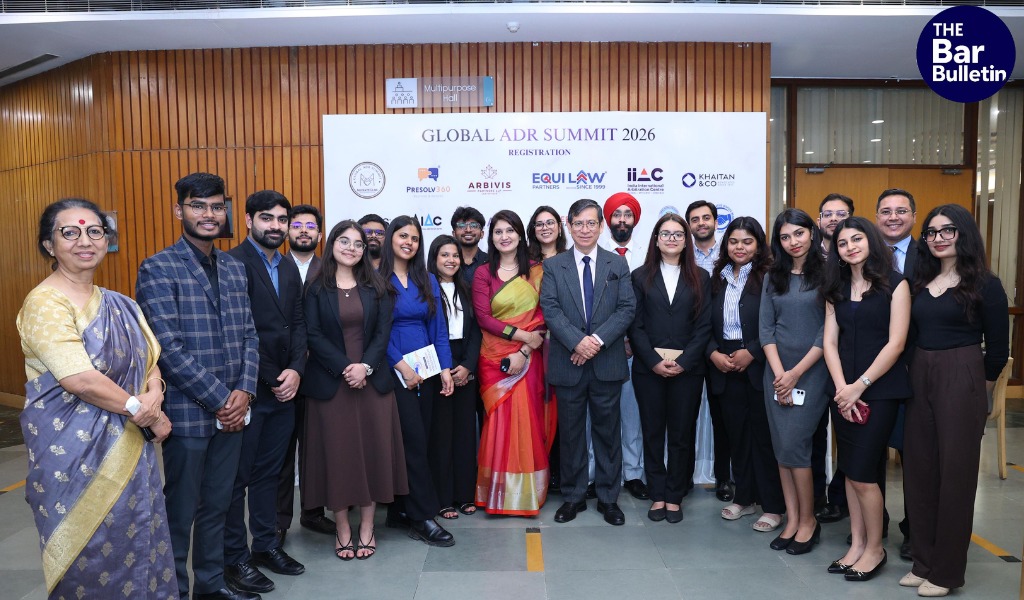
The Global ADR Summit 2026, held on 22 February 2026 at the India International Centre, New Delhi, organised by MediateGuru brought together judges, international arbitrators, mediators, policymakers, corporate counsel, and ADR practitioners to critically examine India’s trajectory as a global hub for arbitration and mediation.
The Global ADR Summit 2026 was organised by Mr. Param Bhamra (Founding Partner of MediateGuru) and hosted in collaboration with leading institutions and firms — including Khaitan & Co, Jindal Global Law School, Arbivis Partners LLP, IIDRC and Vivekananda Institute of Professional Studies, with institutional support from bodies such as the India International Arbitration Centre, JAMS, AIAC, with multiple academic and practitioner-focused engagements reinforcing India’s role in shaping the future of dispute resolution.
The opening session for the evening. Dr. Ashu Dhiman (Chief Advisor at MediateGuru), reflected on India’s long association with non-adversarial dispute resolution and stressed that the future of ADR in India would depend less on legislative volume and more on institutional trust, ethical consistency, and a shift in dispute-resolution mindset. The focus was clear; India does not lack frameworks it lacks confidence in its own ADR outcomes.
This theme was supported by the special address of Mr. W. Patrick McPhilamy III, (International Arbitrator and Mediator), who highlighted the importance of community-driven dispute resolution and innovative thinking. He cautioned against treating ADR conferences as isolated intellectual exercises, urging participants instead to make discussion into practical and collaborative. According to him, India’s strength lies in its collective problem-solving capacity, but that strength remains underutilised.
In one of the most talked-about interventions of the Summit, Mr. Joe Tirado (International Arbitrator and Mediator) delivered a candid assessment of India’s global standing in arbitration. He stated that while India may not enter the global top five arbitration seats in the immediate future, it is firmly positioned to become a top ten jurisdiction within the next decade provided it strengthens strategic vision and ensures consistent implementation. His comments was directed not on law, but on execution highlighting the absence of strategic coherence, the reluctance to fully commit to reform, and the dangers of overconfidence. He stressed that arbitration cannot be forced upon parties and that India must first establish its position as a credible regional hub before aspiring for global leadership.
The Summit was inaugurated by, Hon’ble Mr. Justice N. Kotiswar Singh Judge, (Supreme Court of India), who underscored that ADR is deeply rooted in India’s legal tradition and must be guided by the core values of the rule of law, justice, equality, and fraternity. He observed that while India has made significant strides in digitisation and economic growth, dispute resolution cannot be reduced to statistics alone. He raised concerns about the lack of structured training for mediators, the absence of institutional funding, and the risk of reducing mediation to a mechanical exercise rather than a humane process. Importantly, he underscored that ADR must respond to national needs while remaining open to global integration, especially considering emerging challenges such as artificial intelligence and environmental disputes.
Panel Discussion I, titled “From Draft to Destination: Will India’s Proposed Arbitration Bill Realise the Global Hub Vision?”, featured Hon’ble Mr. Justice Anup Jairam Bhambhani (High Court of Delhi), Mr. Navin Kumar Singh (CEO, India International Arbitration Centre), Mr. S.S. Ray,( Senior Advocate, Supreme Court of India), Ms. Namita Shah(Co-Founder, PreSolv360) and Ms. Aaliya Waziri(Advocate, High Court of Delhi).
The panel exposed the central paradox of Indian arbitration: while legislative amendments continue to proliferate, enforcement remains fragile. Mr. Justice Bhambhani’s remarks stood out for their stark realism. He shared an anonymised account of a ₹15,000-crore arbitration arising out of a Production Sharing Contract between the government and a private party. Despite the arbitral award being upheld by a court, it continued to be challenged up the judicial hierarchy. His explanation cut to the core of the problem no government secretary can advise acceptance of an adverse award without fear of investigative scrutiny, just as no private-sector executive can recommend the same without risking internal repercussions. As a result, challenges continue as a matter of compulsion, not principle.
The panel further critically examined proposed amendments to the Arbitration and Conciliation Act, including the introduction of an appellate arbitral tribunal and statutory recognition of emergency arbitration. While emergency arbitration and institutional strengthening were largely welcomed, several speakers expressed concern that excessive layering, ambiguity, and repeated legislative intervention could undermine predictability and delay enforcement. A recurring theme was that arbitration’s core problem in India is not legislative shortcoming, but lack of faith, discipline, and finality in the process particularly at the post-award stage.
Panel Discussion II, on “Contemporary Developments in Mediation and How to Make India a Mediation Hub”, brought together, Hon’ble Mr. Justice Subramonium Prasad Judge, (High Court of Delhi), Mr. Joe Tirado (International Mediator), Mr. AJ Jawad (Registrar, IAMC Hyderabad), Ms. Mehek Oberoi (Legal Head, Hydro- APAC, GE Vernova), Ms. Puja Anand (Senior Mediator), Mr. Praveen Mahajan (Founder, Equi Law Partners).
The discussion highlighted the growing relevance of pre-litigation mediation, sector-specific mediation, and online dispute resolution, while acknowledging existing challenges such as absence of clear fee structures, limited professional training, and lack of institutional capacity. Mr. Justice Prasad distinguished mediation from adjudication in fundamental terms, describing it as a process of consideration and peace rather than pleadings and proof. He highlighted the relative success of pre-litigation mediation, particularly where parties appear without lawyers, and supported the idea of soft mandatory mediation to build awareness and trust.
Speakers across the panel identified persistent structural gaps, the absence of clear fee frameworks under the Mediation Act, inadequate professional training, and the need for sector-specific mediators with domain knowledge. Corporate perspectives also made it clear that mediation’s value lies not only in cost-saving, but in preserving commercial relationships and reducing long-term risk. International voices stressed that mediation must be professionalised and institutionally supported if it is to be taken seriously
The Summit concluded with closing remarks and a Vote of Thanks delivered by Mr. Param Bhamra (Founding Partner of MediateGuru), who also presented a brief report of the proceedings. In his concluding address, he observed that the discussions across sessions had meaningfully advanced the Summit’s objective and marked that the purpose of the Summit to contribute towards positioning India as a credible ADR hub had been substantially fulfilled.
The deliberations across the Summit reflected a shared a consensus that India is already an important ADR jurisdiction, but its global credibility will depend less on legislative ambition and more on predictability, professionalisation, institutional trust, and disciplined judicial support. Strengthening arbitration and mediation institutions, investing in training, and reducing post-award interference were viewed as critical priorities.