


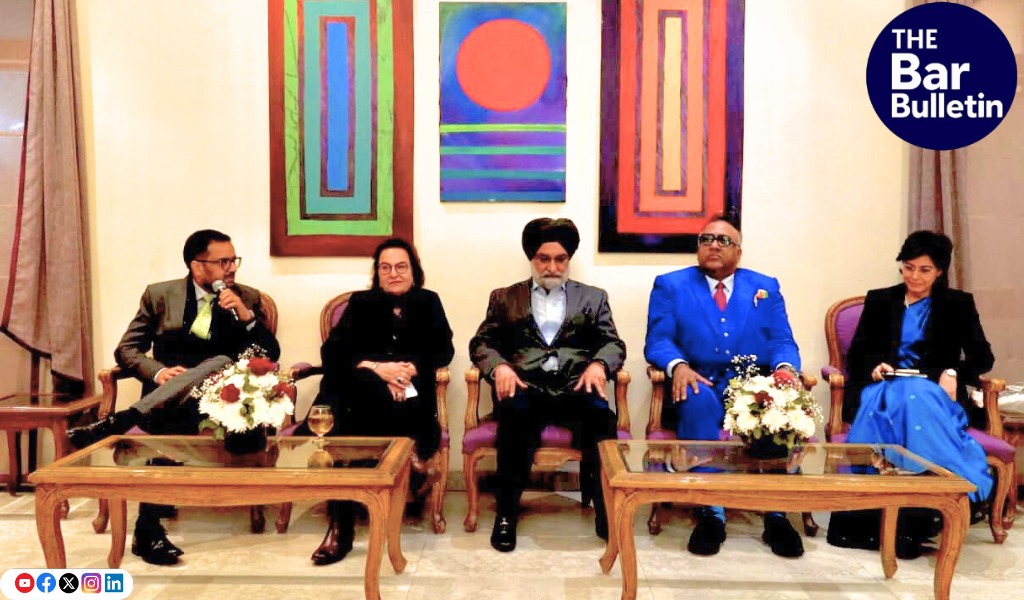

A fireside chat in New Delhi, bringing together senior policymakers, diplomats, legal professionals and academics to deliberate on public service, governance, constitutionalism and global cooperation. The event featured Petal Dhillon, IRTS, Joint Secretary in the Department of Commerce, Government of India, as the host speaker, with Advocate Prateek Som, Supreme Court, moderating the discussion. The panel comprised Ritu Sain, IAS, Investment Commissioner for the Government of Chhattisgarh; Pinky Anand, Senior Advocate and former Additional Solicitor General of India; Taranjit Singh Sandhu, former Ambassador of India to the United States; and Prof. (Dr.) C. Raj Kumar, Founding Vice-Chancellor of O.P. Jindal Global University, who shared insights on leadership, institution-building and the role of constitutional values in shaping governance and policy.
Ambassador Taranjit Sandhu shared insights from his diplomatic career, highlighting the evolving highs and lows of India–US relations and the close interplay between policymaking and diplomacy. Pinky Anand spoke on gender inclusion in the legal profession, women’s representation, and her experience of representing the State before the Supreme Court, emphasizing the Court’s role in policy matters through judicial review. Prateek Som highlighted the unique constitutional framework of India, noting the separation of powers and the authority of the Supreme Court and High Courts to exercise judicial review, including striking down parliamentary laws and influencing policymaking.
Senior civil servant Ritu Sain, IAS, and Prof. (Dr.) C. Raj Kumar, Founding Vice-Chancellor of O.P. Jindal Global University, reflected on the values of public service, constitutionalism and institution-building during a fireside conversation, emphasising that true impact lies not in capital alone, but in how governance stewards resources at scale with purpose.
Speaking on her experience in public service, Ritu Sain underlined that years spent in government instil humility and balance, both of which are indispensable for effective governance. She observed that governance requires an ability to clearly identify what delivers meaningful outcomes, noting that impact is often misunderstood as merely mobilising capital or resources. Instead, she stressed, impact is achieved through credible institutions, sound decision-making and principled administration, which together enable sustainable development.
Responding to questions on competitive federalism, Saini explained that while Indian States do compete to attract investment, such competition is ultimately constrained and guided by the constitutional and legal framework. She cautioned against a “race to the bottom”, asserting that incentives and policies must always serve a public purpose, remain socially responsive, and operate within constitutional limits. According to her, investors are driven less by short-term incentives and more by the credibility, stability and institutional behaviour of States, particularly their ability to ensure continuity despite political or policy changes.
Prof. C. Raj Kumar, addressing questions on legal and policy education, traced the idea behind establishing India’s first Constitutional Museum at Jindal Global University to a deeper commitment to building a culture of constitutionalism. Drawing inspiration from the National Constitution Center in the United States, he said the initiative was conceived to mark 75 years of the Indian Constitution and to promote constitutional awareness beyond the legal community. He emphasised that the Constitution is not merely a legal document for lawyers, but a foundational text for all citizens in a constitutional democracy.
Prof. Raj Kumar highlighted the historical links between Indian and American constitutional traditions, referring to Dr. B.R. Ambedkar’s engagement with comparative constitutional models and interactions with jurists such as Justice Felix Frankfurter. He noted that these cross-jurisdictional influences shaped key constitutional choices, reinforcing the importance of learning from global democratic experiences.
Reflecting on contemporary challenges, Prof. Raj Kumar warned that constitutional democracies worldwide are facing increasing pressures on the rule of law. He stressed that students of law, public policy and governance must cultivate a deep commitment to constitutional values, cautioning that indifference to legal and constitutional violations ultimately erodes both domestic and international norms.