


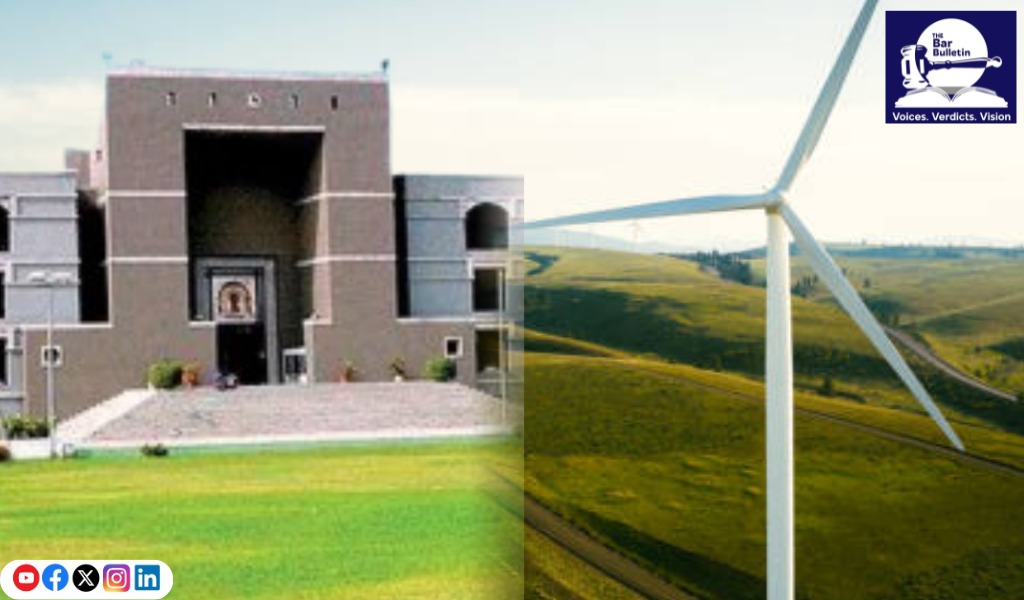

The Gujarat High Court (Ahmedabad Bench) asserted that any input or capital goods received in the factory or any input services received by the manufacturer of the final product would be susceptible to CENVAT Credit. Thus, the Court held that when the electricity generated by the windmills is exclusively used in the manufacturing unit for final products, the CENVAT Rules do not stipulate that the windmills shall be situated in the place of manufacture.
Observing that there is no nexus between the process of electricity generation and the manufacture of final products, the Court declared the appellant (manufacturer) to be entitled to the credit of service tax paid on inputs or capital goods or services received for Windmills for goods manufactured in the factory.
The Court clarified that the appellant has utilised the electricity supplied by Gujarat Energy Transmission Corporation Limited (GETCO) against the electricity generated by Windmills and therefore, service tax paid by the appellant on the installation, erection and services in connection with maintenance of the windmills are exclusively used in relation to manufacturing activity and therefore, the same would be squarely covered under the definition of “input service”.
The Division Bench comprising Justice Bhargav D. Karia and Justice Pranav Trivedi observed that in the absence of the words “within the factory of production” in Rule 2 of the CENVAT Credit Rules, 2004, which defines “input service” to mean that any service used by a provider of taxable service for providing an output service or used by the manufacturer whether directly or indirectly, or in relation to the manufacture of final product and clearance of final product from the place of removal, the definition of ‘input service’ has to be widely construed.
The Bench therefore held that the appellant would be entitled to the credit of service tax paid on inputs or capital goods or services received for Windmills for goods manufactured in the factory, because the only stipulation as per Rule 2 of the 2004 Rules is that the input service should be received by the manufacturer of products.
Briefly, the appellant company, engaged in the manufacture of goods like H.R. Coils and C.R. Coils, had installed a Windmill in Kutch District for generating electricity using wind energy. For the installation and commissioning of this windmill, the appellant has availed of erection services, for which the Agency has paid service tax of Rs. 2.87 lacs. Subsequently, the appellant, after receiving invoices for the erection, commissioning and installation, has availed credit of this amount of service tax. After the successful operation of the windmill, the Gujarat Energy Development Agency (GEDA) also certified that the appellant had duly complied with the Government policy for setting up a wind farm for generating wind energy.
The units of electricity so generated were given to Gujarat Energy Transmission Corporation Limited (GETCO), which transferred the same through the State Government grid line, and the units of electricity allowed to the appellant for being utilised in its factory after adjusting 4% wheeling charges were also issued by GETCO. However, the Central Excise EA-2000 Audit Party found the availment of the CENVAT credit objectionable and proposed to recover the CENVAT credit of Rs. 2.87 lacs on the ground that the windmill was installed at a place other than the factory and hence, the availment of credit was in contravention of Rules 3(1) and 4(1) of CENVAT Rules.
On appeal, the Commissioner of Central Excise confirmed that CENVAT credit was not admissible to the appellant, and also ordered for appropriation and adjustment of the amount along with interest already deposited by the appellant during the intervening period, and a penalty of Rs. 2.87 lacs. On further appeal, the CESTAT upheld the order as regards the denial of CENVAT credit and recovery of interest; however, it reduced the penalty to Rs. 2000.
Appearances:
Advocates Sudhanshu Bissa and Paresh M Dave, for the Appellant/ Taxpayer
Advocate Hetvi Sancheti, for the Opponent/ Revenue
