



The ICC Young Arbitration and ADR Forum (YAAF) hosted “Arbitration Career Beyond Borders” bringing together judges, senior counsel, in-house experts and young practitioners for an in-depth conversation on building arbitration careers that transcend jurisdictions.
Opening the session, ICC YAAF Representative for South Asia, Mr Shashwat Bajpai framed arbitration careers as long-term projects rather than immediate outcomes. Drawing from personal experience, he spoke about how early institutional affiliations often reveal their value much later in one’s career, sometimes in unexpected ways. What appears invisible at the outset, he noted, frequently becomes decisive years down the line.
This idea of delayed but enduring professional payoff found resonance in the remarks of Jayashree Parihar, ICC YAAF Representative for South Asia, who traced her own journey within the ICC ecosystem. She emphasised that her appointment was the result of years of consistent involvement attending conferences, supporting successive ICC initiatives and remaining visibly engaged. Institutions, she observed, tend to reward loyalty, authenticity and persistence far more than sporadic visibility.
Panel Discussion:
The panel discussion, moderated by Arpan Banerjee, Deputy Counsel at the ICC Court of Arbitration, Singapore, explored how Indian arbitration has evolved into a globally integrated practice, while still demanding strong domestic foundations.
From an in-house and practitioner perspective, Payal Chawla, Founder of Juscontractus, cautioned against viewing arbitration in isolation from litigation. She described arbitration as a “luxury trial”, where procedural efficiency and time discipline leave little room for learning fundamentals on the job. Trial court experience, she suggested, remains critical to understanding evidence, witness management and strategy—skills that become indispensable in arbitration.
Adding a long-term institutional lens, Rashmi Kathpalia, former General Counsel of the Technip Group, reflected on how arbitration has gradually shed its earlier dependence on retired judges. She noted that institutions today are far more willing to appoint younger practitioners as arbitrators, marking a significant generational shift. This evolution, she said, has expanded opportunities while also imposing greater responsibility on young professionals to rise to institutional expectations.
Ashutosh Ray, Associate at Jenner & Block LLP, London, tied these perspectives to international exposure. He spoke about how moots, overseas education and institutional internships help young lawyers internalise the shared professional language of international arbitration. Such exposure, he explained, does not replace domestic experience but complements it, allowing practitioners to navigate different legal cultures while remaining anchored in Indian practice.
Rajat Malhotra, Counsel and Member of the ICC Commission on Arbitration and ADR, situated this transformation in the post-2015 reform landscape. He explained that the amendments to the Arbitration and Conciliation Act marked a decisive shift, aligning Indian arbitration with international best practices and enabling Indian parties to confidently seat arbitrations abroad. As a result, Indian practitioners today increasingly operate in a hybrid space handling domestic disputes while engaging with international institutional rules and foreign seats.
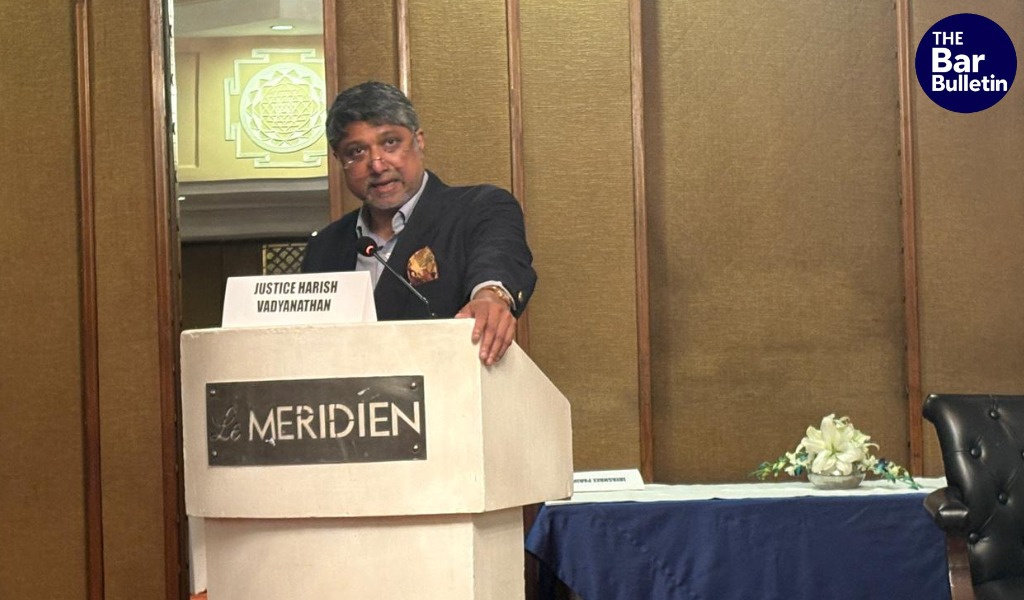
The intellectual centrepiece of the evening was the keynote address by Justice Harish Vaidyanathan, Judge of the Delhi High Court, who offered a candid judicial view on arbitration practice, enforcement and professional standards.
Opening with a reflection on career aspirations, Justice Vaidyanathan urged young lawyers to focus less on geographic ambition and more on professional excellence. If one consistently does good work where one stands, he remarked, professional boundaries eventually dissolve on their own. Arbitration, he noted, has emerged as one of the principal languages of international commerce, and those who master it with integrity and discipline naturally find themselves operating beyond borders.
Placing the discussion in a broader economic context, Justice Vaidyanathan highlighted the sheer scale of commercial disputes in India. With disputes pending before commercial courts accounting for a substantial portion of the country’s GDP, he observed that efficient dispute resolution is no longer merely a procedural concern, it is an economic necessity. The responsibility of addressing this burden, he suggested, will increasingly fall on younger practitioners stepping into arbitration and allied dispute-resolution roles.
From the Bench’s perspective, he emphasised that what courts and tribunals value most is clarity at the drafting stage, during proceedings and in final submissions. He cautioned against prolix pleadings, unfocused challenges and a tendency to treat statutory remedies, particularly under Sections 34 and 37, as opportunities for re-argument rather than review. Precision, brevity and respect for statutory limits, he said, are essential to preserving the credibility of the arbitral process.
Justice Vaidyanathan also spoke at length about professionalism, timeliness, preparation and cultural awareness observing that arbitration demands a higher degree of self-discipline than traditional litigation. As arbitration increasingly involves cross-border parties and tribunals, understanding procedural expectations and professional conduct across jurisdictions becomes critical.
Complementing the judicial perspective, Jayant Mehta, Senior Advocate, noted the importance of foundational legal skills. He cautioned that arbitration practice cannot succeed in isolation from core commercial law principles. Without a strong grounding in contract law, evidence and commercial realities, he warned, practitioners risk becoming superficial arbitration specialists.
Drawing from his own cross-border experience, he noted that arbitration allows little scope for correction, errors in witness preparation, strategy or timing are often irreversible. Thorough preparation and informed judgment, he said, remain the defining traits of effective arbitration advocacy.
The event concluded with a Vote of thanks.