


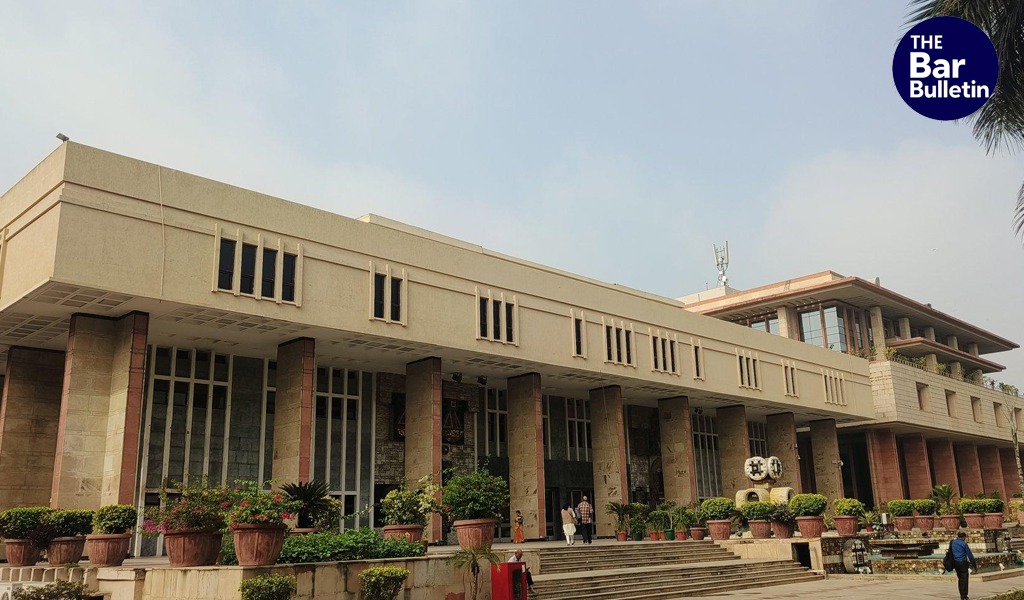

In a writ petition filed before the Delhi High Court, seeking quashing of the order dated 09-04-2019 whereby the petitioner was discharged from service, as well as the order dated 09-10-2020 whereby the appeal against said decision was dismissed, a Division Bench of Justice C. Hari Shankar and Justice Om Prakash Shukla quashed the impugned orders while reinstating the petitioner in service with all benefits except back wages.
The petitioner was appointed as Constable (GD) in the Border Security Force (BSF) on 17-04-2017. On 06-07-2017, it was discovered that the petitioner had contracted HIV and was undergoing Antiretroviral Therapy (ART) while also suffering from abdominal Kochs. The petitioner underwent ART and Antituberculosis Treatment from 28-07-2017 to 31-01-2018, before discharge from the hospital.
The petitioner was then re-examined by a Medical Board on 15-11-2018, and a show cause notice, opining that he was permanently unfit to remain recruited with the BSF, was issued to him on 30-12-2018. Therefore, the notice proposed to retire the petitioner from service.
The petitioner responded to the said notice, but by an order dated 09-04-2019, he was discharged from service for being physically unfit. The petitioner preferred an appeal against said decision before the appellate authority, which was dismissed. Aggrieved, the present petition was filed.
The Court noted that Section 3 of the Human Immunodeficiency Virus and Acquired Immune Deficiency Syndrome (Prevention and Control) Act, 2017, contained an absolute proscription against the termination from employment of a person suffering from HIV unless a healthcare provider and his employer give him a written assessment.
The Court found that, in the present case, no attempt was made to comply with Section 3(a) of the HIV Act. It was said that the proviso to Section 3 clearly mentions that in the event of failure to comply with Section 3(a)(i) and (ii), it would be presumed that there is no significant risk to others if the HIV positive person continues to work in the establishment, and that there is no undue administrative or financial hardship.
Thus, the Court concluded that the termination of the petitioner, on the ground that he was unfit to hold a post in the BSF, was contrary to Section 3(a) of the HIV Act. Further, the Court stated that an HIV positive employee would suffer long-term physical impairment, which would cause hindrance in his full and effective participation in society. Hence, he would be a ‘person with disability’ as defined in Section 2(s) of the Right of Persons with Disabilities Act, 2016 (RPWD Act).
The Court stated that, similar to the HIV Act, the RPWD Act also does not permit a government establishment to discriminate against any person with disability in matters relating to employment. Hence, the Court held that the petitioner could not have been treated as unfit to discharge his duties in the BSF only because he was found to be HIV positive.
Further, the Court directed that if the petitioner’s medical condition causes hindrance in his ability to perform his duties as a constable, the BSF would have to offer him an alternate appointment in any other equivalent post suitable to him. The impugned orders were quashed and set aside, with the petitioner reinstated in service. Lastly, the Court held that the petitioner would be entitled to continuity of service and all other benefits, but would not receive back wages.
Appearances:
For Petitioner – Mr. Anuj Aggarwal, Ms. Divya Aggarwal, Mr. Pradeep Kumar, Ms. Anjali Bansal, Mr. Lovekesh Chauhan, Ms. Kritika Matta, Ms. Shreya Gupta, Mr. Manas Verma, Mr. Nikhil Pawar, Mr. Shubham Bahl, Ms. Bhumica
For Respondents – Mr. Virendra Pratap Singh Charak, Ms. Shubhra Parashar, Mr. Pushpendra Pratap Singh
