


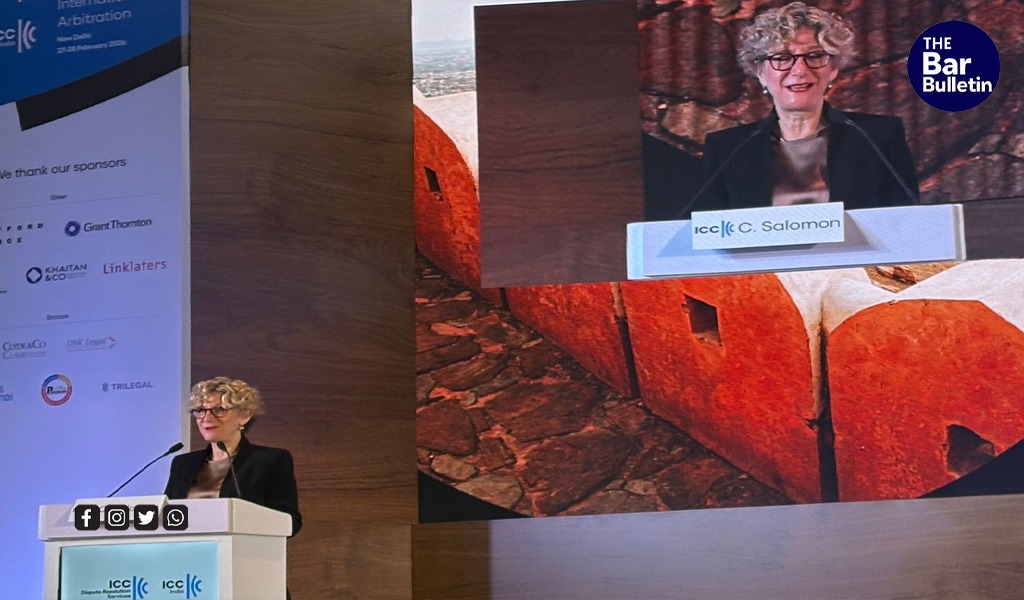

The 8th ICC India Conference on International Arbitration opened in New Delhi with an in-depth examination of how geopolitical uncertainty, regulatory fragmentation, and evolving professional norms are reshaping arbitration strategy for Indian businesses and international users alike.
The conference commenced with a welcome address by Khushboo Deshmukh, Deputy Director, India, ICC Dispute Resolution Services. She noted that India’s engagement with ICC arbitration has deepened significantly in recent years, both in terms of case volume and sophistication of users.
Delivering the opening remarks, Claudia Salomon, President of the ICC International Court of Arbitration, described India as one of the ICC’s most strategically important jurisdictions. Reflecting on her repeated visits to India since assuming office, she remarked that no country outside the United States has seen more frequent engagement from the ICC Court Presidency.
She explained the unique role of the ICC Court in administering arbitrations, highlighting its composition of members from over 120 countries, including vice-presidents and court members from India, Asia, Europe, and the Americas. This diversity, she stressed, ensures that ICC decisions reflect the global user base rather than any single legal tradition. Drawing attention to award scrutiny as a defining feature of ICC arbitration, she revealed that out of more than 600 draft awards reviewed in 2025, 10% were not approved at first instance noting how institutional review mitigates enforceability risks before awards are issued.
In a climate of geopolitical volatility and regulatory uncertainty, Ms Claudia Salomon emphasised that ICC arbitration offers users an additional layer of assurance through institutional independence, neutrality, and procedural rigour.
Session 1: Shifting Winds : Risk Management and Economic Strategies for India’s Businesses amid Geopolitical Haze
Moderated by Kabir Singh, Partner, Clifford Chance Singapore and ICC Court Member, the first session examined how Indian businesses are recalibrating commercial and dispute resolution strategies in response to sanctions regimes, protectionist trade policies, supply-chain realignments, and regulatory nationalism.
Shubhangi Garg highlighted that geopolitical risk must now be addressed at the transaction-design stage. From a financing and deal-structuring perspective, she emphasised that dispute resolution clauses can no longer be treated as boilerplate, but must be crafted to anticipate sanctions exposure, regulatory shocks, and enforcement constraints.
Meghana Singh, speaking from an investor and asset-management standpoint, explained that arbitration strategy is increasingly embedded within broader financial, compliance, and risk-allocation frameworks. She noted that cross-border investments now require alignment between dispute mechanisms and capital protection strategies.
Deepankar Sanwalka addressed the growing complexity of disputes arising from geopolitical disruptions, pointing to increased reliance on economic modelling, expert evidence, and arguments based on force majeure, frustration, and impossibility, issues that were rarely litigated in earlier eras.
Nitesh Jain focused on arbitration strategy, stressing that many disputes crystallise before formal arbitration begins or at the enforcement stage. He underlined the importance of early decisions on seat, governing law, and institutional framework in determining enforceability and outcomes.
In Focus: Revamping the ICC Arbitration Rules : Towards Enhanced Clarity and Efficiency
A dedicated session provided a detailed preview of the ongoing revision of the ICC Rules of Arbitration. Moderated by Claudia Salomon, the discussion featured Amar Gupta, Managing Partner, JSA and Sanjeev Kapoor, Senior Partner, Khaitan and Vice President of the ICC Court.
Amar Gupta explained refinements to the disclosure framework, clarifying that disclosure does not equate to bias and must be assessed contextually. He highlighted proposals requiring parties to assist arbitrators by identifying relevant entities and individuals for disclosure checks, while cautioning against strategic misuse of disclosure obligations.
Claudia Salomon emphasised that the ICC’s high disclosure standard remains unchanged, with proposed amendments elevating the principle of “when in doubt, disclose” into the Rules themselves. She stressed that this enhances transparency without weaponising disclosure.
On emergency arbitration, Claudia Salomon and Sanjeev Kapoor outlined proposed provisions allowing limited ex parte preliminary orders in exceptional circumstances where prior notice could frustrate urgent relief. Kapoor explained that such orders would be strictly temporary, followed by prompt adversarial proceedings to safeguard due process.
Mr Sanjeev Kapoor also addressed the proposal to raise the expedited arbitration threshold from USD 3 million to USD 5 million, noting the need to balance global diversity in dispute values. Salomon added that the ICC Court would retain discretion to remove complex cases from the expedited track. The speakers further discussed a new opt-in “Highly Expedited Arbitration” mechanism aimed at resolving discrete issues within 90 days, particularly in technology and financial disputes.
Session 2: Is Silence Golden? Pitfalls and Practical Insights of Arbitration Involving Defaulting Parties
Moderated by Gaurav Pachnanda, the session addressed one of arbitration’s most persistent practical challenges: how tribunals should proceed when parties default, disengage, or adopt tactical silence.
Dinesh Pardasani opened by categorising defaulting conduct into complete non-appearance, intermittent participation, and the “invisible respondent.” Drawing a cricket analogy, he likened expedited arbitration to a T20 match requiring swift procedural decisions, while full arbitrations resemble test matches demanding patience without stagnation. He stressed the importance of documenting notice, opportunities, and procedural fairness at every stage.
Amita Gupta Katragadda examined the use of anti-arbitration and anti-enforcement injunctions as a justification for non-participation. She cautioned against treating all such conduct as mala fide, noting that jurisdictional challenges are a legitimate part of arbitration. Drawing on recent cross-border litigation involving parallel proceedings, she highlighted the growing willingness of tribunals and courts to issue and enforce anti-anti-arbitration injunctions to protect arbitral integrity.
Andrew Battisson spoke from the tribunal’s perspective, emphasising that enforceability is the ultimate benchmark. He warned tribunals against overcorrecting default situations through aggressive procedures, stressing the need to independently test evidence, confirm jurisdiction, and where appropriate actively question witnesses even in ex parte proceedings. He also highlighted insolvency-related defaults as an emerging area requiring careful coordination between arbitral and insolvency regimes.
Returning to the discussion, Dinesh Pardasani cautioned against over-reliance on adverse inferences, describing them as secondary evidence that cannot replace proof. He stressed that tribunals must clearly record the materiality of documents, issuance of directions, and persistent non-compliance before drawing adverse inferences, and must always corroborate them with primary evidence.
Providing the judicial perspective, Judith Prakash explained how courts assess challenges to awards involving non-participating parties. She noted that courts do not distinguish between public sector and private entities, focusing instead on jurisdiction, notice, and natural justice. While parties may lawfully sit out arbitration and later raise jurisdictional objections, she said courts are reluctant to entertain claims of denial of opportunity where a party had actual notice but chose not to participate.
Session 3: Oxford-Style Debate : Can India’s Arbitration Modernisation Co-Exist with Uncertainty under the BCI Rules?
Moderated by Viren Mascarenhas, the Oxford-style debate examined the tension between India’s arbitration reforms and regulatory uncertainty surrounding foreign lawyer participation.
Diya Kapur, Senior Advocate, arguing for the motion, traced the evolution of Indian arbitration over two decades, emphasising that modernisation has already been achieved through legislative reform, judicial support, institutional growth, and a mature arbitration bar. She argued that BCI rules merely reaffirm that foreign lawyers cannot practise Indian law and do not impede international arbitration.
Supporting her, Saurabh Kirpal cautioned against equating modernisation with deregulation. He stressed that advocacy before Indian tribunals requires deep familiarity with local legal culture and procedure, and warned that unrestricted entry of foreign lawyers could structurally disadvantage Indian practitioners who remain subject to strict ethical and professional constraints.
Opposing the motion, Sameer Jain argued that party autonomy is central to international arbitration and that regulatory ambiguity under the BCI rules undermines India’s aspiration to become a preferred global seat. He pointed to operational uncertainty, discretionary approvals, and reciprocity requirements as barriers deterring foreign users.
Mariel Dimsey added an international perspective, warning that while protection of domestic practice is common, leading arbitration hubs carve out clear exceptions for international arbitration. She highlighted practical barriers such as repeated approvals, high fees, and uncertainty, cautioning that risk-averse foreign practitioners may avoid India altogether potentially limiting opportunities for Indian lawyers as well.
Delivering jury remarks, Tejas Karia observed that sideways steps are sometimes necessary for balance rather than regression. He emphasised that arbitration modernisation depends on institutional trust, procedural certainty, and ecosystem coherence, noting that collaboration between Indian and foreign practitioners has historically enhanced credibility and client confidence.
The conference concluded with closing remarks by Tejus Chauhan, who reiterated the ICC’s commitment to supporting India’s arbitration ambitions through institutional safeguards, global best practices, and sustained engagement with Indian stakeholders.