


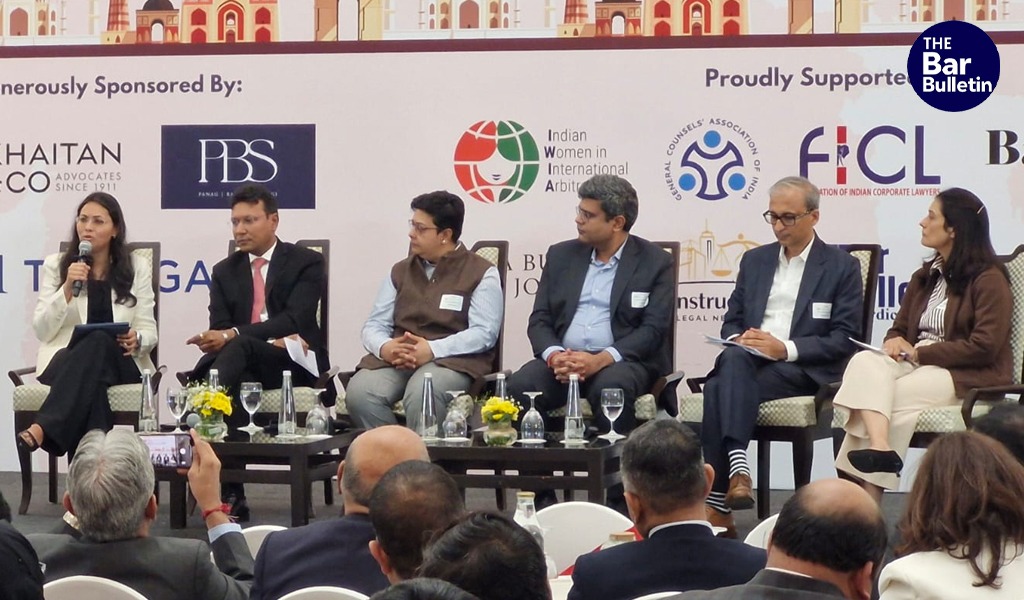

The ICDR India Conference 2026 convened leading judges, practitioners, in-house counsel, arbitrators, and industry leaders to examine how dispute resolution is evolving amid digital disruption, large-scale infrastructure development, energy transition, and increasingly complex shareholder relationships.
The conference opened with Welcome Remarks and a Keynote Address by Hon. Chief Justice Bridget Mary McCormack (Ret’d), President and Chief Executive Officer of the AAA-ICDR, setting the tone for a forward-looking discussion on innovation, trust, and institutional responsibility in arbitration.
.
Panel 1: When the Code Breaks: Disputes at the Speed of Digital Transformation
A high-impact panel titled “When the Code Breaks: Disputes at the Speed of Digital Transformation” examined how rapid technological change is reshaping contractual risk, regulatory exposure, and dispute resolution across sectors.
Moderated by Aparna Gaur (Trace Law Partners), the panel featured Arun Visweswaran (Addleshaw Goddard LLP), Senior Advocate Gopal Jain, Independent Arbitrator Srikanth Navale, and Suruchi Rungta (Zensar Technologies).
Panelists discussed the growing complexity of disputes arising from cybersecurity incidents, cloud service disruptions, cross-border data transfer requirements, and the expanding intersection between competition law and commercial arrangements on digital platforms and marketplaces.
A key concern highlighted was the rising regulatory burden on companies operating in digital ecosystems, particularly in the context of stringent data protection and cybersecurity mandates. Speakers noted that compressed reporting timelines such as India’s six-hour cyber incident reporting requirement pose serious practical challenges during live cyberattacks.
The discussion highlighted that regulatory expectations often move faster than operational realities, exposing companies to enforcement and litigation risk even when acting in good faith. Robust governance frameworks, incident response protocols, and clear compliance documentation were identified as critical safeguards.
The panel also examined how traditional contractual frameworks are being stress-tested by digital transformation. Cloud outages, third-party vendor failures, and cross-border data flows increasingly give rise to multi-jurisdictional disputes. Speakers emphasised the need for carefully negotiated limitation of liability clauses, clearly defined service levels, and precision around data ownership and risk allocation, cautioning that boilerplate provisions are no longer sufficient in high-stakes technology contracts.
Cyber insurance was discussed as an evolving risk management tool, with panelists cautioning that exclusions, sub-limits, and compliance conditions often limit coverage. Alignment between contractual obligations and insurance policies was therefore seen as essential.
Competition law scrutiny of digital platforms formed another key theme. The panel reflected on global enforcement trends involving major technology companies and the implications for Indian businesses navigating platform dependence, data-sharing obligations, and unilateral changes to commercial terms. The increasing overlap between competition law, data protection, consumer protection, and contract disputes was identified as a growing strategic challenge.
As digital transformation accelerates, panelists agreed that disputes will become more frequent, more technical, and more cross-border, requiring integrated legal, technological, and governance responses.
Panel 2: Build, Break, Repeat: Managing Disputes in an Age of Mega Projects
The panel “Build, Break, Repeat: Managing Disputes in an Age of Mega Projects” focused on how risk is allocated, managed, and re-priced in large construction and infrastructure projects.
Moderated by Karthik Somasundram (Spice Route Legal), the panel featured Amba Prasad (Larsen & Toubro Construction), Aniket Singhania (Cyril Amarchand Mangaldas), Arjun Doshi (Adani Ports and SEZ Limited), Senior Advocate Kaadambari Singh, and Mohit Dubey (Military Engineer Services).
Mohit Dubey highlighted the operational realities of executing large public and defence projects:
“In mega public works, particularly in sensitive sectors, the challenge is not just engineering, it is managing layered approvals, compressed working seasons, and interdependent packages. When one element shifts, the ripple effect across time and cost is immediate.”
He also noted the increasing digitisation of measurement and certification processes:
“E-measurement systems have brought transparency. Today, every certification and deviation is digitally recorded, reducing scope for ambiguity and dispute at the end of the project.”
Aniket Singhania focused on delay claims and evidentiary discipline:
“Delay remains the single most common trigger for disputes. Yet many contracts inadequately define critical milestones or fail to anticipate concurrent causes.”
He emphasised the importance of contemporaneous documentation:
“Documentation must begin on day one. You don’t know whether a project will end in arbitration but if it does, contemporaneous records will determine the outcome.”
Kaadambari Singh addressed the complexity of technical evidence and evolving jurisprudence:
“In mega projects, parties often generate extensive correspondence. The tribunal’s task is to separate signal from noise and assess whether delay and cost escalation are causally linked.”
On expert evidence, she added:
“An expert’s role is not to impress with technical jargon, but to assist the decision-maker in understanding causation, critical path impact and financial consequence.”
From a commercial perspective, Arjun Doshi noted:
“Projects today are exposed to supply-chain disruption, regulatory change and mid-stream policy shifts. Risk pricing at bid stage often assumes a stability that no longer exists.”
He observed that renegotiation has become a pragmatic necessity rather than a failure:
“Renegotiation is not necessarily a failure. It can be a pragmatic response where the contractual matrix no longer reflects economic reality.”
Amba Prasad highlighted the contractor’s perspective on variations and cash flow:
“Frequent scope changes under EPC contracts create both technical and financial strain. If variation valuation lags, cash-flow stress can derail execution momentum.”
Summarising the discussion, the panel stressed the importance of clear drafting, disciplined documentation, expert-driven delay analysis, digital tools, and structured renegotiation mechanisms.
In Conversation with Bridget McCormack: The AI Arbitrator
In a special session titled “The AI Arbitrator”, moderated by Alipak Banerjee (Counsel & Arbitrator), Justice Bridget McCormack discussed the launch of the AI Arbitrator by the AAA-ICDR.
Currently available for U.S. documents-only construction disputes, the AI Arbitrator reflects three years of institutional development and experimentation with generative AI.
Justice McCormack emphasised that the initiative is designed to expand choice, not replace arbitrators:
“Generative AI technology is giving us an opportunity to expand the kinds of options we can offer to parties. It is clearly not replacing arbitrators.”
Explaining the system’s architecture, she noted:
“The system parses the information, organizes it by claim, by evidence, and by legal authority and then goes back to the party and says: ‘Did I get this right?’”
She underscored the central role of human oversight:
“AI assists. Humans decide.”
On trust and governance, she observed:
“Trust is the whole ballgame. Foundation, framework, and process are where you build the trust that parties have come back to us for over 100 years.”
Addressing access to justice, she added:
“One way to scale dispute resolution in a modern, complicated world—where many people cannot afford lawyers is to offer new tools that reduce cost and time.”
Responding to concerns within the legal community, Justice McCormack was unequivocal:
“There is only good news here. The pace of scientific and technological progress we are about to see will create more work, not less, for lawyers.”
Panel 3 : The Energy Crunch : Contracts Under Stress in a Transitioning World
Moderated by Kshama Loya (ICDR Y&I Global Advisory Board), this panel examined disputes emerging from the global energy transition.
Panelists Anuja Tiwari (AZB & Partners), Dinesh Pardasani (DSK Legal), Dibyanshu (Khaitan & Co), Abhinav Bhushan (Drew & Napier LLC), and Namrata Arora (Blupine Energy Pte Ltd) discussed intermittency, grid constraints, price shocks, regulatory change, and ESG pressures.
Anuja Tiwari explained:
“Intermittency claims arise because renewable energy, by its very nature, is variable and unpredictable. This variability creates integration challenges for the grid and gives rise to disputes over shortfall, DSM penalties, and forecasting inaccuracies.”
On technological advances, she added:
“With better real-time data and improved forecasting tools, the gap between actual generation and scheduled supply can now be meaningfully reduced. Contracts must evolve to reflect this improved visibility.”
Dinesh Pardasani highlighted grid-related risks:
“Curtailment and grid unavailability are increasingly common in high-renewable states. The real issue is how compensation mechanisms are built into contracts to fairly allocate these risks.”
Dibyanshu addressed battery storage:
“Battery storage is emerging as a key risk-mitigation tool, but it brings its own challenges. Contracts must clearly address whether failures are technical issues, warranty breaches, or insurable events.”
Abhinav Bhushan cautioned:
“Energy contracts are long-term by design, but the world they operate in is changing rapidly. Hardship and change-in-law clauses cannot remain generic, they must be carefully structured, sector-specific, and forward-looking.”
From an industry lens, Namrata Arora observed:
“Energy transition cannot succeed without alignment between commercial incentives and ESG objectives. Contracts must allow flexibility while still supporting long-term sustainability goals.”
The panel also warned against greenwashing risks:
“The challenge lies in balancing operational realities with ESG representations. Over-promising on sustainability without adequate contractual and operational backing can expose companies to serious legal and reputational risks.”
Panel 4: When Partners Turn Opponents : The Anatomy of JV & Shareholder Breakdowns
Moderated by Thara Gopalan (AAA-ICDR), this panel examined governance failures and shareholder disputes.
Opening the discussion, Nandini Khaitan (Khaitan & Co) noted:
“It would be incorrect to assume that differences between shareholders’ agreements and articles are always a deliberate leverage strategy. Often, they arise from legacy structures, evolving family dynamics, or a failure to update governance documents as businesses mature.”
She cautioned:
“Best practice demands alignment. If a right truly matters to shareholders, it must find its way into the articles. Otherwise, ambiguity becomes the breeding ground for oppression and mismanagement claims.”
Senior Advocate Satvik Varma observed:
“It’s a mixture of yes and no. It would be unfair to characterise every hard move as a pressure tactic.”
Adding:
“By the time disputes reach arbitration or tribunals, the real problem is no longer legal, it is relational and strategic.”
Dheeraj Nair (JSA Advocates & Solicitors) highlighted exit disputes:
“Many shareholder disputes stem from misaligned expectations at entry. Parties agree on valuation and control at the start, but fail to realistically plan for divergence five or ten years down the line.”
C. V. Raghu of the General Counsels’ Association of India stressed:
“Disputes do not arise overnight. They build up through information asymmetry, lack of transparency, and the absence of regular, structured communication between shareholders.”
Concluding the panel, Vaibhav Kakkar (Saraf & Partners) stated:
“Shareholder conflicts are as much about psychology as law. Strategy matters knowing when to negotiate, when to escalate, and when to preserve the business rather than ‘win’ the dispute.”
He added:
“The real success is not forcing an exit, but ensuring that when things go wrong, the business survives the conflict.”
Conclusion
The ICDR India Conference 2026 highlighted a common theme across sectors: disputes are becoming more complex, interconnected, and strategic. Whether driven by digital transformation, infrastructure scale, energy transition, or shareholder misalignment, effective dispute management increasingly depends on foresight, governance, and adaptability.