


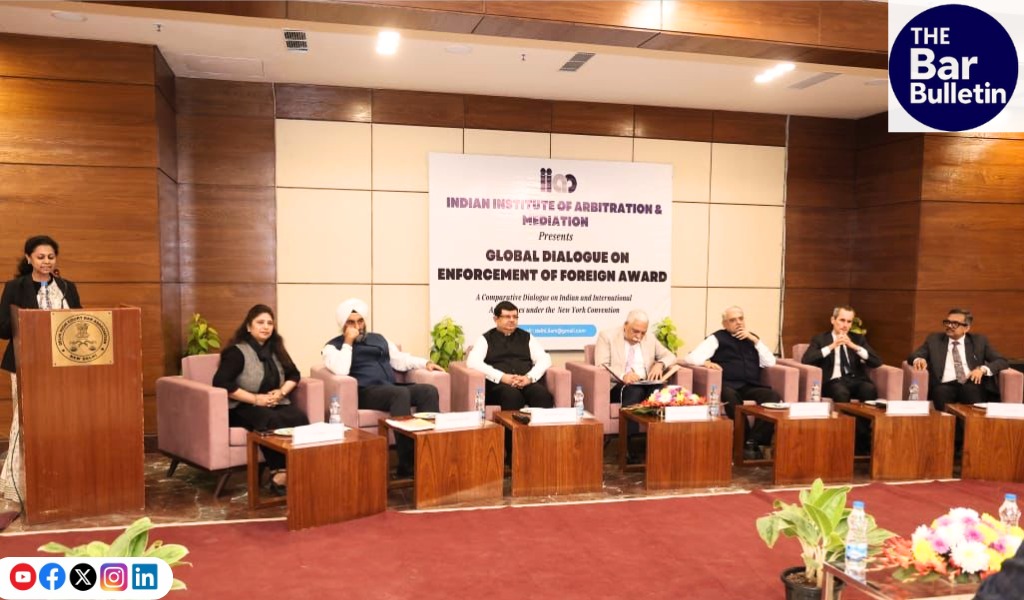

The Indian Institute of Arbitration and Mediation (IIAM) hosted an important and enriching event titled the Global Dialogue on the Enforcement of Foreign Arbitral Awards, bringing together an exceptional gathering of judges, international experts, academicians, and leading practitioners from across India and abroad. The event created a vibrant and collaborative atmosphere, offering a rare opportunity for the arbitration community to engage in meaningful discussion on one of the most crucial pillars of international commercial dispute resolution—the enforcement of foreign arbitral awards.
The welcome note was given by the President of Delhi High Court Bar Association Sr. Adv Mr. Hariharan.
The gathering was graced by distinguished members including Hon’ble Mr. Justice Devendra Kumar Upadhyaya, Chief Justice of the Delhi High Court; Hon’ble Mr. Justice Subramonium Prasad;Hon’ble Mr. Justice Jasmeet Singh; and Hon’ble Mr. Justice Tejas Karia.
International expertise was represented by Mr. Friedrich Rosenfeld, Partner at Hanefeld, Paris and Global Adjunct Professor at NYU Paris,
Senior Advocate Anil Xavier, President of IIAM and Chairman of APCAM, contributed his insights from the institutional arbitration space.
The session was moderated by Ms. Iram Majid, Central Govt Standing Counsel, Director of IIAM and Executive Director APCAM.
The event emphasised that as cross-border transactions expand rapidly, arbitration has become the preferred mechanism for resolving international commercial disputes. However, it is the enforcement of arbitral awards that truly determines the success and credibility of the process. A strong, reliable, and efficient enforcement framework inspires trust among investors, corporations, and foreign parties who operate in multiple jurisdictions. In this context, India’s approach to enforcing foreign arbitral awards plays a pivotal role in shaping its reputation as a global arbitration-friendly jurisdiction.
The remarks highlighted that India has undergone a remarkable transformation over the last decade. With major amendments to the Arbitration and Conciliation Act in 2015, 2019, 2021, and 2024, the country has taken significant steps toward aligning its legal framework with global standards. The judges shared valuable reflections from their judicial experience, offering practical insights into how enforcement proceedings play out in courts. They noted that while India has made substantial progress in reducing delays and ensuring consistency, there remains a need for continued streamlining, clearer structures, and greater specialisation within the judicial system. The dialogue highlighted the importance of maintaining a narrow and careful interpretation of grounds for refusal, keeping in mind the New York Convention’s objective of ensuring uniformity and predictability across member states.
Perspectives from international expert focused on how enforcement works in leading arbitration hubs and how importance of judicial restraint, predictability in judicial reasoning, and coherent application of principles to avoid conflicting outcomes across jurisdictions. He emphasised that international parties look for clarity, consistency, and certainty qualities that directly influence the attractiveness of a jurisdiction as a seat of arbitration or a place of enforcement.
Focus on role of arbitration institutions in improving procedural structure, time discipline, and professionalism to the arbitral process elements that ultimately strengthen the quality and enforceability of awards. The need for ongoing capacity-building and training for arbitrators and practitioners in India was also discussed.
The speakers highlighted real-world challenges such as procedural delays, inconsistent award drafting, and the need for specialised arbitration benches.
Another important theme that emerged was the growing collaboration between the Bar and the Bench. Multiple speakers noted that effective enforcement requires a harmonious and supportive relationship between lawyers, arbitrators, and judges. When all stakeholders work together, a strong, predictable, and credible arbitration ecosystem becomes possible.
With insightful exchanges, collaborative spirit, and a shared commitment to improvement, the dialogue concluded on an optimistic note—leaving the arbitration community better informed, more connected, and more motivated to contribute to India’s journey as a strong, enforcement-friendly jurisdiction under the New York Convention.